Showing posts with label Dharma. Show all posts

Saturday, October 25, 2025

I won but did Dharma win?

Whether it is an online debate, a major decision, a fight, an exam, a project, or a daily office task, these are four simple dharmic criteria to claim 'success'. These are both necessary and sufficient conditions:

1. you win and dharma won =>    you won
2. you lose and dharma lost => you lost
3. you win and dharma lost => you lost big
4. you lost and dharma won => you won big. #3 and #4 are the important ones.
This is just Dharma saying: a lack of preparation on your behalf does not constitute an emergency on my behalf. A win for me doesn't automatically mean that it is also a win for dharma, just because I am a Hindu/Buddhist/Sikh/Jain and the opponent is some leftist, atheist, or racist, or from a different country. These rules are universally applicable and independent of race, religion, nationality, and gender, etc.

In the past when different dharma sampradayas debated in accordance with the rules of dharma, accepting personal defeat meant the dharma won. The win or loss for an individual or a group eventually pales into insignificance when dharma itself loses.

A loss for me (or unsure if I won or lost) in the pursuit of dhama that results in a win for dharma is a huge win, and should be cherished. That is the toughest test for us all. After all, Bharata is the land of Abhimanyu and his descendants. It is not always clear if dharma won or not in today's world with its many shades of grey in this Kaliyuga, the era of uncertainty. Yes, almost all of us are guilty of violating these rules at some point in time, either willfully or out of ignorance. However, if we keep these rules in mind in shaping our intent, we are less likely to make the mistake of hardwiring the dogmatic belief that our minuscule and transient personal success or failure implies dharma's success of failure.


Wednesday, December 6, 2023

#NonBinary is an oxymoron, and the Moral Relativism of #Wokism

"Non-binary" is itself a binary classification, and asserts a binary belief.

The moment you use a label, a nama-rupa- the very idea of using a label, is to introduce a binary split within entities that were previously grouped together, First, create a differentiation based on certain attributes and then use a label to mentally reinforce this partition.


Some related tweets on the skewering of logic.

Shivoham on X: "Can the gender fluid mechanics profs of Supreme court of india even define 'same sex' precisely without tying themselves up into a logical pretzel?" / X (twitter.com)

in this context:

Shivoham on X: "https://t.co/OQfCDa1AQa supreme court jesters must first define "same sex" precisely. let the fun begin." / X (twitter.com)


And talking of 'context', Ivy league woke humanities faculty may have taken a digested and utterly flawed version of Dharma ethics (that is always governed by Satya without ambiguity) and turned it into the antifragile ethics of moral relativism, in order to justify "friendly" calls for genocide.

"dharmic thought offers both universal and contextual poles – not just the latter, as that would be tantamount to moral relativism." - Rajiv Malhotra. Being Different: An Indian Challenge to Western Universalism (2011).

(2) Bill Ackman on X: "The presidents of @Harvard, @MIT, and @Penn were all asked the following question under oath at today’s congressional hearing on antisemitism: Does calling for the genocide of Jews violate [your university’s] code of conduct or rules regarding bullying or harassment? The… https://t.co/eVlPCHMcVZ" / X (twitter.com) 


On the lighter side, gender bias is not a bug but a feature of English:

Shivoham on X: "https://t.co/gTyZDA8I6c caption exposes the built-in gender bias in English :)" / X (twitter.com)


Wokes oppose guns in the US that murder school kids but are comfortable with killing them in the womb to suit a lifestyle.

"Context".


A more useful and deeper multi-valued logic exists in the dharma systems of Bharata that go beyond the Aristotelian logic of the excluded middle, including the Buddhist Catuskoti and Jaina Syadavada. The solution to this mess also is in the harmony of dharma and not the divisiveness and hatred sown by the binary pair of Wokism and Abrahamic Fundamentalism.

Shivoham on X: "https://t.co/6JWasksfUU #MadhuraBhakti continue to be dumbfounded by dharma's ability to effortlessly transcend gender and other dualities and unite with the divine. Beautiful post to read and share with family." / X (twitter.com)

Saturday, September 19, 2020

Contextual vs Situational Awareness

This topic came up for discussion in Satsangs earlier around the contextual sensitivity of dharma, ethics, Ayurvedic medicine, Sanskrit in Hinduism and dharma traditions of India.

We probably already have a working understanding of these terms. As part of my professional Ganita/AI work, we employ 'contextual learning' when building automated recommendation and decision support systems. For example, the products and service we would recommend to a traveler depends on many things including their journey context. The same traveler may benefit from different offers from the AI system depending on whether she is traveling on company business or making a leisure trip with her family.

When the lady is walking to her car at night in a dimly lit parking lot, she would benefit from  situational awareness. This SA is about a person knowing what is going on around him/her and anticipating changes. This is known to be particularly important for pilots.

Using the term 'situational dharma' would be tricky and lead to confusion. A useful comparison between these two types of awareness can found here that may be useful  In particular (emphasis mine):

"Situation awareness is a construct to describe operators’ knowledge about a dynamic environment and is defined as “the perception of the elements in the environment within a volume of time and space, the comprehension of their meaning, and the projection of their status in the near future” by Mica Endsley (Endsley, M.R. (1995) Toward a theory of situation awareness in dynamic systems, Human Factors, 37(1), 32-64.).


Context-awareness is a construct to describe capabilities of a system. Useful is the article Dey, A.K. (2001) Understanding and Using Context, Personal and Ubiquitous Computing, 5(1), 4 – 7. Dey defines: “A system is context-aware if it uses context to provide relevant information and/or services to the user, where relevancy depends on the user’s tasks.
”

Sunday, August 16, 2020

#SattvicHamburgers Anyone?

Sattvic Hamburgers?


To make dharma sound 'appealing' and 'contemporary' to westernized audiences and young professionals, a common strategy employed by some Hindu intellectuals is to combine Sanskrit/Indic terms and western categories to produce neologisms.  
 
Examples of oxymorons generated by sandwiching of incompatible Sanskrit/Indic terms and western social/economic/political categories include:

Vedic Liberalism
Dharmic Capitalism
Vedantic Socialism
Hindu Left / Hindu Right
 
Here, an Indic prefix is attached to the western category. Western academia often adds some western prefix to an Indic category:
Neo-Hinduism (Paul Hacker, exposed in 'Indra's Net' by Sri Rajiv Malhotra)
Neo-Vedanta
American Veda (credit Phil Goldberg) 

What is the problem?
The output western re-categorization generated after a deep immersion in 'English Samadhi' is reductionist and harmful. This should not be surprising given that the Sanskrit/Dharmika terms come with a far broader range of meanings and applicability that include the Paramartika while rejecting that which is anrta and adharma. On the other hand, the western component of the newly generated category is usually secular and materialist, and indifferent to Rta and Dharma. Neologisms coined by Abrahamic missionaries are not secular since their goal is to increase the curb-appeal of history-centric theology. They use a dab of dharmika paint to generate religious oxymorons that many gullible Hindus buy into:
 
Vedic Gospel     
Dharmic Fundamentalism
Christunatyam  
Christ Yoga 
Sufi Bhakti 
 
Whether you add poison to Devi's Prasad, or Devi's Prasad to poison, the deeper dharmic meanings get diminished and severely distorted, and ultimately digested into the western (secular or Abrahamic) category. 
 
We must decolonize and work harder to better understand and retain the original terms, and then apply them more effectively in a contemporary context.


References and Further Reading
Books by Rajiv Malhotra
 

Thursday, April 28, 2016

Rama Loves Squirrels Too

There is merit in picking one area, one project, which we are good at and can create an impact on the ground, and keep at it. But sometimes, we forget our dharma and lose the basic ability of sticking to a message.

An old cricket article by Mike Selvey that recalls fast bowler Ottis Gibson's first ever cricket match, for the Barbados team:
"...He was recalling his first-ever match for his native Barbados, throughout which, as the great Malcolm Marshall stood by and watched, he had been getting a run-a-ball tanking.

In the second innings, Gibson recalled, he came and stood at mid-off. "What are you going to do?" Marshall queried after Gibson had bowled a rare dot-ball at the start of an over. Gibson remembered his response. "'I'm going to bounce him' I said, and Malcolm would just say 'Why don't you just do what you did again?' And I did and it was another dot-ball. 'Now what are you going to do?' 'I'm going to york him.' 'No, do the same thing again'. And so he talked me through the first maiden over I bowled in first-class cricket. He taught me to construct an over."

There you have it then, in a nutshell: the simple art of bowling from perhaps the greatest fast man who ever drew breath and not a mention of good areas.
"


The anger against the corrupt ecosystem and its Hinduphobia cannot be myopically expended in a jiffy on sloganeering and wild, emotional ideas. It can be channeled into long-term, sober, and meaningful effort. Even if it seems lonely, boring, or insignificant in comparison to others. The tiny squirrel that contributed its bit in support of the Sethu was eventually touched by the transcendental hand of divinity.

Thursday, December 17, 2015

Abhaya: A Fearless First Indian Novel


This post is simply a description of my personal experiences reading 'Abhaya', Saiswaroopa Iyer's first novel, which I've quickly penned down in no particular order.

I got the Kindle edition at Amazon.com, and began to read immediately, and did not put it down, finishing the novel in one go. From a Rasika's perspective, the characters in the book and the situations cover all nine Rasas. We'll look at just two examples here: the Hasya of Krishna's predicament reminded me just a bit of Kapil Sharma's comical situation in the movie 'Kis Kis to Pyar Karoon'. And the Veera Rasa the reader experiences when we read about Princess Abhaya's courage as she fights against all odds for the cause of Bharatavarsha is a highlight. I'm sure readers who are keyed into social media will want to know about the 'Swachch Bharat' lady of Varanasi in the novel. Read and find out! 

Some of the pages, along with the vivid descriptions, appear to leap right out of old Amar Chitra Katha and Chandamama stories that we all loved to read and re-read before the advent of 24-7 TV. The Shringara Rasa is also on view, some of which I'd personally rate as 'U/A', making the content suitable for young adults. There are excellent and lucid discussions centered on dharma and duty which are suitable and perfect for any age. The dilemmas and challenges that Abhaya and other characters face, and the dharma ethics that is evident in the subsequent decisions they take was brilliant to read.

Saiswaroopa employs several Sanskrit non-translatables, and the author must be commended for this. This is a daunting task, and the author's Shraddha in the sensitive but frank handling of native Indian traditions is evident. There is little or no spoon-feeding of poor approximations of key Sanskrit terms in order to cater to the westernized reader. For example, the meaning of 'dharma' is contextual, and is used as is, and is not mistranslated as 'religion' etc. Also the accurate term 'Arya' is used in the novel, although the dreaded 'Aryan' did appear once, perhaps inadvertently. Hope this gets fixed in the next cycle of edits. There is some emphasis on 'faith' toward the end, which caused me some confusion. I personally chose to interpret 'faith' as 'Bhakti derived from a deep Anubhava' rather than as a dogmatic belief in a purely external force that is highly unlikely to bear fruit no matter how long, and how much 'hope' and 'faith' one has. On the other hand, the dharmic discussions toward the end were both moving and riveting. Yes, this is a work of fiction, but it also full of truth.

Despite being a fictional novel, it is quite clear and impressive that the author has taken pains to ensure an accurate portrayal of dharma traditions. And to be able to do so honestly, and without compromising on the readability and the smooth progress of a fairly intricate plot surely requires a high degree of skill, and fearlessness. This is a lesson, and a benchmark for every budding Indian writer. How many times have we have seen Indian and Western authors compose grandiose works and dramatizations set in a dharmic context, but approach the work purely intellectually and without the requisite Shraddha or Anubhava. They write from a "outsider" perspective, and without any adhyatmic insight, inevitably end up mangling dharmic concepts and the deep civilizational ideas. In direct contrast, this author's writing appears to be grounded in her dharma, and for me, this is the fundamental reason for the success of this work.

Finally, some brief notes on the writing style and some memorable characters. The first thing that came to mind when Krishna enters the story is Sri SL Bhyrappa's epic 'Parva'. Abhaya's Krishna will be loved by everybody. Full of wit, compassion, courage, mischief, love, understanding, and wisdom. Abhaya's lead character is smart, resourceful, cool, beautiful, and thoughtful. The quintessential Indian woman. There were some places where the turn of phrase employed pleased the Ganitha/analytics professional in me. Cool! The author seems to have a natural story telling ability, and she does so with a brisk and clear style.  I'm quite convinced this is the first of many books we will get to read and enjoy.

Abhaya is an authentic Indian work that has something positive for everybody.  Those who have grown up reading stories from Indian Itihasa will be able to relate to this book. I highly recommend it.

Friday, March 20, 2015

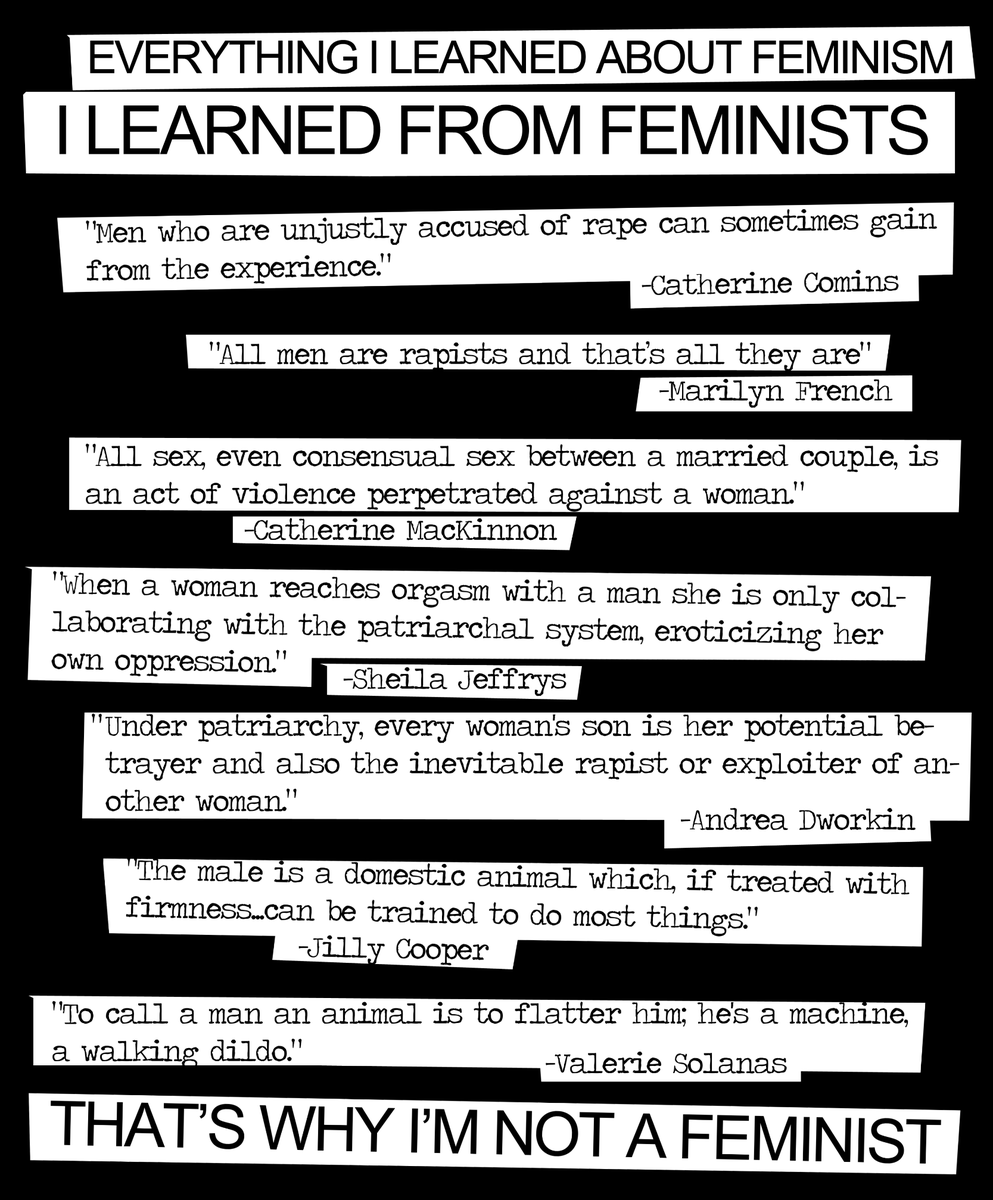
Western Feminism as a Counter-Terrorism Doctrine

A small sample of statements by leading lights of Western feminism (WF):
(via @DeepikaBhardwaj on twitter to explain why she is not a feminist as she states in the last line of the picture above)

If these statements represent a more violent expression of a widespread but latent fear and rage among the persecuted women of some western societies, then it is both fair and useful to also analyze Western Feminism as a counter-terrorism doctrine. This suggestion should not be surprising, as the facts unearthed in the aftermath of 'India's Daughter' video show, the per-capita rate of violent crime against women in such societies are orders of magnitude worse than India (with significant under-reporting in most societies). Of course, India clearly has an emerging problem, but one that should and is being tackled boldly, and perhaps with a lot more wisdom, by women leaders in its society. More on that later. A limited point raised in this blog is this:
WF must also be analyzed as a counter-terrorism doctrine because, as data will show, there exists ample evidence to suggest that it was created to counter gender chauvinist terror inspired by History-centricAbrahamic male-dominated theology adopted in those societies. Terror victims respond violently by attacking the other gender, with scant or no regard for collateral damage in terms of destroyed families, innocent lives lost, and cultures exterminated. At best, the WF approach tolerates the male who accepts 'defeat', just like the MCP tolerates women who do the same, resulting in a constant state of tension that boils over repeatedly. In fact, one could say, that the WF members have become male gladiators for all practical purposes, in order to be successful in executing their adharmic counter-terrorism strategy. And this strategy, which looks more like a race to the bottom, is being promoted and marketed in all parts of the world as 'progressive'.

On the other hand, the Indian response is dharmic, and focuses on harmony and restoring balance via mutual respect, rather than myopically and foolishly thinking in terms of order versus chaos, of triumphant victor tolerating sore loser, and seeks to return the feminine to the highest place in the society it has traditionally occupied. This article is a good place to start.  For a detailed comparative analysis of the idea of mutual respect in dharma versus Abrahamic ideology, read Rajiv Malhotra's book Being Different'. The data has shown (read the books by Dr. R. Vaidyanathan, or the talks by S. Gurumurthy on this subject, for example) that the practical success of the traditional Indian economy (Mahalakshmi), its learning models (Saraswati), and its strength against aggression (Durga), are because they are rooted in the divine feminine. Thus, it seems clear to me that these particular choices of Lakshmi, Saraswati, Durga arose from the actions of ancient Indians who were actually practicing this successful approach, i.e., ground up, and in turn these deities served as exemplars for future generations to follow and be successful too. The ideas of eco-feminism, Yoga, vegetarianism, etc. that have become popular in the west, especially among women, also come from dharmic India. This is not surprising, since the very idea and source of strength is Shakti, which is important in the dharmic traditions of India. One can also understand the Indian versus western response as that of a Yogi versus the Gladiator.

Should one respond to gender-based fault-lines in societies by widening them using a counter-terrorism doctrine to achieve victory? or should one employ a dharmic solution to achieve harmony? Seems like a no-brainer.

Sunday, January 25, 2015

Dharmic Clock Running Out

A quick back-of-the-envelope 5-minute 'ball-park' estimate of the 'market share' of dharmic people in undivided India.

Please feel free to post corrections if the numbers are way off, so that readers may benefit.

The following three rows display a recent population estimate by country (in millions), and the approximate percentage of Hindus (dharmics) in that national population.


India: 1230M (78.5%)
Pakistan: 192M (1.85%)
Bangladesh: 158M (8%)

total share of dharmics
= (1230*0.785+192*0.0185+158*0.08)/(1230+192+158)
~ 62%

I recall reading somewhere that the percentage of Hindus in
1947 undivided India was 66% (link needed). If true, this means, from 947CE to 1947, dharmic share dropped from 100% to 66%. This gives us a decline rate of  34/1000, or about 3.4 percentage points every hundred years, on average. During this period, the Abrahamic invaders of India perpetrated the biggest holocaust in the history of mankind, dwarfing both the massive genocide of native Americans by Euro-Christian invaders, and the mass-murder of millions of Jews during WW2 by the Nazis. Most native populations around the world crumbled under such continuous onslaught, but dharma stood its ground.

Yet, post independence, in just 67 yrs since 1947, the dharmic share appears to have dropped 4 percentage points. This despite enjoying more than 3/4 majority in India and having the freedom to chart their own prosperous future, and the luxury of having no organized Abrahamic genocidal opposition to fight. Today's Hindus, in far, far more benign times, appear to be losing demographic share at roughly twice the rate at which their heroic ancestors lost ground in the previous thousand years. Instead of the decline being arrested and reversed, it appears to have accelerated. Why? There are likely to be many reasons, both internal and external. Let's look at one internal picture.

Lack of dharmic grounding?
In this era when Tamas rules Hindu minds, when educated Indians recklessly brand and market themselves using "center right wing" or "center left wing" or "regional" or "world citizen" or some other gibberish label, and some its intellectuals cumulatively devote precious man-months to intellectual gymnastic dogfights over Vimanas, this should not come as a surprise. We see respected thinkers continue to fund and celebrate the suicidal process of outsourcing the R&D of key strategic knowledge areas (which should've been their core dharma) to Hinduphobic academics in India and the west, and mock native attempts. This is not merely a sign of intellectual bankruptcy, but utter adhyatmic bankruptcy. IQ, and not dharmic quotient is revered today, and consequently, almost all of India's thought leaders have lost their dharmic compass, and it does not seem to worry them in the least.  

If Moron Smriti continues to reign, then simple math sends a message: for the first time in many thousand years, dharma will no longer be the majority in a little more than 200 years from now in its own sacred geography. That's just a few rebirths away.

Thursday, January 1, 2015

Moral victories are useless in a Dharma Yuddham

'Never let your sense of morals prevent you from doing what is right' - Salvor Hardin (Issac Asimov, Foundation series).

After a recent retaliation by the Indian army, Pakistan now seeks a moral victory. Incredulous.

https://twitter.com/ANI_news/status/550628803412623361

Laughable as this sounds, such moves will have plenty of support from their support base amongst the leftist and secular sepoy ecosystem in India and both the left and right wings in the west - despite India losing the life of yet another soldier in this latest unprovoked attack. This "no first use" type policy is costing the democracies of the world, in general, and India in particular, a lot of precious lives. Despite every attempt at peace by India over the last 60+ years, Pakistan has continued its diabolical attempts to bleed India, even if it has had to sacrifice its own children in Peshawar to achieve this vision. Why?

At its core, Pakistan is a 3-D printed artifact, a synthetic unity enforced by a violent ideology and thus in a constant state of tension that can only be released by periodic acts of Himsa. And clearly, these acts are increasing in both frequency and amplitude. Unlike India, which is characterized by a viable integral unity based on dharma, Pakistan as a single entity has no basis in reality. In fact, many thousands of people from east and west Pakistan migrate back into India, seeking refuge from the Frankenstein that they themselves constructed. Like a USSR, it is inevitable that a stable peace and equilibrium can only be achieved by disaggregating such a synthetic unity into its organic, more integral constituents. Attempts to bring about such a sustainable peace genuinely represents ahimsa since it will reduce tensions, minimize the harm and alleviate the misery in the region, and thus should not be discouraged but actively encouraged by all the peace loving peoples of the world. To feign ignorance over what is happening in Pakistan may seem moral, but it is certainly not dharmic. If India truly believes in 'Ahimsa paramo dharma', then it needs to act accordingly, and not based on flaky Abrahamic notions of morality. In a dharma yuddham, there can be fairness, but no compromise. Rather than continuing to endure Himsa to gain some non-existing moral upper ground that nobody cares about, India must, like Lee Child's Jack Reacher, seriously consider getting its retaliation in first - to save dharmic lives and rip apart the synthetic unity of a Jarasandha that has made its hostile intent and actions abundantly and repeatedly clear.

Sunday, October 5, 2014

Free Speech, RoPiophobia, and the Karna Syndrome

Said the Viceroy to brown natives: What do you know about free speech? Until voices like yours are silenced, there can never be free speech in India. And this Pax-Romana ushered in an era of peace and free speech was born. And the quiet native started to listen.

The viceroy continued: Tis a religion of peace. You suffer from RoPiophobia. If an RoP chap commits violence and disturbs peace, he can't be RoP, by definition, can he? Never mind its operating manual. It's a R.o.P. Like R.o.L. Peace & love in our time. How hard can this be? Remember how you, with your Hindu rate of 'growth', were not a team player and let down the perfect world we gave you? After all, it worked perfectly elsewhere. In addition to this FreeSpeech, We launched many a BestProduct, designed many a FoolProofPlan, passed a variety of PerfectLaws, provided TopSecurity, created many a DreamJob, gave you every FundamentalRight, IdeaOfIndia, RoP, RoL, ... we built a freakin utopia for 60 years, and it still did not work because - know this - India is a country which even perfection cannot save. You fatalistic natives are utterly incapable of improving yourselves. Karma. You are only fit to be chaiwallas.

And one did, but many a native believed this Indra and turned sepoy. He gave up the very divinity and distinctiveness that he was born with in a moment of stupefying generosity. That resilient defense - those divine earrings of Sanskriti, the unbreakable armor of Dharma, in exchange for a one-time use of wonder-weapons made in the west. He's used it up. Karna's wheels have come off. His moral compass is lost and he is rudderless. Yet the syndrome looks for a way out. He's still got the gift of the gab.  Arjuna must do his duty. This is Kurukshetra, and there can be no compromise in a Dharmayudh.

postscript: western universal idea of "branding" creates a lot of useless products. Remember the flat cricket pitch marketed as "those who bend their back can extract bounce"? If you did not extract any bounce, then you did not bend your back. Hindu rate of growth.

Monday, August 25, 2014

Murugan, Pillayaar, and Anjaneya as Hindu Knowledge Models

An inordinate number of Indians born in dharmic families who are understanding their dharma and sharing experiences of this self-study journey online over the last couple of decades belong to STEM disciplines. This is no coincidence. Science, technology, and the scientific approach (via first person empiricism, for example) is one of the useful means in this rediscovery. As we progress along this path, we note the beneficial and positive changes it brings within us, our family, and our community. Our body and mind becomes a laboratory in this fascinating journey. Non-verified theorizing using pulled-out-of-thin-air ideas, text-parsing-regurgitating, or using mental gymnastics to come up with new formulas, however brilliant they may seem, falls short in the end. The process cannot be reduced to some intellectual steeple chase. From a personal point of view, it is a scientific journey of inner-discovery.

So, how have we gone about acquiring this dharmic fruit of knowledge?

There are two ways. Many Hindus (self included) have taken the scenic route. You leave dharmic India to travel round the world (mentally or physically) learning about everything else, before realizing, after a decade or three, that you have to do a full circle and return home to India and start from near-scratch to seek the questions that really matter and the answers that are really honest. This is the Murugan (Kartikeya) model. It is no coincidence that I visit Sri Subramaniya Swami at Pazhani every year in this voyage of inner-discovery. A lucky few have adopted the Pillayaar (Ganapathi) model. They already realize (not merely believe) that this 'Gyana Pazham' is right there in India, and save themselves a lot of time and hassle. Muruganists can be grumpy about all the hard yards they've put in and retreat into their shell, but their encounters with the non-dharmic world is not a wasted effort. Some of the Pillayaarists, because of their kind disposition or naivete, tend to be less aware of the subtle nature, ways and means employed by hostile non-dharmic forces, and despite their naturally deep understanding of Hinduism, become likely candidates for 'digestion' into secular/Abrahamic ideologies. Hence, rather than debate endlessly on "which model is better", we can see this as a re-enactment of 'Thiruvilayadal', the divine play of Shiva to bring his children who have adopted different paths to realize the underlying integral unity that binds us, and to complement one another to achieve balance. Doing so allows us to combine the strong points of each model to produce the best response to the challenges we face today.

But is this enough? Most Indians (of either model) are in doubt about their own strengths, while being excellently up-to-date as far as knowing their negatives and limitations. 'What Indians cannot do', 'top 1008 defects in Hindus', 'why we are corrupt', etc. is what we are hearing every day. It has reached such a stage where this stuff is becoming a self-fulfilling prophecy, and we have forgotten all that is strong and positive about dharmics that is critical to turning things around. India today is like the Anjaneya who sat quietly when the rest of his team was volunteering to take the giant leap across the ocean. Yet, Hanuman is there to remind us that just like he forgot his own strength for long but recalled it at the right time, and was there at the right place to be able to take advantage of it, we too are sure to discover our inner Anjaneya if we do our dharma without expectations, and show up at the table. And it doesn't matter which dharmic path we took to show up there.

Clearly, our wise ancestors have left us enough clues on how to go about things.

Thursday, August 14, 2014

Let Us Not be Art Sepoys

A bizarre request came the other day. We'd like your kid to be part of the festivities at some kind of Teen USA type beauty pageant. Specifically, an opportunity to showcase classical Indian dance forms like Bharatanatyam, Odissi, etc. How long was this performance? 30 seconds. The bigger kids would be putting on a few seconds of show to lend 'color'. The theme: atrocity art. You know depict how the girls of India have overcome the oppression of patriarchy, dowry, female infanticide, rape, and all the other good stuff that is used to define India and Hinduism.

I have to drive my kid more than 60 miles each way to be part a 30-sec exotica side-show in some teenage beauty pageant with the express purpose of volunteering my heritage to mock my heritage in front of a ignorant TV audience? I was in two minds. Like Viv Richards undecided whether to hit the ball for a four or six. Dear organizers, idhu konjam over.

Still, I would be ready to do the needful, provided the following things are part of the festivities:
- dancers from the middle east depict how Yazidi girls, Kurds, etc. are overcoming the slaughter and oppression of fundamentalist Islam
- Ballet from Europe will depict how Roma girls,  African girls, and Jewish girls have overcome centuries of racism and colonialism that continue to this day, the two world wars that they inflicted on the rest of the world, the communism and the churchianity that continues to extinguish the aspirations of millions of girls all over the world, ..
- Dances from China will depict how their girls are fighting for the human rights that have been trampled there for decades, and the millions that their secularism has killed
- Dances from North America will depict how the few remaining native American girls from a population that was once as big as Europe's are fighting against all odds, and how little kids continue to be molested in some of their churches, girls being shot in schools, girls being abused at a very high per-capita rate, girls overcoming racism, girls not joining science courses in college, girls on drugs, girls with mental issues, girls bullying in schools, etc. are being overcome ...
- South America will similarly show how their natives have overcome the torture and massacre of tyrants from European invaders to corrupt leftists to drug-lords
- Australia will show how the few remaining Aborigine girls who have escaped extermination are coping ..
- dances from "South Asia" will show how Hindu girls in Pakistan and Bangladesh have been systematically annihilated solely because of their faith
....

Let us see all those dances too. Let atrocity art be equal and proportional opportunity. If India gets 30 seconds to "showcase" itself, then surely these other examples should be given at least 300 seconds each to depict how they have covered themselves with glory. Noting that dharmic India has on its own, done more self-reflection, self-criticism, and self-reform than the rest of these ideologies and cultures put together despite centuries of brutal foreign occupation that introduced a lot of the problems. Let us showcase that fact too.

Or, let us use the occasion to spread a positive message of hope amongst our girls, and proportionally show each of the cultures celebrating the best representation and accorded status to the women and the girl child in their heritage. You will find that dharmic India will need to be given 3000 seconds if the others get 30 seconds.


Of course, one need not go far from India to find folks ready to fight stupidity with stupidity. Many dysfunctional male and female artists in India are misusing their dharmic art training to mock Hinduism and dharmic India and make a quick buck in front of a cheering western universalist audience - betraying the very open-minded culture and heritage that bestowed on them their skills and fame without fear or favor in the first place. 'Being clueless' has become a marketable talent in secular India.

This August 15, let us pledge to free ourselves of mental colonization. For starters, we must not allow our children to become tomorrow's art sepoys.

जननी जन्मभूमिश्च स्वर्गादपि गरीयसी


Tuesday, August 12, 2014

The Essential Dharmic - Part 1: Necessary Conditions

This blog is as always, a work in progress, and will be revisited in the future as the ideas further crystallize. This post is introductory and leaves a few statements undefended and unexplained. This will be revisited in subsequent posts rather than make this introduction a very long one.

Background, Motivation, Preliminaries
a) This brief note was triggered by this tweet by the dedicated blogger @realitycheckind whose analysis and insightful commentary on the Indian education system, among other important topics, has helped shape a lot of minds.


b) This note uses ideas from a prior work that introduced a new modeling interpretation of History-Centrism, a concept introduced by Rajiv Malhotra in his book 'Being Different' (BD). The aim is to reintroduce the problem of 'who is Hindu' as the task of determining necessary and sufficient conditions (N/S), if any to 'be Hindu'. To answer this question, I borrow heavily from Rajiv Malhotra's new book 'Indra's Net' (IN). These posts are a first attempt to look at the ideas introduced in these books from a math-logical angle and see if any novel and useful insight reveals itself.

In the introductory blogs in this space, we saw how dharmic thought systems (DTS) were non-trivially different from history-centric (HC) ones, and the N/S conditions that used to delineate HC, and deemed "secular" and "universal" in nature, are in fact inadequate - they are neither sufficient nor necessary to distill the essentials of a dharmic. We explore this space further using ideas from 'Indra's Net'.

c) Most, if not all, of those who are trying to rediscover their dharma in their own way, belong to science, engineering, and math-based disciplines. Hopefully the language employed here is not so unfamiliar as to make it entirely unreadable.

d) Rather than just examine the Hindu issue, we follow Rajiv Malhotra and address the broader and (more powerful) general case of 'dharmic', which then allows us to treat 'Hindu' as a special/specific instance within this dharmic family.

e) These posts are less about conclusive and definitive answers, and more about getting dharmics to ask rigorous questions and initiate a debate: Who are we?
To begin to know what makes us who "we are",  a good place to start is knowing 'who we are not', so let's begin there.

Questions
First, I agree with the depicted tweet.
Reason: Abrahamics are an instance of HC religious membership, and it has been shown before that N/S conditions that define HC do not work for DTS (including Hindu Sampradayas, Jains, Buddhists, and Sikhs).

This leads us to three questions:
a) Are there essential features that allow a person to even qualify as a potential dharmic, and then
b) go a step even further and ask if we can stipulate conditions that are sufficient to characterize/define a dharmic?
c) What are the benefits and risks of having or not having such 'essentials'?

Separation Rule: Machine Learning Analogy
We will address these three question over the next few blogs, starting with (a) today. In particular, we are looking for a separation rule that allows us to achieve two objectives:
a) The separation rule should bring out certain salient properties of dharma thought systems, and be commonly satisfied by all instances within the system
b) These salient features should not be present in non-dharmic systems.

In other words, identify what is special and common to the dharmic cluster, but is also anathema to non-dharmic systems. This problem can be illustrated via this classical machine-learning picture that classifies incoming data as 'red' or 'blue'.
(picture source: http://glowingpython.blogspot.com/2011_10_01_archive.html)
Imagine the blue dots to be instances of a dharmic system such as Advaita, Buddhism, Jaina, etc., and the red dots to signify instances of non-dharmic systems (including history-centric faiths like Sunni, Mormonism, Protestantism, and new-age systems like scientology, random hippie movements, tree-huggers, cargo cults, etc.). The dotted line represents a machine-learning rule such that any current or future new religion that lies to the left of the line (e.g. answer computes a "YES" to the rule) is classified as potentially dharmic, and instances that fall to the right (e.g. answer computes a "NO" to the rule) is classified as surely non-dharmic. Also the proximity of the observed data point to the line may indicate the degree of violation or satisfaction. For example, an exceedingly adharmic system that permits genocide and slavery of innocents would be "red" and far away from the dotted line while some pagan faiths may be merely borderline red. Therefore, such a separation rule would also prescribe an 'escape route' for a non-dharmic system that allows it to eventually turn dharmic by reforming itself by becoming a "YES" instance. Clearly the presence or absence of such a separation rule has important practical implications in this world.

This allows us to rephrase our questions by asking:
- does there exist a separation rule that allows us to classify an input system as dharmic or not dharmic.
- Is this rule necessary, sufficient, both, or neither?

Rajiv Malhotra answers the first question in the affirmative and specifies an instance of a separation rule in his recent works (BD, IN) by a detailed examination of a variety of historical data and other sources of information.  Whether this rule is necessary and/or sufficient needs to be carefully analyzed.


The Essential Dharmic
There are three possibilities regarding the essentials in (a):
Possibility 1. We can reliably write down necessary conditions to even qualify as dharmic. These conditions may or may not be sufficient.

Possibility 2. We can reliably write down sufficient conditions to even qualify a dharmic. These conditions may or may not be necessary.

Possibility 3. No necessary or sufficient conditions can be written down that qualify or disqualify a person from being dharmic.

Response:
1. There are necessary conditions to even qualify as a dharmic. Equivalently, these represent sufficient conditions to disqualify a person from being dharmic
In other words, before we even try to essentialize Hinduism or other members of the dharmic family, we can and must be at least be able to tell what it is not. These conditions include:
- rejection of Karma
- rejection of Punar Janm

A person who rejects Karma or Punar Janm cannot be accepted as dharmic. A rejection of any one of these dharmic beliefs is sufficient grounds for disqualification, and an acceptance indicates a basic and necessary qualification (i.e., in the sense that it does not guarantee anything and in itself is not sufficient to pass the exam, but at least allows you to take the exam). Indra's Net makes innovative use of the terms Nastika, and Astika to distinguish between those who reject, or accept these two truth claims, respectively. HC members, in particular, are disqualified, since Karma or reincarnation are irreconcilable with the N&S conditions (why?) that define their own membership. The reasons for including these two specific truth claims are quite deep and worth studying. These beliefs are shared by all members of the dharmic family, but are not (in fact, cannot be) shared by history-centric systems at least, and some other new-age cults and other historic faiths. Detailed reasons can be obtained by reading the works of Rajiv Malhotra, but we will try to present additional intuition in the next post using the models developed in this space.

 
What is also important is that this separation rule is derived from dharma and not some secular-western legalese, and are also significantly different from HC/Abrahamic type membership conditions. To see the intuition behind this, let's look at two tweets together:


Again, I would agree with statements in both tweets if it means that essential features of DTS (if any) are not same as that for HC (e.g. Abrahamic). However, given the 140-char limit of twitter, this is a bit terse and is more focused on the legal point of view. I would disagree if the intent of these tweets was 'anything goes for Hinduism'. There has to be certain necessary conditions of elimination that narrow the scope and state a basic qualification for a person to possibly be dharmic, and there can be a debate on what these necessary conditions are. The conditions stated above are based on my understanding of the discussion in 'Indra's Net'. For example:
- a person who believes in any of the truth claims in the Nicene creed would not be able to meet these conditions and thus be disqualified as Nastika from a dharmic perspective.
- A secular person or an atheist who rejects Karma or say, an Islamist or a pagan who rejects reincarnation would be disqualified and deemed a Nastika from a dharmic perspective.
- It follows that a person who is not rejected is an Astika. However, whether these conditions are also sufficient to fully and definitively answer 'who is a dharmic' i.e., is an astika = a dharmic? is a discussion for another day.
- It is also interesting to note that the Astika/Nastika dichotomy and the necessary conditions employed to come up with this classification does not depend on simplistic belief or non-belief in some dualistic 'God'. Evidently, Nastika does not equal "atheist" and Astika does not equal to 'believing in God'. This is not surprising once we see that 'atheism' and 'God' are constructs that came out of history-centric systems that has dominated the airwaves in the west and middle east for many centuries now.

A key differentiation is that HC membership rules (e.g. Nicene Creed) imply exclusivity and introduce a host of duality-ridden binary partitions like us-them, before/after, moral/immoral, atheist/theist, Satan/God, etc. that are of limited use to dharmics. Although these partitions are simple and easy to grasp, separation rules derived from HC are not universally applicable (including in legal courts), and certainly cannot be employed to narrow the scope of who dharmics are or are not. We will conclude part-1 with a case study to illustrate this point.

Case Study: The SGPC in 1925 came up with a definition of 'Sikh'. Here is Arun Shourie talking during the book release of Indra's Net:

" ...People were asked what is your religion. So, 95% of them said we are Shinto, 76% of them said we are Buddhists. It couldn't be: because it was no different for them. It was completely Judaic, Christian, Islamic notion that you can either belong to this or to that. We are Hindus, many of the people, persons like me, all my reading is Buddhist, many of my practices would be from teaching of the Buddha but nobody would say that I am less of a Hindu or more of a Buddhist or vice versa and actually this notion was fomented in India and the first time this happened is in the Shiromani Gurudwara Prabandhak Committee Act. In that Act, ‘Who is a Sikh’ is defined. ‘Who is a Sikh’ – He who believes in the Granth Saheb, He who believes in the Ten Gurus. Most of us could be Sikhs from that point of view, therefore a new clause was added "..and who does not belong to any other religion". You and I may think it is just an administrative thing, but that seed is sown in 1925 and you see it in the agitations of Bhindranwale and others much later... as to what happens when these seeds come into being. "

We can see that the SGPC came up with two conditions
i) the first is clearly a necessary condition: belief in Granth Saheb and Ten Gurus. Seems pretty reasonable and natural. I, like most dharmics, deeply believe in both, and I personally agree that this is an important requirement.

ii) a second necessary condition that in combination with the definition-type ruling on "who is a Sikh", makes their statement taken in totality behave like a sufficient condition for defining a Sikh, and weeding out non-Sikhs:
A Sikh is essentially one who believes in the truth claims of the Granth Saheb and the Ten Gurus, and does not simultaneously belong to any other religion.

The latter clause is a HC-like membership rule that forbids any dual-citizenship, and is likely to be a bitter pill for dharmics to swallow and I personally reject it. Why? (i) in itself is sufficient to reject all HC members (e.g all Abrahamics) who cannot simultaneously satisfy HC's N&S conditions that irreconcilably contradict (i), and have to pick one faith over the other. However, (i) is not sufficient as far as excluding members within the dharmic family who do not explicitly label themselves Sikh. Therefore, the only role of (ii) appears to be to introduce an exclusivity clause to reject those who call themselves Hindus, Buddhists, Jains, etc. Rajiv Malhotra's separation rule does not repeat this sectarian mistake, and returns the focus rightly to the biggest picture there is, the Kurukshetra where dharma battles adharma. This decision may well turn out to be one of the great turning points of the Kurukshetra. It is possibly a side-effect of the mistake by SGPC that Wikipedia today describes Sikhism as 'monotheist' - tragic fiction. Depending on the context and situation, most dharmics today operate like a Hindu, Sikh, Buddhist, or Jain, or one or more combinations. Clearly this kind of exclusivity based essentializing is dangerous, misinformed, and adharmic because of the harmful tensions it creates within the society. There may be disagreements within the dharmic family on the nature of the ultimate reality (e.g. Shunya or Brahman) that causes one to choose a Buddhist or an Advaitin perspective, but there was and is unanimous agreement on the primacy of (saamanya) dharma, and upholding its integral unity (ref: BD, IN).

This sets up the ground rules for coming up with such N/S conditions or rejecting such conditions. Any alternative candidate for the separation rule that is put forward to improve upon the necessary conditions for dharmics stated here has to be equally, or more sustainable and must transparently and unambiguously support dharma. Simply put, a viable alternative can only arise from a dharmic basis. Furthermore, dharma, unlike history-centric constructs, is truly universal.

Take Aways
The key takeaways of Part-1 are:
- "anything goes" and some (random) "way of life" answers to who is dharmic is non-rigorous, open to adharmic manipulation, random claims and definitions of Hindu-ness that are neither necessary or sufficient, and is especially unacceptable in a world where the dharmic market-share of demographics, geography, and global influence is shrinking at an alarming rate every year. We can and must do better.

- the presence of a separation rule that narrows down the scope of who is and is not dharmic has important practical implications and value. However, a bad choice of a separate rule brings with it its own negative side effects and risk

- necessary and/or sufficient conditions derived from History-centric theology or secular concepts are unlikely to work for dharmic classification/qualification, are not universal, and hence rejected.

- necessary conditions rooted in dharma are required to narrow the scope on who qualifies to be dharmic, and thus also prescribe sufficient grounds for disqualification.

- Necessary conditions based on the ideas from the book 'Indra's Net' are stated here.

- Note that this response rejects Possibility #3 by clearly stating that there are indeed certain essentials having a dharmic basis, that are at least necessary to be Hindu, Buddhist, Sikh, or Jain (or dharmic, in general). However, are these conditions sufficient? What is so special about Karma and Reincarnation? Does having any separation rule invariably come with the burden of risk? We will discuss this in a later post.


Acknowledgements:
thanks to @sighbaboo and @DigestionResist for reviewing an early draft and sending me feedback despite their busy schedules. Errors and shortcomings in this post are entirely mine and bugs will be fixed periodically blogs as more data becomes available and understanding improves.


Monday, March 17, 2014

Alternative History or Alternate History?

Alternate versus Alternative
I would've sworn that Wendy's book on the 'Hindus' was 'an alternate history'. I rechecked the amazon book title, which said : 'alternative history'. Why is this distinction important? Wendy, like most western academics born and brought up in English, choose their words smartly. Grammarist.com (or any one of the popular grammar sites) notes:


The implicit claim in Wendy's title is that her book does not seek to replace what existed for thousands of years, but provides an alternative for today's confused Hindus, 95% of who live in Nehruvian India. An India where the assertion of  being a proud practitioner of Hinduism, a religion that offers genuine mutual respect instead of mere tolerance like Abrahamic faiths, is considered "communal".

Fantasy is not a valid alternative
If God gave Wendy Doniger lemons, you really do not want to know what she does with it. One of the assumptions that Wendy's silly books relies on is that some Sanskrit words can have multiple, context-driven interpretations and she can freely choose whatever suits her psychology ("stuck in the anal-genital chakras"). Wendy's Child Syndrome. Alternative does not mean "anything goes". Alternative re-tellings of the Ramayana and Mahabharata cannot be mapped into some Star-wars or Lord of the Rings type fantasy. An alternative driving route cannot send you to a different destination. A necessary condition for any alternative interpretation of Hindu concepts and methods is that it be dharmic. Hinduism, like Buddhism, Sikhism, and Jainism, is a dharmic thought system. Unfortunately, Wendy's approach is dharma-nirpeksha, i.e. utterly indifferent to dharma. Dharma has contextual interpretation that is neither frozen as a commandment or fatwa, nor is it "anything goes" that degenerates into moral relativism. Wendy & her children lack the cognitive capacity to comprehend such profundity. An adharmic alternative can only really be a perverse substitute that seeks to wipe out rather than serve dharma. An alternate history that mocks natives as savages is a precursor to cultural genocide.

Facts = Data aberrations = noisy signal
Shoddy scholarship is not just Wendy's problem. Mentally colonized Indian intellectuals (sepoys) have shown that they are not just clueless but also careless. The so-called intellectual output toward creating an alternate history, produced by an entire generation of India's leftists, from Romila Thapar and Amartya Sen, down to those lower in the ranks like Ramachandra Guha, etc., is defined by mediocrity: sloppy research, use of meaningless adjectives, unquantifiable claims, and a lack of scientific rigor. Unlike scientific and engineering journal papers, here the conclusions come first, and the reasoning is whatever is necessary to justify the conclusion. There appears to be some kind of a mental condition that fails to recognize that facts are ... facts and that if something happened, it did happen (some so-called 'right wing' columnists too have fallen prey to this). But no. It is possible for sepoys to time-travel and alter what happened. And it is justifiable to do so because such facts are merely an aberration, a blip in the radar that does not, and should not be allowed to, derail their grand narrative.

The Invader Avatar Theory
(update  March 2015: Refer Rajiv Malhotra's 2015 Jaipur Lit Fest video for this)
If the ancient Indian civilization is advanced, it cannot have a Hindu origin since Hinduism is backward. So it must have come from outside. So add a "n" to Arya and invent the Aryan invaders. Then a succession of "invader avatars" who show up every few centuries to give India what it needed, from Vedas to Mughlai cuisine to sports to liberalism. Any factual evidence, be it genetic, linguistic, archaeological, astronomical, economic data, which contradicts the IA theory is but an isolated violation, a series of coincidences that do not invalidate the overall narrative. If Hindu leaders perform social service, then it cannot have Hindu origins and must have been borrowed from the Christian west or Islam, because Hinduism is fully of exotic mysticism and represents a self-centered, out-worldly quest for Moksha, and does not have or even require philanthropy. If Nehruvian India failed, it is because of Hinduism and their "Hindu rate of growth", not because of Nehru's corrupt Stalinist policies that has ruined the nation. If unimpeachable data is shown that dharma civilization was a dominant in major measurement indices for most of the thousand-plus years prior to colonization, this too is an aberration - some white noise, and the overall signal-to-noise ratio of their IA theory is strong. If Marxist-Leninist-Maoist politics has produced untold misery all over the world, and yet is blindly imported by sepoys and used to destroy the economy and society of Kerala and Bengal in India, that too is an aberration, and merely improper implementation of a sophisticated IA concept. Hinduism cannot be reformed by a Sankara because Hinduism is fossilized. If it is reformed, then of course, it cannot be Hinduism, which by definition is fossilized, so this has to be some neo-Hinduism that is the invention of a nationalist-minded Vivekananda after learning from the USA (read 'Indra's Net;). Hinduism, like India the nation, never existed until recently, yet this same Hinduism, even without existing, miraculously managed to destroy Buddhism and Jainism, as Arun Shourie pointed out recently. If a Babasaheb Ambedkar who spoke up for Dalits against persecution is venerated, the fact that he became Buddhist and remained true to his dharma (like Arun Shourie) and even wrote in praise of Advaitic Hinduism and 'Hindutva', is dismissed as an aberration. 

Heads I Win, Tails You Lose
If Islamic genocidal maniacs like Aurangazeb killed more than four million Indians, that too is an aberration, since he was more like Shakespeare who went wrong only towards the end of his reign when office-pressures were mounting (credit: William Dalrymple). If Tipu massacred or forcibly converted hundreds of thousands of Hindus, then that is an aberration, since he was secular on the average because he left a couple of Hindu temples intact (read this recent book for reasons). Balance! Reminds me of Pam Shriver who described a 0-6, 1-6 tennis match against Martina Navratilova: "it was a very balanced game. I broke serve once, and held once". Detailed first-hand accounts by neutral Westerners and Europeans against such fundamentalist maniacs who've committed mass-murder of Indians cannot be accepted since they are biased. Heck, blow-by-blow accounts by personal biographers of these tyrants are not acceptable because they don't really mean what they saying, unless they are speaking of non-homicidal contributions, if any.  However, the neo-Hindu oxymoron propagated by western 'missionaries in mufti' like Paul Hacker and Ursula King is perfectly balanced and acceptable to Ramachandra Guha, Ashutosh Varshney,  Pankaj Mishra (who won a $150K sepoy Baksheesh recently), Romila Thapar, etc.. The stuff of Wendy and children from the west is lauded and praised as a scholarly alternative. The racist colonial missionary myth of "Aryan-Dravidian" is acceptable. Anything said against the Hindus in any book, by anybody is acceptable; neutrality, objectivity, fact-checking be damned. The conclusion drives the cherry-picking of data. Such is the world of social "science" and humanities! If no data remains after all this pruning, then their IA theory is proposed as something that actually happened, and taught to Indian school kids to create the next generation of mentally colonized Indians.

In every instance, it is clear that the aim is not to provide an alternative picture, but an alternate narrative that is written to erase evidence and replace it with pet theories. What is the mental condition that drives sepoys to such dishonesty?

(The basis for some of the info interpreted above is derived from the works of original Indian thinkers, including Rajiv Malhotra, Arun Shourie, and S. Gurumurthy)
Why?
The Islamic mauraders and Western colonizers murdered, raped and pillaged India for centuries. Yet the vast majority of India - the hundreds of millions of ordinary Indians held on to their dharma. They endured mind-boggling physical torture and mental trauma, yet their spirit was intact, their 'Mano bal' (morale) remains alive, thanks to dharma, the very basis of anti-fragility. As Ajit Doval asks and answers: "When is a war over? The war is over only after we win". The Hindus have protected their itihasa and dharma, and with the guidance of Rishis like Rajiv Malhotra and fact-driven thinkers like Gurumurthy, they will continue until they prevail.  The only irreversibly damaged people? The sepoys. They rejected dharma, thereby allowing their intellects to be repeatedly molested, their deepest thoughts to be violently penetrated by Hinduphobic thinkers. Consequently, their deflowered minds have collectively produced ZERO original, truly alternative Indian thought, but given birth to tons of mutilated, bastardized alternate ideas of India and Hinduism that are dead on delivery. I have only pity for sepoys. Truly tragic victims of colonialism.

Saturday, February 8, 2014

The moral-relativism of India's neo-secularists

Introduction: AAP the New Party

There is much criticism of the hypocritical actions and 'U-turns' of the Aam Aadmi Party (AAP) in New Delhi after it seized power with the support of the Indian national congress. Much of this is justified. Their:
a) inattention to governance, dangerous calls for a referendum in border states,
b) a membership consisting of a few misguided pro-capitalist elements, naive alternative-seekers, amongst a crowd of Marxist activists, and
c) rapidly mutating behaviors,

is slowly but surely made India uncomfortable and nervous. One quality of AAP is undeniable. On the surface, all of (a)-(c), when taken in combination, represents a new politics. The AAP portrays this novelty as a positive feature, and it's ability to accommodate diversity as an example of its flexible thinking. The Delhi Chief Minister Arvind Kejriwal's life before AAP, as well as the antecedents of other leaders of the party is now being scrutinized, and the picture is not very pleasant. When the extent of its Ford-Foundation links become fully public knowledge, AAP will be in further trouble. It is worth examining the ideological banner under which such anarchist elements have rallied to.

AAP's Guiding Philosophy
Let's briefly set aside for now their economic/political orientations, and focus on their core DNA. What is the fundamental "chip" inside that drives the AAP machine? We must be indebted to senior ex-AAP member Surajit Dasgupta, the whistle blower who has given us a ringside view of what happened in the AAP prior to its Delhi 'coup'. In particular, let us focus on the passage where Surajit notes (emphasis mine):
"...The problem was with the AAP’s erroneous understanding of the fundamentals. The name of the committee for Muslims figured under the topic, secularism! ...

how do we plan to reach a different destination by traversing the same path as that of faltering political parties before us and the British Empire that looked at Indians as separate electorates? ..."


Yogendra Yadav, AAP ideologue, responds.
"...
we have to avoid three ways of being secular: 

... Congress [secularism] which is often about selective appeasement of minorities
...BJP secularism which wants to reduce the formal equality before law just to a formality
...communist secularism that treats anything religious as untouchable. 

We need to evolve a principled approach that can relate without any guilt to religious and cultural symbols and discuss the material and community related difficulties of any community whether it is majority or minority..."

Surajit responds:
"... I have no objection whatsoever to addressing the concerns of Muslims under our project of social justice. In fact, I shall extend all-out support to such endeavours. My case is that it should not be masqueraded as secularism. "

Yadav rejects this statement and justifies this approach citing:
...you might wish to refer to Rajeev Bhargav's body of work on [secularism] that argues that Indian secularism has its distinct identity and that is not necessarily a problem..."

"... is a big tactical blunder Kejriwal committed by inviting Yadav and outsourcing policy to him.
... The party continued with its policy of multi-communalism, undeterred by the corrective suggestions members and supporters kept sending to it"


Thus, ignoring protests, Mr. Yogendra Yadav chose for AAP,  Rajeev Bhargava's new model of secularism based on the state "maintaining a principled distance" from various religious groups. This, he claims to be superior, fairer, and also a wholly indigenous alternative to the Congress/BJP/Marxist way. In particular, it claims to be better than what is universally recognized as pseudo-secularism of India since independence. We will argue that AAP's secularism, like Congress' secularism is just as anti-Hindu, and in fact, makes things worse.

Secularism has been universally rejected by Indian thinkers
Bhargava's body of work on an 'Indian secularism' has gained a lot traction within India's westernized intellectual circles, as well as in some parts of the west. In fact, Bhargava has been presenting these ideas as a universal solution for communal harmony based on a neo-secularism formulated by borrowing from the best principles of India and the west. His ideas are motivated by the failure of 'secularism' to solve India's communal problems (Bhargava's many essays on this topic invariably start from the events of December 1992). What may be surprising to some is that the total failure of secularism in India has now been accepted by at least five different groups, including:
(i) Marxists like Bhargava and the JNU-AAP ideologues,
(ii) so-called Gandhian proponents like Ashish Nandy,
(iii) the Indian nationalist parties, as well as(iv) objective thinking academic scholars like SN Balagangadhara, and
(v) dharmic intellectuals like Arun Shourie and 'Being Different' author Rajiv Malhotra.

All these thinkers have exposed the inherent flaws of secularism in their writings from diverse viewpoints. In particular, the last two groups of thinkers have in different ways, provided rigorous logical reasoning to explain why secularism or its derivative variations (in its most 'genuine' form) are guaranteed to fail in India, even if it is implemented as intended.

A common reason for all these groups rejecting secularism for India can be traced to the Abrahamic origins of secularism and the context in which it was created and is applicable to, i.e. to prevent Abrahamic institutions from running a competing government that undermines the rule of the land, aka "separation of church and state". For example, S.N. Balagangadhara constructs convincing and consistent logical argument to show that:
b) Secularism can never be neutral when it has to deal with an Abrahamic religious community and an Indian religious community

b) Secularism in India favors Abrahamic proselytizing religions over Indian ones, and consequently,

c) this western/christian model of secularism has not just helped, but has been the primary and active culprit in inciting communal violence in India.

The extensive body of work of Rajiv Malhotra on this topic represents the most comprehensive, and original Indian thought (dharmic perspective) and intellectual contribution in this area in recent times, and is very briefly touched upon at the end of this essay.  This work is already having a remarkable influence in positively shaping the course of Indian society and politics and will be covered in-depth in a future post.

Alternatives to Secularism: Go Indian
Similarly, each of these aforementioned five groups offer alternatives to secularism. Interestingly again, all their alternative claims (including, interestingly those of the Marxists) are openly derived from an Indian basis, which is quite remarkable. At this level of analysis, it sounds promising: Indian thinkers across the board have recognized and then rejected the Abrahamic-western model of secularism and have opted for an Indian replacement. But what does this replacement look like?

- Bhargava does not reject secularism altogether but proposes a 'redefined secularism' or a neo-secularism that he claims is suitable for the Indian context, which essentially allows for temporary suspensions of secularism ostensibly in the interest of fairness and neutrality.

- self-styled 'Gandhians' offer 'Sarva dharma Sama bhava'

- Indian nationalist groups (e.g. pre-Modi BJP) propose Hindutva as an alternative

- Balagangadhara does not propose a clear alternative but indicates that a solution is available within Indian traditions of pluralism that upheld communal harmony for centuries prior to colonial rule

- Arun Shourie noted that the world 'secularism' has been prostituted, and suggests 'pluralism' as an alternative in a recent NDTV panel discussion with Barkha Dutt. In recent times, it appears that he has spoken publicly about 'mutual respect' being preferable to 'tolerance', which is the critical idea tied to the approach of:

- Rajiv Malhotra (independent non-Hindutva Hindu scholar), who provides an in-depth analysis of the contradictions of secularism, and why a 'dharma sapeksha' society is a viable and sustainable alternative for India, in his book 'Being Different: An Indian Challenge to Western Universalism'. His new book 'Indra's Net' emphasizes that such an 'Open Architecture' based on mutual respect is critical to maintaining India's unity in diversity. This approach is not bound to any particular religion, and appears to be the most preferable approach.

But first, to understand AAP's DNA, we have to study Bhargava's model which is claimed to be derived from an Indian perspective.

Bhargava's Neo-secularism: a gift to the West

There are pros and cons to the Bhargava model. The 'pros' being an attempt to present an Indian way (albeit "Indian" is limited to a post-1947 world) and a grudging recognition of the potential within Hindu tradition. A fatal flaw of this model is induced by Bhargava's seemingly desperate attempts to maintain the illusion of a neutrality of 'secularism' despite recognizing its western origins and Christian context for which it was designed. He proposes several ingenious modifications to work around this problem to create a more workable model.

His first failure is the inability to grasp the irreconcilable differences between the nature of the truth claims of history-centric religions (e.g. Abrahamic) and dharmic systems like Hinduism, Buddhism, etc. (which, as SN Balagangadhara mentioned earlier is the key reason why secularism can never be neutral in an Indian context (although SNB uses the less precise word 'pagan' instead of dharmic, which is Rajiv Malhotra's more correct terminology). Rajiv Malhotra's BD provides a more comprehensive comparison of these different truth claims by examining them from a dharmic perspective. He coined the phrase history-centrism to characterize Abrahamic truth claims, which when implemented in practice as a claim of exclusivity, are incompatible with an inclusive, open architecture based on mutual respect. It stands to reason that any modification to "classical" secularism that ignores these fundamental differences will not be neutral either. The modifications introduced by Bhargava include:

a) the state adopting maintaining a principled distance from all religious communities "which entails a flexible approach on the question of intervention or abstention, combining both, dependent on the context, nature or current state of relevant religions"

b) the state adopting a contextual secularism which "recognizes that the conflict between individual rights and group rights or  between claims of equality and liberty or between claims of liberty and the satisfaction of basic needs cannot always be adjudicated by a recourse to some general and abstract principle. Rather they can only be settled case by case and may require a fine balancing of competing claims".

This results in a "multi-value character of  secularism [as opposed to a binary separation of church/state] makes it inherently unstable and necessarily  ambiguous but that this instability is inescapable and given the context in which it is meant to work, this vagueness is a virtue."

Unfortunately, a combination of (a) and (b) without addressing the inherent bias within secularism that skews it in favor of Abrahamic religions only worsens the situation for dharmic religions, because Bhargava allows the state to negotiate with Abrahamic institutions (e.g. Church) as needed, while also allowing the state to essentially dictate to pluralistic dharmic systems like Hinduism which never had a centralized law-making institution in its traditions that competed with the law of the land. In other words not only will a prejudiced (original) secularism be unnecessarily foisted on dharmic systems like Hinduism, when it was totally unnecessary to do so in the first place, it will additionally augment this by mandating that an secular Indian state act as a proxy quasi-Hindu law-making institution for Hindus from time to time to prevent incoherent groups of Hindu traditions from misbehaving due to the "caste system, arguably the central feature of Hinduism". Therefore "in Hinduism, the absence of an
organized institution such as the Church has meant that the impetus for effective
reform cannot come exclusively from within. Reform within Hinduism can hardly be initiated without help from powerful external institutions such as the state
".  One cannot but ask Bhargava if he has bought into the neo-Hinduism myth that was invented by a group of missionary scholars in the west and was emphatically debunked in 'Indra's Net'. The net result is not principled distance as intended, but an unprincipled and increased proximity to Abrahamic religions. Why does this happen?

Bhargava's second failure: moral relativism
One reason is that Bhargava has:
a) misappropriated, mangled and relabeled portions of the contextual ethics of dharma into an ill-defined and ambiguous notion of "contextual moral reasoning" - a vagueness that he himself has recognized in his exposition, and sees as its strength
b) erased its Hindu origins to make it palatable to his westernized peers and pass it off as some original contribution

Using Rajiv Malhotra's terminology, these two steps result in the digestion of the nuanced contextual ethics of dharma into western secularism.  Without fully understanding how dharma-based ethics works, Bhargava has bypassed the universal pole of Indian ethics, i.e. the 'Samanya dharma' completely, retaining only the contextual pole. Dharma works well because of the usage of the universal pole as the definitive scanner that scrutinizes the motive when contextual deviations are requested.  This is explained in detail by Rajiv Malhotra in his book 'Being Different':.
".. The frequently levelled charge of moral relativism against this [dharmic] contextual morality is inaccurate, because the conduct and motive are considered consequential in judging the ultimate value of statements. The degree of common good is the universal standard, and the well-being of all creatures, in terms of non-harming (ahimsa), is the highest truth. For the Buddha and for the sages of the Mahabharata, non-harming is the universal ideal ('ahimsa paramo dharmah') and truth, the highest dharma ('satyan paro nasti dharmah'). The contextual morality serves the universal morality and is an individualized expression of it. In other words, the contextual dharma applies the principles of higher universal dharma of benevolence and compassion to specific contexts. 

Thus, dharmic thought offers both universal and contextual poles – not just the latter, as that would be tantamount to moral relativism..."
 
An additional reference is the set of essays of Sandeep Balakrishna that critique A. K. Ramanujan's work on this topic. Historian-scholar Sandeep Balakrishna in a series of essays in 2008:
1. Dissecting contextual morality (part 1, part 2)
2.  'Dharma 101' series

examines the differences between dharma-based ethics versus the "unipolar contextual morality" trap that western thinkers (like Bhargava here) fall into.

Bhargava's contextual morality specifies no unambiguous anchoring within a universal moral reasoning that will deter unprincipled interference. He rejects dharma-based solutions, as evidenced by his reference to "filth" in India's traditions and the erase of the dharmic origin of his ideas, leaving its user with no clear universal guidance. Mutual respect is not even mentioned opening the doors to communal tension with a neo-secular government acting as the capricious policeman. Consequently, Bhargava's interpretation gives the state the right to tactically cherry-pick and make motivated choices (e.g. votebank politics, populism, foreign support) on when to and when not-to deviate from dharma. In the case of Abrahamic religions, their powerful globally-networked institutions headquartered in the west or middle-east can and will mount a vigorous defence to thwart any interference, whereas the decentralized open architecture of Hindu/Buddhist/Sikh/Jain traditions are left relatively vulnerable to such intrusions. Thus, implementation of AAP's contextual secularism of Bhargava opens the doors wide to moral relativism in the Indian context.

Breaking India


This unipolar contextual morality and resulting moral relativism is the core 'doctrine' that the founding fathers of AAP have adopted. It's now famous 'U-turns', rejection of national interest, alignment with adharmic forces and distancing themselves from dharmic peoples, invariably followed by a justification of these actions, may well be a reflection of the moral-relativism in these context-dependent actions. If the Indian National Congress practiced pseudo-secularism (which is really no better than 'genuine' secularism, as we have seen already), AAP has chosen a contextual secularism that is open to moral relativism. It appears that the more sophisticated the secularism model, the more anti-Hindu it is, and the more justifiable these actions seemingly become.

All these ideas are being bandied about ignoring the undeniable fact that  dharmic religions have been at the receiving end of ethnic cleansing pogroms and depraved indifference of colonial rulers in several parts of India for the last several centuries that has resulted in catastrophic geographical and demographic losses that dwarf the Jewish holocaust and the genocide of the Native Americans. All these adharmic models being proposed ignoring the fact that the open architecture of dharma has been the sole working exemplar for sustainable communal harmony in the history of the world. Yet, every such secularism model is justified on the never-materializing threat of the oxymoron of Hindu fundamentalism and the reductionism of the ever-evolving and self-reforming open architecture to either a fossilized Smriti or a neo-Hinduism myth. Not surprisingly, Koenraad Elst has severely condemned the Bhargava model that has now been embraced by the AAP:
"...In fact, India is not a secular state at all. Casanova is a well-meaning but unforewarned Westerner swallowing and reproducing what he is spoon-fed by Bhargava. The latter is a cunning representative of India’s rulers, who has an interest in pretending that India practices “secularism”, and that anything that might seem unsecular to Westerners is due not to a defect in India’s secularism but to the observers being Westerners who don’t understand India’s unique approach to secularism. Well, he would, wouldn’t he?

... India does not satisfy a minimum definition of a secular state (which means Bhargava and all the other self-described secularists are wrong)..."


One can only wonder how many of AAP's members have been seduced by this "progressive Indian" version 2.0 of secularism.

AAP's DNA
Let us now apply Rajiv Malhotra's analysis presented in his book 'Being Different' to decipher AAP's DNA.

1. The Aam Aadmi party in its current form is dharma-nirpeksha, just like the Congress. 
Proof: Whereas the original movement of Anna Hazare and Baba Ramdev was dharmic (dharma ~ that which upholds, sustains, and maintains in harmony), i.e. arose from a sustainable grass-roots movement to solve problems common to people of all faiths, the AAP has digested this movement by misappropriating the goals, embraced a virulent version of secularism, erasing its entire dharmic basis, thereby making it dharma-nirpeksha, i.e. indifferent to dharma. It follows then that AAP's objectives are unsustainable and prone to adharma and corruption.This is an entirely predictable outcome of embracing dharma-nirpeksha governance methods. Those who foolishly believe that secular parties will somehow reform themselves for India's sake first need to educate themselves by reading the essays and books linked above.

2. The AAP is also anti-Indian. 
Proof: It maintains strong and open links to the Ford Foundation that features prominently in the 'Breaking India' book of Rajiv Malhotra. Ford Foundation has never denied its links to the CIA. This angle has been investigated in-depth by any websites and agencies, including intelligence personnel, so we will not cover this very important topic in this post.


3. Secular parties are an example of an unstable, synthetic unity
Proof: The diversity of groups like the AAP does not enhance but weaken's India's unity since their constituent ideologies are all exclusivist. Consequently, any alliance formed by these contradictory power-centers can only be based on the temporary notion of mere tolerance rather the sustainable mutual-respect that promotes an integral unity within diversity. Such alliances are one of tension-filled convenience that limit such secular parties to being an inherently unstable entity held together solely by unprincipled internal compromises. The promotion of AAP and similar clones to a national stage therefore represents a clear and present danger to India's unity.

This concludes our analysis of Rajeev Bhargava's model of secularism that AAP's ideologues have adopted. We conclude with a brief postscript on a viable alternative to such secular or overtly religious models.

Postscript: A dharma-sapeksha society based on mutual respect.


Rajiv Malhotra's book "Being Different: India's Challenge to Western Universalism" provides detailed and logical arguments for why a dharma-sapeksha society based on mutual respect is the best available alternative to secularism for India. 'Indra's Net' presents this an 'open architecture model'. In other words, it demonstrates the a dharma-sapeksha open architecture based on mutual respect represents both a necessary and sufficient alternative to the biased incumbent model of secularism. In fact, Bhargava's essays on secularism run into a road-block when he talks of inter-religious dialogue because of his limited understanding of the differences between their truth claims, which can be resolved elegantly and fairly based on the dharmic concept of mutual respect. Readers are referred to Rajiv Malhotra's books on this topic to understand the complete picture.

Dharma is a universal law of the cosmos that was discovered in India, which is not limited to any religion, location, or sect in India and is thus acceptable to all. A society without dharma is unsustainable. The state as well as the religious and a-religious communities, as well as every individual entity (including the environment and animal life) in India will interact in an open architecture on the principle of mutual respect and ahimsa (the principle of minimum harm). This bi-directional respect is far better placed than the uni-directional mode of mere tolerance on the basis of which secularism and history-centric faiths interact in the western societies.