Showing posts with label Anti-Fragile. Show all posts

Sunday, May 2, 2021

Voting during Covid-era Elections: A Quest for Predictability

There are already many expert articles explaining why Kerala re-elected a corrupt communist leader with a history of violence, how TN deliberately chose a party that ranks among the worst in the world in terms of security of women, corruption and public decency; why Bengal went back to a violent party that has failed its people dismally.

Below is my brief view as a Ganita professional currently studying fragility from an Indic and dharmic perspective. 

The recent Indian State election results (and the POTUS election) can be primarily explained as a public response to uncertain times. Am I covid positive? what will happen if I am? How reliable are the vaccines? Will they make a bad situation worse?

In these highly uncertain chaotic times, regaining, even craving for, a measure of certainty and control in every aspect of life is what we seek. It's a modern human tendency. This quest for more certainty among the public manifests in different ways. People will vote for a party that is (or projects itself as) one single entity with one strong local leader and offers more predictability.

Trump lost his re-election because his handling of the Corona pandemic lacked clarity and pushed the US into greater uncertainty. This was apparent in July 2020 itself. 

Indian public in these times of lockdowns and broken economies too want a party that offers more certainty and predictability. Of course, there are many other factors that domain experts have pointed out. But a state party that appears as one edifice, one clear leader, and projects a degree of certainty that has gone missing in public lives stands to gain from nervous fence sitters in these times.

TN prefers a known gasbag to a bunch of leaky Oxygen cylinders. The winning leader with his party firmly behind him was preferred to the ruling party that was depicted as a coalition of coalitions riddled with in-fighting and tussles, however good their performance was during these troubled times. Of course, when people elect confident gas bags, they will get predictably bad governance they voted for, which during these covid years will eventually result in more uncertain futures for the people, not less.

The lesson for the next set of Covid-era elections is clear then: The party that brings more certainty into people's lives stands a good chance of winning. A party that brings more certainty along with dharma will also benefit the Rashtra and its people.


Sunday, January 25, 2015

Dharmic Clock Running Out

A quick back-of-the-envelope 5-minute 'ball-park' estimate of the 'market share' of dharmic people in undivided India.

Please feel free to post corrections if the numbers are way off, so that readers may benefit.

The following three rows display a recent population estimate by country (in millions), and the approximate percentage of Hindus (dharmics) in that national population.


India: 1230M (78.5%)
Pakistan: 192M (1.85%)
Bangladesh: 158M (8%)

total share of dharmics
= (1230*0.785+192*0.0185+158*0.08)/(1230+192+158)
~ 62%

I recall reading somewhere that the percentage of Hindus in
1947 undivided India was 66% (link needed). If true, this means, from 947CE to 1947, dharmic share dropped from 100% to 66%. This gives us a decline rate of  34/1000, or about 3.4 percentage points every hundred years, on average. During this period, the Abrahamic invaders of India perpetrated the biggest holocaust in the history of mankind, dwarfing both the massive genocide of native Americans by Euro-Christian invaders, and the mass-murder of millions of Jews during WW2 by the Nazis. Most native populations around the world crumbled under such continuous onslaught, but dharma stood its ground.

Yet, post independence, in just 67 yrs since 1947, the dharmic share appears to have dropped 4 percentage points. This despite enjoying more than 3/4 majority in India and having the freedom to chart their own prosperous future, and the luxury of having no organized Abrahamic genocidal opposition to fight. Today's Hindus, in far, far more benign times, appear to be losing demographic share at roughly twice the rate at which their heroic ancestors lost ground in the previous thousand years. Instead of the decline being arrested and reversed, it appears to have accelerated. Why? There are likely to be many reasons, both internal and external. Let's look at one internal picture.

Lack of dharmic grounding?
In this era when Tamas rules Hindu minds, when educated Indians recklessly brand and market themselves using "center right wing" or "center left wing" or "regional" or "world citizen" or some other gibberish label, and some its intellectuals cumulatively devote precious man-months to intellectual gymnastic dogfights over Vimanas, this should not come as a surprise. We see respected thinkers continue to fund and celebrate the suicidal process of outsourcing the R&D of key strategic knowledge areas (which should've been their core dharma) to Hinduphobic academics in India and the west, and mock native attempts. This is not merely a sign of intellectual bankruptcy, but utter adhyatmic bankruptcy. IQ, and not dharmic quotient is revered today, and consequently, almost all of India's thought leaders have lost their dharmic compass, and it does not seem to worry them in the least.  

If Moron Smriti continues to reign, then simple math sends a message: for the first time in many thousand years, dharma will no longer be the majority in a little more than 200 years from now in its own sacred geography. That's just a few rebirths away.

Monday, March 17, 2014

Alternative History or Alternate History?

Alternate versus Alternative
I would've sworn that Wendy's book on the 'Hindus' was 'an alternate history'. I rechecked the amazon book title, which said : 'alternative history'. Why is this distinction important? Wendy, like most western academics born and brought up in English, choose their words smartly. Grammarist.com (or any one of the popular grammar sites) notes:


The implicit claim in Wendy's title is that her book does not seek to replace what existed for thousands of years, but provides an alternative for today's confused Hindus, 95% of who live in Nehruvian India. An India where the assertion of  being a proud practitioner of Hinduism, a religion that offers genuine mutual respect instead of mere tolerance like Abrahamic faiths, is considered "communal".

Fantasy is not a valid alternative
If God gave Wendy Doniger lemons, you really do not want to know what she does with it. One of the assumptions that Wendy's silly books relies on is that some Sanskrit words can have multiple, context-driven interpretations and she can freely choose whatever suits her psychology ("stuck in the anal-genital chakras"). Wendy's Child Syndrome. Alternative does not mean "anything goes". Alternative re-tellings of the Ramayana and Mahabharata cannot be mapped into some Star-wars or Lord of the Rings type fantasy. An alternative driving route cannot send you to a different destination. A necessary condition for any alternative interpretation of Hindu concepts and methods is that it be dharmic. Hinduism, like Buddhism, Sikhism, and Jainism, is a dharmic thought system. Unfortunately, Wendy's approach is dharma-nirpeksha, i.e. utterly indifferent to dharma. Dharma has contextual interpretation that is neither frozen as a commandment or fatwa, nor is it "anything goes" that degenerates into moral relativism. Wendy & her children lack the cognitive capacity to comprehend such profundity. An adharmic alternative can only really be a perverse substitute that seeks to wipe out rather than serve dharma. An alternate history that mocks natives as savages is a precursor to cultural genocide.

Facts = Data aberrations = noisy signal
Shoddy scholarship is not just Wendy's problem. Mentally colonized Indian intellectuals (sepoys) have shown that they are not just clueless but also careless. The so-called intellectual output toward creating an alternate history, produced by an entire generation of India's leftists, from Romila Thapar and Amartya Sen, down to those lower in the ranks like Ramachandra Guha, etc., is defined by mediocrity: sloppy research, use of meaningless adjectives, unquantifiable claims, and a lack of scientific rigor. Unlike scientific and engineering journal papers, here the conclusions come first, and the reasoning is whatever is necessary to justify the conclusion. There appears to be some kind of a mental condition that fails to recognize that facts are ... facts and that if something happened, it did happen (some so-called 'right wing' columnists too have fallen prey to this). But no. It is possible for sepoys to time-travel and alter what happened. And it is justifiable to do so because such facts are merely an aberration, a blip in the radar that does not, and should not be allowed to, derail their grand narrative.

The Invader Avatar Theory
(update  March 2015: Refer Rajiv Malhotra's 2015 Jaipur Lit Fest video for this)
If the ancient Indian civilization is advanced, it cannot have a Hindu origin since Hinduism is backward. So it must have come from outside. So add a "n" to Arya and invent the Aryan invaders. Then a succession of "invader avatars" who show up every few centuries to give India what it needed, from Vedas to Mughlai cuisine to sports to liberalism. Any factual evidence, be it genetic, linguistic, archaeological, astronomical, economic data, which contradicts the IA theory is but an isolated violation, a series of coincidences that do not invalidate the overall narrative. If Hindu leaders perform social service, then it cannot have Hindu origins and must have been borrowed from the Christian west or Islam, because Hinduism is fully of exotic mysticism and represents a self-centered, out-worldly quest for Moksha, and does not have or even require philanthropy. If Nehruvian India failed, it is because of Hinduism and their "Hindu rate of growth", not because of Nehru's corrupt Stalinist policies that has ruined the nation. If unimpeachable data is shown that dharma civilization was a dominant in major measurement indices for most of the thousand-plus years prior to colonization, this too is an aberration - some white noise, and the overall signal-to-noise ratio of their IA theory is strong. If Marxist-Leninist-Maoist politics has produced untold misery all over the world, and yet is blindly imported by sepoys and used to destroy the economy and society of Kerala and Bengal in India, that too is an aberration, and merely improper implementation of a sophisticated IA concept. Hinduism cannot be reformed by a Sankara because Hinduism is fossilized. If it is reformed, then of course, it cannot be Hinduism, which by definition is fossilized, so this has to be some neo-Hinduism that is the invention of a nationalist-minded Vivekananda after learning from the USA (read 'Indra's Net;). Hinduism, like India the nation, never existed until recently, yet this same Hinduism, even without existing, miraculously managed to destroy Buddhism and Jainism, as Arun Shourie pointed out recently. If a Babasaheb Ambedkar who spoke up for Dalits against persecution is venerated, the fact that he became Buddhist and remained true to his dharma (like Arun Shourie) and even wrote in praise of Advaitic Hinduism and 'Hindutva', is dismissed as an aberration. 

Heads I Win, Tails You Lose
If Islamic genocidal maniacs like Aurangazeb killed more than four million Indians, that too is an aberration, since he was more like Shakespeare who went wrong only towards the end of his reign when office-pressures were mounting (credit: William Dalrymple). If Tipu massacred or forcibly converted hundreds of thousands of Hindus, then that is an aberration, since he was secular on the average because he left a couple of Hindu temples intact (read this recent book for reasons). Balance! Reminds me of Pam Shriver who described a 0-6, 1-6 tennis match against Martina Navratilova: "it was a very balanced game. I broke serve once, and held once". Detailed first-hand accounts by neutral Westerners and Europeans against such fundamentalist maniacs who've committed mass-murder of Indians cannot be accepted since they are biased. Heck, blow-by-blow accounts by personal biographers of these tyrants are not acceptable because they don't really mean what they saying, unless they are speaking of non-homicidal contributions, if any.  However, the neo-Hindu oxymoron propagated by western 'missionaries in mufti' like Paul Hacker and Ursula King is perfectly balanced and acceptable to Ramachandra Guha, Ashutosh Varshney,  Pankaj Mishra (who won a $150K sepoy Baksheesh recently), Romila Thapar, etc.. The stuff of Wendy and children from the west is lauded and praised as a scholarly alternative. The racist colonial missionary myth of "Aryan-Dravidian" is acceptable. Anything said against the Hindus in any book, by anybody is acceptable; neutrality, objectivity, fact-checking be damned. The conclusion drives the cherry-picking of data. Such is the world of social "science" and humanities! If no data remains after all this pruning, then their IA theory is proposed as something that actually happened, and taught to Indian school kids to create the next generation of mentally colonized Indians.

In every instance, it is clear that the aim is not to provide an alternative picture, but an alternate narrative that is written to erase evidence and replace it with pet theories. What is the mental condition that drives sepoys to such dishonesty?

(The basis for some of the info interpreted above is derived from the works of original Indian thinkers, including Rajiv Malhotra, Arun Shourie, and S. Gurumurthy)
Why?
The Islamic mauraders and Western colonizers murdered, raped and pillaged India for centuries. Yet the vast majority of India - the hundreds of millions of ordinary Indians held on to their dharma. They endured mind-boggling physical torture and mental trauma, yet their spirit was intact, their 'Mano bal' (morale) remains alive, thanks to dharma, the very basis of anti-fragility. As Ajit Doval asks and answers: "When is a war over? The war is over only after we win". The Hindus have protected their itihasa and dharma, and with the guidance of Rishis like Rajiv Malhotra and fact-driven thinkers like Gurumurthy, they will continue until they prevail.  The only irreversibly damaged people? The sepoys. They rejected dharma, thereby allowing their intellects to be repeatedly molested, their deepest thoughts to be violently penetrated by Hinduphobic thinkers. Consequently, their deflowered minds have collectively produced ZERO original, truly alternative Indian thought, but given birth to tons of mutilated, bastardized alternate ideas of India and Hinduism that are dead on delivery. I have only pity for sepoys. Truly tragic victims of colonialism.

Saturday, December 28, 2013

How Sumitranandan Pant Rediscovered Dharma

Introduction
28th December is the birthday of the late, great poet of India, Sri Sumitranandan Pant.

here is the picture source.

Return from Marxism
Sumitranandan Pant appears to one of many in the Indian artistic and intellectual traditions who were initially drawn into Marxism and communism. However, over time, these thinkers became disillusioned after either seeing through the fraudulence, or the narrow materialist view of the world, and returned to their Indian roots, seeking a deeper and more honest meaning to their life and art. Fellow Jnanapith award winning poet Nirmal Sharma is perhaps another example of a poet who appears to have returned to dharmic roots after dabbling with Marxism.

Quest For Truth
The questions we can ask here is: Did they find a deeper meaning in dharmic India that Marxism failed to provide? If so, what is that? But before we get to that, a seemingly unrelated but important event occurred today. Rajiv Malhotra, author of 'Breaking India' and 'Being Different' landed in India on a trip that will soon launch his latest book:
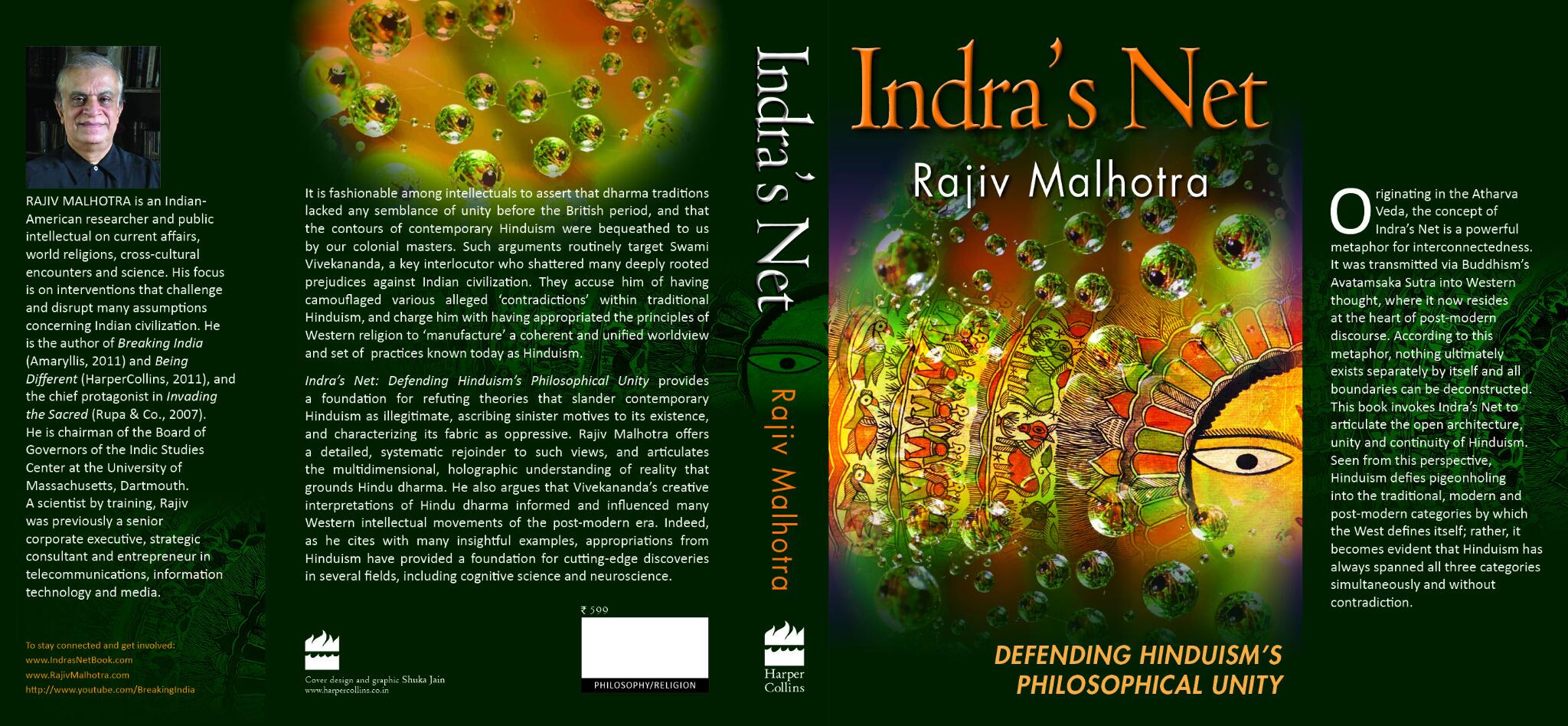
Indra's Net: Defending India's Philosophical Unity


The connection will become clear shortly.  Let us now return to Sri. Pant's quest for a deeper truth. For that, we turn to this interesting article on Sumitranandan Pant at Yalburi.org:
"......he was deeply influenced by Mahatma Gandhi, Swami Ramakrishna Paramahamsa and Vivekananda. Another influence was also slowly making an impact on his sensibility. This was Marxism which came through his friendship with P. C. Joshi who later on became the Secretary of the Communist Party of India....Pant was also drawn towards that movement and wrote some immaculate verses about social reality. He, however, soon realised that this movement was committed only to a change in the externals and was indifferent to the urges for a basic change in the sensibility. ...The poet was convinced that it is the duty of the creative artist to unite the external and internal worlds; ... In the first phase of his creative career society was on the margin of his artistic picture while nature occupied the centre. In the second phase of his creative career it was the social reality which advanced towards the centre and occupied it. Nature and soul-stirrings remained there but they were pushed to the margin. Sumitranandan Pant was now on the brink of a new breakthrough which could unite the two worlds into a new harmony through an adequate creative alchemy....

....This breakthrough came through a contact with the famous Indian dancer and artist Udayshankar. Udayshankar had lived for sometime in Almora in Garhwal and an intimacy developed between the two kindred souls. Both became partners of a pilgrimage to search a principle of unity between the outer and the inner worlds. The ballet and other stylized forms of dance also attracted Pant. Udayshankar made a film named Kalpana (Imagination) which interpreted the outer and inner realities through stylized pictures and movements. Sumitranandan was also associated with the making of this picture. This film was made in South India where Pant came into contact with Sri Aurobindo and his philosophy. Sri Aurobindo confirmed many of Pant’s own speculations and the former’s philosophy gave resonance and richness to the ideological residue of Pant’s poetry. Like Sri Aurobindo the poet also believed that true spirituality should not mean a repudiation of external reality. It should irradiate and impregnate the external reality and make it more meaningful and oriented towards God. Sham spirituality should be replaced by true spirituality which takes as its junior partner the social reality. The later poems of Sumitranandan Pant give expression and celebrate the union of the outer and inner worlds....His poems are verbal artifacts containing warm human experience. They are neither intellectual exercises nor philosophical abstractions."

Return to Dharma 
This is an amazing narrative.
1) A poet, disconcerted by the Marxist lack of an inner reality is struck by an Indian dancer/theater artist's remarkable ability to harmoniously bridge the inner and outer realities and depict it effortlessly in art-form, and without any need to reconcile 'conflicts' between the two, and also do so beautifully. How come there is no conflict?

2) The poet, after internalizing Aurobindo's philosophy learns how the inner- and outer-reality co-exist in dharmic harmony. He was able to recognize the integral unity in dharma that was different from the synthetic unity of the west, and not even possible in the materialistic Marxism due to the outright rejection of an inner reality. Perhaps, this was Pant's 'A-ha' moment.


3) Pant was finally able to creatively replicate and incorporate into his poetry, like UdayShankar's artistic dance/theater representation, the dharmic harmony of inner-outer reality. He had elevated his poetry to a higher level and also make it more accessible by tying it to a human experience rather than stopping at either intellectual abstraction or some fuzzy spirituality. This achievement was not a fluke or a one-time thing. It is a classic example of the Bandhu, the correspondence principle of dharma at work, that also gives Hinduism its remarkable anti-fragility. As Rajiv Malhotra writes in 'Being Different':

"Bandhu is a concept used to explain how the whole and the parts are held together in integral unity. All aspects of the world stem from a common ineffable source, and what we perceive as nature is but a pointer to a higher reality. There is interlinking among the various faces of this reality, such as sounds, numbers, colours and ideas, and this interlinking is bandhu.... 

.... Not only does each discipline presume this unity; so does the relationship among disciplines. All the arts and sciences are interrelated and may be seen as manifold ways in which human nature, itself an emanation of cosmic unity, expresses itself. One discipline contains and reflects the others. Delving deeply into any one of them eventually leads to similar integral principles and structures..."

... Bandhu accounts for the survival of dharmic spirituality, for even when certain disciplines and practices were destroyed, other disciplines encoding the same principles survived and helped revive the overall tradition."

.... Natya Shastra treats Natya as the total art form, including representation, poetry, dance, music, make-up, and indeed the whole world. It is an organic and integral view encompassing the vedic rituals, Shaivite dance and music, and the epic tales..."

Integral Unity

Thus, the principle of Bandhu breathed a new and refreshing life back into Sumitranandan Pant's poetry. He was able to seamlessly integrate his social realities and nature/atma-stirring ideas into verse. These 'realities' was like a jewel that reflected the shine of the other, like those in Indra's Net, as Rajiv Malhotra further notes in his book 'Being Different':

"The conceptual matrix of Integral Unity is illustrated in the metaphor of Indra's Net ... which symbolizes a universe with infinite dependencies and relations interwoven among all its members, none of which exists apart from but only in the context of this collective reality..."

Now this is a genuinely 'holistic' (or holographic) view.

Indra's Net
The unity in diversity in dharmic India is truly integral, unlike the brittle, synthetically fused versions of unity that we see are slowly falling apart in western and middle-eastern countries as their immigrant diversity increases.  Unfortunately, external forces either opposed to or seeking to gain leverage over India (read 'Breaking India' for full details) appear to have zeroed-in on the critical role played by this integral unity in ensuring the long-term survivability of India. India's last line of defense must be defended at multiple fronts. Rajiv Malhotra's new book may tells us more.


Monday, December 3, 2012

Hinduism: The Ultimate Anti-Fragile

[as always, this article is a work in progress ...]


Note: This post is not to be viewed as a 'celebration' by the Hindu society of 'succeeding in surviving continually for a very long time'. After all, a cockroach has also survived for a long time. Barely surviving is not a cause for high-fives. Indeed as Rajiv Malhotra says:
"I have too many times responded to this false belief as an instance of what I have coined the Moron Smriti. Dharma's space and share went down by 80% over the past 1500 years. Imagine your company CFO saying, "Congratulations, boss! We lost 80% of our marketshare, share price, revenues, but guess what? We are still not bankrupt! Isn't that cool?""

Rather the attempt here is to recognize the key concept of integral unity present in Hinduism that gives it its unsurpassed resilience and ability to constructively harness 'disorder' in the hope that it helps shape the future of Hinduism in a positive manner.

Anti-Fragile
Reading Naseem Taleb and following this interview is interesting.
"Linda Geddes: In your new book you talk about things being "antifragile." What do you mean exactly?
Nassim Nicholas Taleb: When you ask people what is the opposite of fragile, they mostly answer something that is resilient or unbreakable—an unbreakable package would be robust. However, the opposite of fragile is something that actually gains from disorder. In the book, I classify things into fragile, robust, or antifragile...
...

LG: How would you make something antifragile?
NNT: If antifragility is the property of all these natural complex systems that have survived, then depriving them of volatility, randomness, and stressors will harm them...

"


Note the highlighted terms used to represent what to the West essentially is some form of "chaos".  Readers of the book "Being Different: India's Challenge to Western Universalism", will most probably grasp the meaning of the title of this post relatively quickly. Empirically, it is well known that Hinduism and India's Dharmic civilization has managed to not just survive but continually thrive for 5000+ years. There is a lesson to be learned here. Furthermore, Hinduism has withstood the onslaught of invaders who practiced and imposed barbaric versions of Abrahamic ideologies for more than 800 years on India, but remarkably, with relatively little success. Reason: They could not decipher the "chaos" and "disorder" within Hinduism required to cause it to disintegrate. The path of least resistance employed to conquer Hinduism led them into a maze and a series of dead ends. In comparison, almost the entire middle east was converted to Islam within a few decades using similar methods. Similarly, Europe and the United States witnesses a rapid conquest of paganism centuries ago, and presently, a steady decline in Church membership in the last century, despite enjoying a monopoly in the religious market and unprecedented and robust material prosperity. Why?
Although a lot of this post focuses on religion and philosophy, this is not just a religion versus religion comparison on resilience. This is more a civilization versus civilization comparison.


Integral Unity
Dharmic thought systems' organic Integral Unity, as opposed to the Judeo-Christian approach of synthesizing unity makes it anti-fragile. In BD, Rajiv Malhotra points out: "... All dharmic schools begin by assuming that ultimately the cosmos is a unified whole in which absolute reality and the relative manifestations are profoundly connected. Western worldviews, by contrast, have been shaped by a tension between the absolute status of Judeo-Christian historical revelations on the one hand and the knowledge produced by a highly dualistic and atomistic Greek metaphysics and Aristotelian binary logic on the other".

Chapter 3 of this book shows precisely how the organic and integral unity-based Dharmic traditions are anti-fragile in contrast with the Judeo-Christian one that is based on various inorganically synthesized coalition of ideas, which is inherently fragile (i.e. a Jarasandha Model). As far as chaos, Rajiv Malhotra notes: "Sri Aurobindo, the great Indian yogi and philosopher of the twentieth century, said that since unity in the dharmic traditions is grounded in a sense of oneness, there can be immense multiplicity without fear of collapse into disintegration and chaos. He went on to say that nature can afford the luxury of infinite differentiation, since the underlying immutability of the eternal always remains unaffected. In the West, chaos is seen as a ceaseless threat both psychologically and socially – something to be overcome by control or elimination. Psychologically, it drives the ego to become all-powerful and controlling. Socially, it creates a hegemonic impulse over those who are different. A cosmology based on unity that is synthetic and not innate is riddled with anxieties. Therefore, order must be imposed so as to resolve differences relating to culture, race, gender, sexual orientation and so on ..."

Thus is clear from this passage that Rajiv Malhotra perceives this inability of the West to embrace chaos as a major fault line. Interestingly, Gurumurthy, India's brilliant investigative journalist, and Hindu thinker in a recent talk in Bangalore said "the west has nationalized the family and privatized the state". The fear of chaos has breached the western family's living room and bedroom.

The Bandhu Principle
So how exactly does Integral Unity make Hinduism anti-fragile? To that we turn to the Bandhu principle, which is described in 'Being Different' as follows:
"Bandhu is a concept used to explain how the whole and the parts are held together in integral unity. All aspects of the world stem from a common ineffable source, and what we perceive as nature is but a pointer to a higher reality. There is interlinking among the various faces of this reality, such as sounds, numbers, colours and ideas, and this interlinking is bandhu.... 

Furthermore .... Not only does each discipline presume this unity; so does the relationship among disciplines. All the arts and sciences are interrelated and may be seen as manifold ways in which human nature, itself an emanation of cosmic unity, expresses itself. One discipline contains and reflects the others. Delving deeply into any one of them eventually leads to similar integral principles and structures..."

Thus "... Bandhu accounts for the survival of dharmic spirituality, for even when certain disciplines and practices were destroyed, other disciplines encoding the same principles survived and helped revive the overall tradition."

The West is slowly beginning to see the benefits of such highly decentralized 'anti-fragile' designs - something that India always had used, and informally understood for thousands of years. The study of complex network systems in the aftermath of the West's financial collapse of 2007 reveals some interesting preliminary results [see this 15-minute video]. The talker notes the high degree of centralization of ownership as well as the high levels of interactions between the nodes in the network.


This interview reiterates why it is extremely important for Hinduism to survive in its original form and context without bad Western translations, uncredited appropriations, digestion, and new-age makeovers. Among many other things, it also provides crucial answers, feedback, and examples to some of the most complex practical and dire problems facing societies in the world today and in the future. Next, let us look at the nature of the "Black Swans" that Hinduism may face in the future.

Black Swans and the anti-fragile future of Hinduism
The Amazon book description says "Antifragile is a blueprint for living in a Black Swan world." Let's go back to the interview once again.

"LG: Does all this connect to your black swans?

NNT: Those are rare events with extreme impacts that lie outside the realm of regular expectations because nothing in the past can convincingly point to their possibility. The global financial collapse is one example ...


LG: How do we get out of the way of these rare catastrophic events?
NNT: We can't measure the probability of rare events because small measurement errors will cause those predictions to explode. The real point of my book The Black Swan is not to talk about the weird things that can happen but to be able to identify how resistant and robust you are to computationally small probabilities..."

Yes, Hinduism (or more accurately, Dharmic Civilization) has survived a few totally unexpected and incredibly hostile attacks, albeit at a very heavy price paid in terms of a Dharmic decay in Hindu society. The questions that it faces today are 
- can this decaying Hindu society that was once a vehicle of integral unity be induced to implode? 
- what if Dharmic Civilization is attacked by an adversary that simulates the Bandhu principle? This is precisely the method of inculturation being adopted by the Church in India. 
- How can this anti-fragile exemplar survive such a viral attack? 

Broadly speaking, it seems that the Church has employed three different types / stages in their attack on Hinduism:

Stage 1: 1757 - 1857 : Overt Missionary tactics to convert natives as a de-facto  and active government policy. One of the tangible victories of the 1857 war of Independence was to strongly discourage the use of this type of a frontal attack.

Stage 2: 1857 - 1947 : Government-sanctioned methods to impart Church-friendly / Western-Universal, convent-English education and the destruction and marginalization of native traditions, teaching, and training methods. 

Stage 3: 1947 - present: The political freedom gained by India ended the blatantly pro-Abrahamic methods but not the Western-Universalism that Gandhi fought against.  The WU controlled media and educational material contains ample anti-Hindu messaging that largely encourages the rejection of Hindu philosophy using textbooks riddled with straw-man arguments.
Furthermore, distributed stealth-marketing methods employing native force multipliers (inculturation and converted Christian transmitters). This, by far, has the maximum chance of success and empirical results can confirm this. This approach attempts to destroy Hinduism:
a) from the inside-out, by 
b) employing not just a single central agency, but a union of varied agents having diverse talents, and in pursuit of their own objectives, and 
c) outwardly simulates a Hinduism-like integral unity.

Note that (c) is just a simulation and obfuscation since this ploy is merely another (admittedly clever) instance of synthetic-unity at work given the history-centric core of the adversarial sections of the West. In stage-1 and stage-2, the Hindu society, either willingly or reluctantly, joined hands with the India's Islamic society to repel Western universalism, but paid a heavy price in terms of territorial and demographic losses apart from enduring a cultural genocide. How it will be able to defend itself against this novel inside-out attack is an open question. However, the heartening news is that the books "Breaking India" and "Being Different" have 
a) deciphered the mechanism, tactics, and to some extent, also understood the strategy employed by the adversary
b) Prescribed some methods and techniques that can be employed toward preserving the DNA of the ultimate anti-fragile system of the universe.

-----------
Update 1 (December 5, 2012)
The video of the brilliant lecture by Gurumurthy in Bengaluru last week (alluded to earlier in the original post above) is now online. The first 15-20 minutes of the talk is especially interesting in that it reveals the "anti-fragile" nature of Indian civilization's native, self-governing, entrepreneurial, decentralized, eco-friendly, pluralistic economy that is neither Darwinian-Capitalistic or Socialist/Marxist. The Bandhu principle appears to extend to the 'Hindu business model' as well. This is contrasted with the West's fear of 'chaos' that inevitably converges toward a centralized ownership model (either the government, or a few private organizations), which is evident from the empirical observations in the 'who controls the west' video in the above post. Per Dr. Vaidyanathan (who also spoke that day), more than 90% of Indian work-force is self-employed. Amazing resilience!


The resilience of this native Hindu economy as described by Gurumurthy is best captured within the first 5-10 minutes of the followup to this talk by M. R. Venkatesh. I have embedded that video as well, below for the sake of completion.


-----------
Update 2 (December 13, 2012)
This update comes thanks to the insightful questions asked of the thesis by an anonymous commentator. The robustness and fragility of History-Centric (HC) versus Dharmic cultures are compared side-by-side, and some hypotheses postulated.

Robustness and Anti-fragility of History-Centric Cultures
A HC faith's only but glaring weakness is its complete dependence on history. This results in a Synthetic but not Integral Unity (Ref: 'Being Different' book). All additional theology are derived dependencies and extensions of this HC core. This resembles a "Star-wars Death-Star" model. If the core is damaged beyond a point, the system implodes. History-Centrism is a non-regeneratable resource. If their history is discredited or erased, that culture will disappear. Consequently, it is a strategy that even a low-grade threat to their HC objects (e.g. religious structure/holy book/prophet) must receive a disproportionately severe response. HC faith based cultures are designed to be robust, so their first line of defense is tight. They have the support of oil-rich countries or Western nations with strong military, economic, and information base.
Hypothesis: Working HC-systems are typically very (strategically) robust to make up for the poor anti-fragile properties that make them vulnerable to implosion.

The best way to take down such a system is an open question and is left to the reader.

Comparative Analysis of Hinduism
As already argued, Hinduism has been super anti-fragile in the past. The response to an attack on its religious resources typically elicits a disproportionately muted response. Temples damaged, texts and concepts distorted, Yoga, Ayurveda, Advaita digested, etc..,  eliciting nothing more than a whimper and grumblings. Thus Hindus have been been terribly complacent about their primary line of defense for decades, and this has hurt them badly. Furthermore, a major emerging threat is the systematic attack (Stage 3) on Hindu Gurus all over the world.  Unlike HC theologists whose main task is to memorize 'HC Smriti' (Claim: A machine is sufficient to replicate and teach all necessary HC theology??), the wise Guru carries with her or him, the 'DNA' of Hinduism that can be used to re-generate and propagate Dharmic concepts and inspire future leaders of the nation (Can we even count the number of patriotic Indian leaders inspired by Swami Vivekananda?).

Hypothesis: Working Dharmic systems (e.g. Hindu society) today are typically non-robust that leaves them vulnerable to sustained pressure. They have excellent anti-fragile properties that have been understood by adversarial HC systems.


Update 3: Dec 21, 2012
-----------------------------
Perspectives on Indian History: The anti-fragile nature of India's cultural unity (Sanskriti) comes out really well in this insightful and superb presentation (Jijnasa Charcha) by Sandeep Balakrishna. This Google-docs link may look better. In particular note the empirical comparison with HC-dominated Europe. You can view the Jijnasa Charcha on Youtube here (turn the audio way up). This is a 5-part video, that is well worth listening to.


Update 4: January 9, 2012
------------------------------
Updated terminology in a few places.


Update 5: January 11, 2012 
----------------------------------
Added introductory note and reference to Rajiv Malhotra's coined phrase "Moron Smriti".

Update 6: August 08, 2014
------------------------------------ 
anti-fragility of Hinduism (and dharmic systems, in general) also appear to be related to its allostatic nature ~ 'unchanging, perhaps even getting stronger, by adaptively changing' without sacrificing dharma. Here's a tweet by the @macroresilience twitter handle:
Update 7: May 3, 2016
------------------------------
Briefly updated content.