Showing posts with label History-Centrism. Show all posts

Saturday, April 4, 2015

The Indian Proselytization Equation

While helping my daughter with arithmetic, I uncovered a simple but powerful application of elementary school concepts that helps me do a basic purva paksha numerical analysis of the Christian Evangelism in India. Hopefully scholars in India can analyze this serious social problem at the more sophisticated level that it deserves.

Recall Indian Prime Minister Narendra Modi once talked about India's demographic dividend, viewing India's population not simply as a source of all problems, but as an asset that produces solutions? Now consider this equation.

Demographic Dividend ÷ Missionary Divisor = Soul Harvesting Quotient (SHQ)

Note the usefulness of this equation to Missionaries.

1) The size of the missionary pie is equal to Modi ji's demographic dividend.  
India's population is also a great source of joy for churches. The more the Hindu bodies, the biggest the soul harvest, the richer their rewards.

2) Conversion Efficiency
Given N missionaries allocated to India, the SHQ immediately tells their CEOs the required sales target or the per-missionary rate of conversion required for Breaking India, completely destroying dharma, and establishing dogma. For example, if you have 10^9 dharmic bodies, 10^5 harvesters , and a 100-year plan, each missionary has to corrupt an average of 100 atmas annually, over a century for achieving 100% cultural genocide. However, there are non-linearities at work.

3) Proselytization Calculus: Increased conversion rate over time

Theorem: At any point in time, if converting 50% of a dharmic population takes N decades, the second 50% will take (far) less than N decades.
 

To see this, let us apply Vivekananda's observation: A Hindu lost is not just a Hindu lost, but also an enemy gained. This means that a significant fraction of the harvested population turns vampire. If you started off with 10^5 missionaries, you may be able to continually double the number after a significant increment of harvested recruits join the sales force, without having to import foreigners. Thus, the divisor goes up, and the required SHQ comes down. Equivalently, if the missionary army maintain their SHQ rate, and the Hindu dividend does not grow as rapidly as the divisor, the time taken to harvest the remaining population keeps on reducing over time.


Conclusion
The rate of dogma growth (and reduction in dharmics) in India is likely to increase nonlinearly,  unless there is a sharp and immediate reduction in the number of soul-harvesters before critical mass is reached, at which point, the harvesting process is likely to go viral (exhibit exponential growth) and become almost surely irreversible.

Friday, March 20, 2015

Western Feminism as a Counter-Terrorism Doctrine

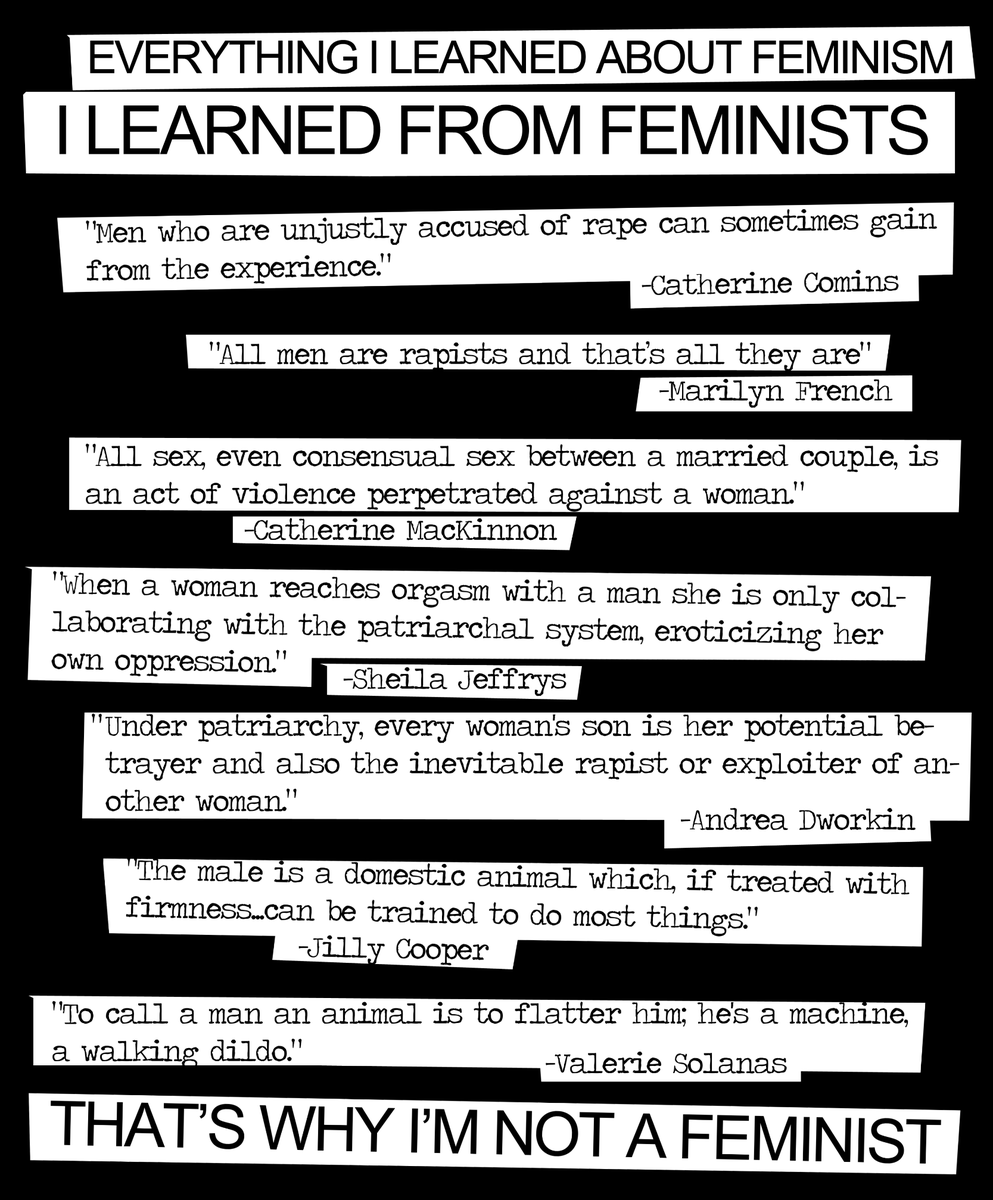
A small sample of statements by leading lights of Western feminism (WF):
(via @DeepikaBhardwaj on twitter to explain why she is not a feminist as she states in the last line of the picture above)

If these statements represent a more violent expression of a widespread but latent fear and rage among the persecuted women of some western societies, then it is both fair and useful to also analyze Western Feminism as a counter-terrorism doctrine. This suggestion should not be surprising, as the facts unearthed in the aftermath of 'India's Daughter' video show, the per-capita rate of violent crime against women in such societies are orders of magnitude worse than India (with significant under-reporting in most societies). Of course, India clearly has an emerging problem, but one that should and is being tackled boldly, and perhaps with a lot more wisdom, by women leaders in its society. More on that later. A limited point raised in this blog is this:
WF must also be analyzed as a counter-terrorism doctrine because, as data will show, there exists ample evidence to suggest that it was created to counter gender chauvinist terror inspired by History-centricAbrahamic male-dominated theology adopted in those societies. Terror victims respond violently by attacking the other gender, with scant or no regard for collateral damage in terms of destroyed families, innocent lives lost, and cultures exterminated. At best, the WF approach tolerates the male who accepts 'defeat', just like the MCP tolerates women who do the same, resulting in a constant state of tension that boils over repeatedly. In fact, one could say, that the WF members have become male gladiators for all practical purposes, in order to be successful in executing their adharmic counter-terrorism strategy. And this strategy, which looks more like a race to the bottom, is being promoted and marketed in all parts of the world as 'progressive'.

On the other hand, the Indian response is dharmic, and focuses on harmony and restoring balance via mutual respect, rather than myopically and foolishly thinking in terms of order versus chaos, of triumphant victor tolerating sore loser, and seeks to return the feminine to the highest place in the society it has traditionally occupied. This article is a good place to start.  For a detailed comparative analysis of the idea of mutual respect in dharma versus Abrahamic ideology, read Rajiv Malhotra's book Being Different'. The data has shown (read the books by Dr. R. Vaidyanathan, or the talks by S. Gurumurthy on this subject, for example) that the practical success of the traditional Indian economy (Mahalakshmi), its learning models (Saraswati), and its strength against aggression (Durga), are because they are rooted in the divine feminine. Thus, it seems clear to me that these particular choices of Lakshmi, Saraswati, Durga arose from the actions of ancient Indians who were actually practicing this successful approach, i.e., ground up, and in turn these deities served as exemplars for future generations to follow and be successful too. The ideas of eco-feminism, Yoga, vegetarianism, etc. that have become popular in the west, especially among women, also come from dharmic India. This is not surprising, since the very idea and source of strength is Shakti, which is important in the dharmic traditions of India. One can also understand the Indian versus western response as that of a Yogi versus the Gladiator.

Should one respond to gender-based fault-lines in societies by widening them using a counter-terrorism doctrine to achieve victory? or should one employ a dharmic solution to achieve harmony? Seems like a no-brainer.

Sunday, September 7, 2014

A Sufficiently Large Value of Zero

Constructing false equivalences comes naturally to the science- and logic-illiterate seculars in India coming out of the assortment of humanities departments in the west and India. For example, see this tweet:

False equivalences like these eventually rest on the following theorem:
"For sufficiently large values, zero can be rounded up to one".
Proof: Take any zero. Press on both sides long enough.

Corollary: "For sufficiently small values, 1 can be rounded to 0".
Proof: Take a unity shaped balloon and blow sufficient hot air into it.

When you begin to treat Boolean true vs false as merely unit rounding error, a whole lot of things are possible. By repeatedly applying this "rounding rule", you can make anything equal to anything else. All it takes is vivid imagination, and this department, one must concede that non-dharmics do rule the world.

Examples

'For sufficiently large values, the 300-yr rule by Mughal invaders was the pinnacle of Indian historical achievement' (All their genocides and native dharmic achievements rounded down to zero by repeated application of corollary, etc.)

'For sufficiently small values, Hindu dharma is negligible and can hence be rounded down to zero' (non-negligible residuals are either some Neo-Hinduism 0-to-1 fabrication or generic 'South-Asian' Gaussian noise)

'First there was nothing, then there was something'. Genesis - a restatement of  the main theorem.  'First there will be something, then nothing' is an application of the corollary. Judgement-day and Jahannam. This before/after miracle has sustained thousands of marketing campaigns. This belief is the bedrock of marxism, history-centrism and its monotheisms. Non-dharmic thought will always prefer Magic over Yoga, Prophesy over Forecast, and Dogma over Karma. (Karma and Punar Janm represent the clearest refutation of this "something to nothing" adharmic fallacy).

Sometimes, applying this theorem can fail badly.

1. 'For sufficiently large values, Rahul Gandhi > Narendra Modi'. Sadly, some zeros are irreversibly, irretrievably, absolutely zero.

2. 'For sufficiently large values, Nalanda university can be brought back to life'.

Nalanda university was destroyed by Jihadis centuries ago. Round that fact down to zero, round up some funds from gullibles, and you end up with the brand-hijacking led by Mr. Sen, the numericidal genius whose body of work has convinced millions that there is a place for fantasy in economics and public policy.

To honor the secular magician and his university, this rounding rule is named "ΓΈ0", The Null-Anda Theorem.

Tuesday, August 12, 2014

The Essential Dharmic - Part 1: Necessary Conditions

This blog is as always, a work in progress, and will be revisited in the future as the ideas further crystallize. This post is introductory and leaves a few statements undefended and unexplained. This will be revisited in subsequent posts rather than make this introduction a very long one.

Background, Motivation, Preliminaries
a) This brief note was triggered by this tweet by the dedicated blogger @realitycheckind whose analysis and insightful commentary on the Indian education system, among other important topics, has helped shape a lot of minds.


b) This note uses ideas from a prior work that introduced a new modeling interpretation of History-Centrism, a concept introduced by Rajiv Malhotra in his book 'Being Different' (BD). The aim is to reintroduce the problem of 'who is Hindu' as the task of determining necessary and sufficient conditions (N/S), if any to 'be Hindu'. To answer this question, I borrow heavily from Rajiv Malhotra's new book 'Indra's Net' (IN). These posts are a first attempt to look at the ideas introduced in these books from a math-logical angle and see if any novel and useful insight reveals itself.

In the introductory blogs in this space, we saw how dharmic thought systems (DTS) were non-trivially different from history-centric (HC) ones, and the N/S conditions that used to delineate HC, and deemed "secular" and "universal" in nature, are in fact inadequate - they are neither sufficient nor necessary to distill the essentials of a dharmic. We explore this space further using ideas from 'Indra's Net'.

c) Most, if not all, of those who are trying to rediscover their dharma in their own way, belong to science, engineering, and math-based disciplines. Hopefully the language employed here is not so unfamiliar as to make it entirely unreadable.

d) Rather than just examine the Hindu issue, we follow Rajiv Malhotra and address the broader and (more powerful) general case of 'dharmic', which then allows us to treat 'Hindu' as a special/specific instance within this dharmic family.

e) These posts are less about conclusive and definitive answers, and more about getting dharmics to ask rigorous questions and initiate a debate: Who are we?
To begin to know what makes us who "we are",  a good place to start is knowing 'who we are not', so let's begin there.

Questions
First, I agree with the depicted tweet.
Reason: Abrahamics are an instance of HC religious membership, and it has been shown before that N/S conditions that define HC do not work for DTS (including Hindu Sampradayas, Jains, Buddhists, and Sikhs).

This leads us to three questions:
a) Are there essential features that allow a person to even qualify as a potential dharmic, and then
b) go a step even further and ask if we can stipulate conditions that are sufficient to characterize/define a dharmic?
c) What are the benefits and risks of having or not having such 'essentials'?

Separation Rule: Machine Learning Analogy
We will address these three question over the next few blogs, starting with (a) today. In particular, we are looking for a separation rule that allows us to achieve two objectives:
a) The separation rule should bring out certain salient properties of dharma thought systems, and be commonly satisfied by all instances within the system
b) These salient features should not be present in non-dharmic systems.

In other words, identify what is special and common to the dharmic cluster, but is also anathema to non-dharmic systems. This problem can be illustrated via this classical machine-learning picture that classifies incoming data as 'red' or 'blue'.
(picture source: http://glowingpython.blogspot.com/2011_10_01_archive.html)
Imagine the blue dots to be instances of a dharmic system such as Advaita, Buddhism, Jaina, etc., and the red dots to signify instances of non-dharmic systems (including history-centric faiths like Sunni, Mormonism, Protestantism, and new-age systems like scientology, random hippie movements, tree-huggers, cargo cults, etc.). The dotted line represents a machine-learning rule such that any current or future new religion that lies to the left of the line (e.g. answer computes a "YES" to the rule) is classified as potentially dharmic, and instances that fall to the right (e.g. answer computes a "NO" to the rule) is classified as surely non-dharmic. Also the proximity of the observed data point to the line may indicate the degree of violation or satisfaction. For example, an exceedingly adharmic system that permits genocide and slavery of innocents would be "red" and far away from the dotted line while some pagan faiths may be merely borderline red. Therefore, such a separation rule would also prescribe an 'escape route' for a non-dharmic system that allows it to eventually turn dharmic by reforming itself by becoming a "YES" instance. Clearly the presence or absence of such a separation rule has important practical implications in this world.

This allows us to rephrase our questions by asking:
- does there exist a separation rule that allows us to classify an input system as dharmic or not dharmic.
- Is this rule necessary, sufficient, both, or neither?

Rajiv Malhotra answers the first question in the affirmative and specifies an instance of a separation rule in his recent works (BD, IN) by a detailed examination of a variety of historical data and other sources of information.  Whether this rule is necessary and/or sufficient needs to be carefully analyzed.


The Essential Dharmic
There are three possibilities regarding the essentials in (a):
Possibility 1. We can reliably write down necessary conditions to even qualify as dharmic. These conditions may or may not be sufficient.

Possibility 2. We can reliably write down sufficient conditions to even qualify a dharmic. These conditions may or may not be necessary.

Possibility 3. No necessary or sufficient conditions can be written down that qualify or disqualify a person from being dharmic.

Response:
1. There are necessary conditions to even qualify as a dharmic. Equivalently, these represent sufficient conditions to disqualify a person from being dharmic
In other words, before we even try to essentialize Hinduism or other members of the dharmic family, we can and must be at least be able to tell what it is not. These conditions include:
- rejection of Karma
- rejection of Punar Janm

A person who rejects Karma or Punar Janm cannot be accepted as dharmic. A rejection of any one of these dharmic beliefs is sufficient grounds for disqualification, and an acceptance indicates a basic and necessary qualification (i.e., in the sense that it does not guarantee anything and in itself is not sufficient to pass the exam, but at least allows you to take the exam). Indra's Net makes innovative use of the terms Nastika, and Astika to distinguish between those who reject, or accept these two truth claims, respectively. HC members, in particular, are disqualified, since Karma or reincarnation are irreconcilable with the N&S conditions (why?) that define their own membership. The reasons for including these two specific truth claims are quite deep and worth studying. These beliefs are shared by all members of the dharmic family, but are not (in fact, cannot be) shared by history-centric systems at least, and some other new-age cults and other historic faiths. Detailed reasons can be obtained by reading the works of Rajiv Malhotra, but we will try to present additional intuition in the next post using the models developed in this space.

 
What is also important is that this separation rule is derived from dharma and not some secular-western legalese, and are also significantly different from HC/Abrahamic type membership conditions. To see the intuition behind this, let's look at two tweets together:


Again, I would agree with statements in both tweets if it means that essential features of DTS (if any) are not same as that for HC (e.g. Abrahamic). However, given the 140-char limit of twitter, this is a bit terse and is more focused on the legal point of view. I would disagree if the intent of these tweets was 'anything goes for Hinduism'. There has to be certain necessary conditions of elimination that narrow the scope and state a basic qualification for a person to possibly be dharmic, and there can be a debate on what these necessary conditions are. The conditions stated above are based on my understanding of the discussion in 'Indra's Net'. For example:
- a person who believes in any of the truth claims in the Nicene creed would not be able to meet these conditions and thus be disqualified as Nastika from a dharmic perspective.
- A secular person or an atheist who rejects Karma or say, an Islamist or a pagan who rejects reincarnation would be disqualified and deemed a Nastika from a dharmic perspective.
- It follows that a person who is not rejected is an Astika. However, whether these conditions are also sufficient to fully and definitively answer 'who is a dharmic' i.e., is an astika = a dharmic? is a discussion for another day.
- It is also interesting to note that the Astika/Nastika dichotomy and the necessary conditions employed to come up with this classification does not depend on simplistic belief or non-belief in some dualistic 'God'. Evidently, Nastika does not equal "atheist" and Astika does not equal to 'believing in God'. This is not surprising once we see that 'atheism' and 'God' are constructs that came out of history-centric systems that has dominated the airwaves in the west and middle east for many centuries now.

A key differentiation is that HC membership rules (e.g. Nicene Creed) imply exclusivity and introduce a host of duality-ridden binary partitions like us-them, before/after, moral/immoral, atheist/theist, Satan/God, etc. that are of limited use to dharmics. Although these partitions are simple and easy to grasp, separation rules derived from HC are not universally applicable (including in legal courts), and certainly cannot be employed to narrow the scope of who dharmics are or are not. We will conclude part-1 with a case study to illustrate this point.

Case Study: The SGPC in 1925 came up with a definition of 'Sikh'. Here is Arun Shourie talking during the book release of Indra's Net:

" ...People were asked what is your religion. So, 95% of them said we are Shinto, 76% of them said we are Buddhists. It couldn't be: because it was no different for them. It was completely Judaic, Christian, Islamic notion that you can either belong to this or to that. We are Hindus, many of the people, persons like me, all my reading is Buddhist, many of my practices would be from teaching of the Buddha but nobody would say that I am less of a Hindu or more of a Buddhist or vice versa and actually this notion was fomented in India and the first time this happened is in the Shiromani Gurudwara Prabandhak Committee Act. In that Act, ‘Who is a Sikh’ is defined. ‘Who is a Sikh’ – He who believes in the Granth Saheb, He who believes in the Ten Gurus. Most of us could be Sikhs from that point of view, therefore a new clause was added "..and who does not belong to any other religion". You and I may think it is just an administrative thing, but that seed is sown in 1925 and you see it in the agitations of Bhindranwale and others much later... as to what happens when these seeds come into being. "

We can see that the SGPC came up with two conditions
i) the first is clearly a necessary condition: belief in Granth Saheb and Ten Gurus. Seems pretty reasonable and natural. I, like most dharmics, deeply believe in both, and I personally agree that this is an important requirement.

ii) a second necessary condition that in combination with the definition-type ruling on "who is a Sikh", makes their statement taken in totality behave like a sufficient condition for defining a Sikh, and weeding out non-Sikhs:
A Sikh is essentially one who believes in the truth claims of the Granth Saheb and the Ten Gurus, and does not simultaneously belong to any other religion.

The latter clause is a HC-like membership rule that forbids any dual-citizenship, and is likely to be a bitter pill for dharmics to swallow and I personally reject it. Why? (i) in itself is sufficient to reject all HC members (e.g all Abrahamics) who cannot simultaneously satisfy HC's N&S conditions that irreconcilably contradict (i), and have to pick one faith over the other. However, (i) is not sufficient as far as excluding members within the dharmic family who do not explicitly label themselves Sikh. Therefore, the only role of (ii) appears to be to introduce an exclusivity clause to reject those who call themselves Hindus, Buddhists, Jains, etc. Rajiv Malhotra's separation rule does not repeat this sectarian mistake, and returns the focus rightly to the biggest picture there is, the Kurukshetra where dharma battles adharma. This decision may well turn out to be one of the great turning points of the Kurukshetra. It is possibly a side-effect of the mistake by SGPC that Wikipedia today describes Sikhism as 'monotheist' - tragic fiction. Depending on the context and situation, most dharmics today operate like a Hindu, Sikh, Buddhist, or Jain, or one or more combinations. Clearly this kind of exclusivity based essentializing is dangerous, misinformed, and adharmic because of the harmful tensions it creates within the society. There may be disagreements within the dharmic family on the nature of the ultimate reality (e.g. Shunya or Brahman) that causes one to choose a Buddhist or an Advaitin perspective, but there was and is unanimous agreement on the primacy of (saamanya) dharma, and upholding its integral unity (ref: BD, IN).

This sets up the ground rules for coming up with such N/S conditions or rejecting such conditions. Any alternative candidate for the separation rule that is put forward to improve upon the necessary conditions for dharmics stated here has to be equally, or more sustainable and must transparently and unambiguously support dharma. Simply put, a viable alternative can only arise from a dharmic basis. Furthermore, dharma, unlike history-centric constructs, is truly universal.

Take Aways
The key takeaways of Part-1 are:
- "anything goes" and some (random) "way of life" answers to who is dharmic is non-rigorous, open to adharmic manipulation, random claims and definitions of Hindu-ness that are neither necessary or sufficient, and is especially unacceptable in a world where the dharmic market-share of demographics, geography, and global influence is shrinking at an alarming rate every year. We can and must do better.

- the presence of a separation rule that narrows down the scope of who is and is not dharmic has important practical implications and value. However, a bad choice of a separate rule brings with it its own negative side effects and risk

- necessary and/or sufficient conditions derived from History-centric theology or secular concepts are unlikely to work for dharmic classification/qualification, are not universal, and hence rejected.

- necessary conditions rooted in dharma are required to narrow the scope on who qualifies to be dharmic, and thus also prescribe sufficient grounds for disqualification.

- Necessary conditions based on the ideas from the book 'Indra's Net' are stated here.

- Note that this response rejects Possibility #3 by clearly stating that there are indeed certain essentials having a dharmic basis, that are at least necessary to be Hindu, Buddhist, Sikh, or Jain (or dharmic, in general). However, are these conditions sufficient? What is so special about Karma and Reincarnation? Does having any separation rule invariably come with the burden of risk? We will discuss this in a later post.


Acknowledgements:
thanks to @sighbaboo and @DigestionResist for reviewing an early draft and sending me feedback despite their busy schedules. Errors and shortcomings in this post are entirely mine and bugs will be fixed periodically blogs as more data becomes available and understanding improves.


Saturday, February 8, 2014

The moral-relativism of India's neo-secularists

Introduction: AAP the New Party

There is much criticism of the hypocritical actions and 'U-turns' of the Aam Aadmi Party (AAP) in New Delhi after it seized power with the support of the Indian national congress. Much of this is justified. Their:
a) inattention to governance, dangerous calls for a referendum in border states,
b) a membership consisting of a few misguided pro-capitalist elements, naive alternative-seekers, amongst a crowd of Marxist activists, and
c) rapidly mutating behaviors,

is slowly but surely made India uncomfortable and nervous. One quality of AAP is undeniable. On the surface, all of (a)-(c), when taken in combination, represents a new politics. The AAP portrays this novelty as a positive feature, and it's ability to accommodate diversity as an example of its flexible thinking. The Delhi Chief Minister Arvind Kejriwal's life before AAP, as well as the antecedents of other leaders of the party is now being scrutinized, and the picture is not very pleasant. When the extent of its Ford-Foundation links become fully public knowledge, AAP will be in further trouble. It is worth examining the ideological banner under which such anarchist elements have rallied to.

AAP's Guiding Philosophy
Let's briefly set aside for now their economic/political orientations, and focus on their core DNA. What is the fundamental "chip" inside that drives the AAP machine? We must be indebted to senior ex-AAP member Surajit Dasgupta, the whistle blower who has given us a ringside view of what happened in the AAP prior to its Delhi 'coup'. In particular, let us focus on the passage where Surajit notes (emphasis mine):
"...The problem was with the AAP’s erroneous understanding of the fundamentals. The name of the committee for Muslims figured under the topic, secularism! ...

how do we plan to reach a different destination by traversing the same path as that of faltering political parties before us and the British Empire that looked at Indians as separate electorates? ..."


Yogendra Yadav, AAP ideologue, responds.
"...
we have to avoid three ways of being secular: 

... Congress [secularism] which is often about selective appeasement of minorities
...BJP secularism which wants to reduce the formal equality before law just to a formality
...communist secularism that treats anything religious as untouchable. 

We need to evolve a principled approach that can relate without any guilt to religious and cultural symbols and discuss the material and community related difficulties of any community whether it is majority or minority..."

Surajit responds:
"... I have no objection whatsoever to addressing the concerns of Muslims under our project of social justice. In fact, I shall extend all-out support to such endeavours. My case is that it should not be masqueraded as secularism. "

Yadav rejects this statement and justifies this approach citing:
...you might wish to refer to Rajeev Bhargav's body of work on [secularism] that argues that Indian secularism has its distinct identity and that is not necessarily a problem..."

"... is a big tactical blunder Kejriwal committed by inviting Yadav and outsourcing policy to him.
... The party continued with its policy of multi-communalism, undeterred by the corrective suggestions members and supporters kept sending to it"


Thus, ignoring protests, Mr. Yogendra Yadav chose for AAP,  Rajeev Bhargava's new model of secularism based on the state "maintaining a principled distance" from various religious groups. This, he claims to be superior, fairer, and also a wholly indigenous alternative to the Congress/BJP/Marxist way. In particular, it claims to be better than what is universally recognized as pseudo-secularism of India since independence. We will argue that AAP's secularism, like Congress' secularism is just as anti-Hindu, and in fact, makes things worse.

Secularism has been universally rejected by Indian thinkers
Bhargava's body of work on an 'Indian secularism' has gained a lot traction within India's westernized intellectual circles, as well as in some parts of the west. In fact, Bhargava has been presenting these ideas as a universal solution for communal harmony based on a neo-secularism formulated by borrowing from the best principles of India and the west. His ideas are motivated by the failure of 'secularism' to solve India's communal problems (Bhargava's many essays on this topic invariably start from the events of December 1992). What may be surprising to some is that the total failure of secularism in India has now been accepted by at least five different groups, including:
(i) Marxists like Bhargava and the JNU-AAP ideologues,
(ii) so-called Gandhian proponents like Ashish Nandy,
(iii) the Indian nationalist parties, as well as(iv) objective thinking academic scholars like SN Balagangadhara, and
(v) dharmic intellectuals like Arun Shourie and 'Being Different' author Rajiv Malhotra.

All these thinkers have exposed the inherent flaws of secularism in their writings from diverse viewpoints. In particular, the last two groups of thinkers have in different ways, provided rigorous logical reasoning to explain why secularism or its derivative variations (in its most 'genuine' form) are guaranteed to fail in India, even if it is implemented as intended.

A common reason for all these groups rejecting secularism for India can be traced to the Abrahamic origins of secularism and the context in which it was created and is applicable to, i.e. to prevent Abrahamic institutions from running a competing government that undermines the rule of the land, aka "separation of church and state". For example, S.N. Balagangadhara constructs convincing and consistent logical argument to show that:
b) Secularism can never be neutral when it has to deal with an Abrahamic religious community and an Indian religious community

b) Secularism in India favors Abrahamic proselytizing religions over Indian ones, and consequently,

c) this western/christian model of secularism has not just helped, but has been the primary and active culprit in inciting communal violence in India.

The extensive body of work of Rajiv Malhotra on this topic represents the most comprehensive, and original Indian thought (dharmic perspective) and intellectual contribution in this area in recent times, and is very briefly touched upon at the end of this essay.  This work is already having a remarkable influence in positively shaping the course of Indian society and politics and will be covered in-depth in a future post.

Alternatives to Secularism: Go Indian
Similarly, each of these aforementioned five groups offer alternatives to secularism. Interestingly again, all their alternative claims (including, interestingly those of the Marxists) are openly derived from an Indian basis, which is quite remarkable. At this level of analysis, it sounds promising: Indian thinkers across the board have recognized and then rejected the Abrahamic-western model of secularism and have opted for an Indian replacement. But what does this replacement look like?

- Bhargava does not reject secularism altogether but proposes a 'redefined secularism' or a neo-secularism that he claims is suitable for the Indian context, which essentially allows for temporary suspensions of secularism ostensibly in the interest of fairness and neutrality.

- self-styled 'Gandhians' offer 'Sarva dharma Sama bhava'

- Indian nationalist groups (e.g. pre-Modi BJP) propose Hindutva as an alternative

- Balagangadhara does not propose a clear alternative but indicates that a solution is available within Indian traditions of pluralism that upheld communal harmony for centuries prior to colonial rule

- Arun Shourie noted that the world 'secularism' has been prostituted, and suggests 'pluralism' as an alternative in a recent NDTV panel discussion with Barkha Dutt. In recent times, it appears that he has spoken publicly about 'mutual respect' being preferable to 'tolerance', which is the critical idea tied to the approach of:

- Rajiv Malhotra (independent non-Hindutva Hindu scholar), who provides an in-depth analysis of the contradictions of secularism, and why a 'dharma sapeksha' society is a viable and sustainable alternative for India, in his book 'Being Different: An Indian Challenge to Western Universalism'. His new book 'Indra's Net' emphasizes that such an 'Open Architecture' based on mutual respect is critical to maintaining India's unity in diversity. This approach is not bound to any particular religion, and appears to be the most preferable approach.

But first, to understand AAP's DNA, we have to study Bhargava's model which is claimed to be derived from an Indian perspective.

Bhargava's Neo-secularism: a gift to the West

There are pros and cons to the Bhargava model. The 'pros' being an attempt to present an Indian way (albeit "Indian" is limited to a post-1947 world) and a grudging recognition of the potential within Hindu tradition. A fatal flaw of this model is induced by Bhargava's seemingly desperate attempts to maintain the illusion of a neutrality of 'secularism' despite recognizing its western origins and Christian context for which it was designed. He proposes several ingenious modifications to work around this problem to create a more workable model.

His first failure is the inability to grasp the irreconcilable differences between the nature of the truth claims of history-centric religions (e.g. Abrahamic) and dharmic systems like Hinduism, Buddhism, etc. (which, as SN Balagangadhara mentioned earlier is the key reason why secularism can never be neutral in an Indian context (although SNB uses the less precise word 'pagan' instead of dharmic, which is Rajiv Malhotra's more correct terminology). Rajiv Malhotra's BD provides a more comprehensive comparison of these different truth claims by examining them from a dharmic perspective. He coined the phrase history-centrism to characterize Abrahamic truth claims, which when implemented in practice as a claim of exclusivity, are incompatible with an inclusive, open architecture based on mutual respect. It stands to reason that any modification to "classical" secularism that ignores these fundamental differences will not be neutral either. The modifications introduced by Bhargava include:

a) the state adopting maintaining a principled distance from all religious communities "which entails a flexible approach on the question of intervention or abstention, combining both, dependent on the context, nature or current state of relevant religions"

b) the state adopting a contextual secularism which "recognizes that the conflict between individual rights and group rights or  between claims of equality and liberty or between claims of liberty and the satisfaction of basic needs cannot always be adjudicated by a recourse to some general and abstract principle. Rather they can only be settled case by case and may require a fine balancing of competing claims".

This results in a "multi-value character of  secularism [as opposed to a binary separation of church/state] makes it inherently unstable and necessarily  ambiguous but that this instability is inescapable and given the context in which it is meant to work, this vagueness is a virtue."

Unfortunately, a combination of (a) and (b) without addressing the inherent bias within secularism that skews it in favor of Abrahamic religions only worsens the situation for dharmic religions, because Bhargava allows the state to negotiate with Abrahamic institutions (e.g. Church) as needed, while also allowing the state to essentially dictate to pluralistic dharmic systems like Hinduism which never had a centralized law-making institution in its traditions that competed with the law of the land. In other words not only will a prejudiced (original) secularism be unnecessarily foisted on dharmic systems like Hinduism, when it was totally unnecessary to do so in the first place, it will additionally augment this by mandating that an secular Indian state act as a proxy quasi-Hindu law-making institution for Hindus from time to time to prevent incoherent groups of Hindu traditions from misbehaving due to the "caste system, arguably the central feature of Hinduism". Therefore "in Hinduism, the absence of an
organized institution such as the Church has meant that the impetus for effective
reform cannot come exclusively from within. Reform within Hinduism can hardly be initiated without help from powerful external institutions such as the state
".  One cannot but ask Bhargava if he has bought into the neo-Hinduism myth that was invented by a group of missionary scholars in the west and was emphatically debunked in 'Indra's Net'. The net result is not principled distance as intended, but an unprincipled and increased proximity to Abrahamic religions. Why does this happen?

Bhargava's second failure: moral relativism
One reason is that Bhargava has:
a) misappropriated, mangled and relabeled portions of the contextual ethics of dharma into an ill-defined and ambiguous notion of "contextual moral reasoning" - a vagueness that he himself has recognized in his exposition, and sees as its strength
b) erased its Hindu origins to make it palatable to his westernized peers and pass it off as some original contribution

Using Rajiv Malhotra's terminology, these two steps result in the digestion of the nuanced contextual ethics of dharma into western secularism.  Without fully understanding how dharma-based ethics works, Bhargava has bypassed the universal pole of Indian ethics, i.e. the 'Samanya dharma' completely, retaining only the contextual pole. Dharma works well because of the usage of the universal pole as the definitive scanner that scrutinizes the motive when contextual deviations are requested.  This is explained in detail by Rajiv Malhotra in his book 'Being Different':.
".. The frequently levelled charge of moral relativism against this [dharmic] contextual morality is inaccurate, because the conduct and motive are considered consequential in judging the ultimate value of statements. The degree of common good is the universal standard, and the well-being of all creatures, in terms of non-harming (ahimsa), is the highest truth. For the Buddha and for the sages of the Mahabharata, non-harming is the universal ideal ('ahimsa paramo dharmah') and truth, the highest dharma ('satyan paro nasti dharmah'). The contextual morality serves the universal morality and is an individualized expression of it. In other words, the contextual dharma applies the principles of higher universal dharma of benevolence and compassion to specific contexts

Thus, dharmic thought offers both universal and contextual poles – not just the latter, as that would be tantamount to moral relativism..."
 
An additional reference is the set of essays of Sandeep Balakrishna that critique A. K. Ramanujan's work on this topic. Historian-scholar Sandeep Balakrishna in a series of essays in 2008:
1. Dissecting contextual morality (part 1, part 2)
2.  'Dharma 101' series

examines the differences between dharma-based ethics versus the "unipolar contextual morality" trap that western thinkers (like Bhargava here) fall into.

Bhargava's contextual morality specifies no unambiguous anchoring within a universal moral reasoning that will deter unprincipled interference. He rejects dharma-based solutions, as evidenced by his reference to "filth" in India's traditions and the erase of the dharmic origin of his ideas, leaving its user with no clear universal guidance. Mutual respect is not even mentioned opening the doors to communal tension with a neo-secular government acting as the capricious policeman. Consequently, Bhargava's interpretation gives the state the right to tactically cherry-pick and make motivated choices (e.g. votebank politics, populism, foreign support) on when to and when not-to deviate from dharma. In the case of Abrahamic religions, their powerful globally-networked institutions headquartered in the west or middle-east can and will mount a vigorous defence to thwart any interference, whereas the decentralized open architecture of Hindu/Buddhist/Sikh/Jain traditions are left relatively vulnerable to such intrusions. Thus, implementation of AAP's contextual secularism of Bhargava opens the doors wide to moral relativism in the Indian context.

Breaking India


This unipolar contextual morality and resulting moral relativism is the core 'doctrine' that the founding fathers of AAP have adopted. It's now famous 'U-turns', rejection of national interest, alignment with adharmic forces and distancing themselves from dharmic peoples, invariably followed by a justification of these actions, may well be a reflection of the moral-relativism in these context-dependent actions. If the Indian National Congress practiced pseudo-secularism (which is really no better than 'genuine' secularism, as we have seen already), AAP has chosen a contextual secularism that is open to moral relativism. It appears that the more sophisticated the secularism model, the more anti-Hindu it is, and the more justifiable these actions seemingly become.

All these ideas are being bandied about ignoring the undeniable fact that  dharmic religions have been at the receiving end of ethnic cleansing pogroms and depraved indifference of colonial rulers in several parts of India for the last several centuries that has resulted in catastrophic geographical and demographic losses that dwarf the Jewish holocaust and the genocide of the Native Americans. All these adharmic models being proposed ignoring the fact that the open architecture of dharma has been the sole working exemplar for sustainable communal harmony in the history of the world. Yet, every such secularism model is justified on the never-materializing threat of the oxymoron of Hindu fundamentalism and the reductionism of the ever-evolving and self-reforming open architecture to either a fossilized Smriti or a neo-Hinduism myth. Not surprisingly, Koenraad Elst has severely condemned the Bhargava model that has now been embraced by the AAP:
"...In fact, India is not a secular state at all. Casanova is a well-meaning but unforewarned Westerner swallowing and reproducing what he is spoon-fed by Bhargava. The latter is a cunning representative of India’s rulers, who has an interest in pretending that India practices “secularism”, and that anything that might seem unsecular to Westerners is due not to a defect in India’s secularism but to the observers being Westerners who don’t understand India’s unique approach to secularism. Well, he would, wouldn’t he?

... India does not satisfy a minimum definition of a secular state (which means Bhargava and all the other self-described secularists are wrong)..."


One can only wonder how many of AAP's members have been seduced by this "progressive Indian" version 2.0 of secularism.

AAP's DNA
Let us now apply Rajiv Malhotra's analysis presented in his book 'Being Different' to decipher AAP's DNA.

1. The Aam Aadmi party in its current form is dharma-nirpeksha, just like the Congress. 
Proof: Whereas the original movement of Anna Hazare and Baba Ramdev was dharmic (dharma ~ that which upholds, sustains, and maintains in harmony), i.e. arose from a sustainable grass-roots movement to solve problems common to people of all faiths, the AAP has digested this movement by misappropriating the goals, embraced a virulent version of secularism, erasing its entire dharmic basis, thereby making it dharma-nirpeksha, i.e. indifferent to dharma. It follows then that AAP's objectives are unsustainable and prone to adharma and corruption.This is an entirely predictable outcome of embracing dharma-nirpeksha governance methods. Those who foolishly believe that secular parties will somehow reform themselves for India's sake first need to educate themselves by reading the essays and books linked above.

2. The AAP is also anti-Indian. 
Proof: It maintains strong and open links to the Ford Foundation that features prominently in the 'Breaking India' book of Rajiv Malhotra. Ford Foundation has never denied its links to the CIA. This angle has been investigated in-depth by any websites and agencies, including intelligence personnel, so we will not cover this very important topic in this post.


3. Secular parties are an example of an unstable, synthetic unity
Proof: The diversity of groups like the AAP does not enhance but weaken's India's unity since their constituent ideologies are all exclusivist. Consequently, any alliance formed by these contradictory power-centers can only be based on the temporary notion of mere tolerance rather the sustainable mutual-respect that promotes an integral unity within diversity. Such alliances are one of tension-filled convenience that limit such secular parties to being an inherently unstable entity held together solely by unprincipled internal compromises. The promotion of AAP and similar clones to a national stage therefore represents a clear and present danger to India's unity.

This concludes our analysis of Rajeev Bhargava's model of secularism that AAP's ideologues have adopted. We conclude with a brief postscript on a viable alternative to such secular or overtly religious models.

Postscript: A dharma-sapeksha society based on mutual respect.


Rajiv Malhotra's book "Being Different: India's Challenge to Western Universalism" provides detailed and logical arguments for why a dharma-sapeksha society based on mutual respect is the best available alternative to secularism for India. 'Indra's Net' presents this an 'open architecture model'. In other words, it demonstrates the a dharma-sapeksha open architecture based on mutual respect represents both a necessary and sufficient alternative to the biased incumbent model of secularism. In fact, Bhargava's essays on secularism run into a road-block when he talks of inter-religious dialogue because of his limited understanding of the differences between their truth claims, which can be resolved elegantly and fairly based on the dharmic concept of mutual respect. Readers are referred to Rajiv Malhotra's books on this topic to understand the complete picture.

Dharma is a universal law of the cosmos that was discovered in India, which is not limited to any religion, location, or sect in India and is thus acceptable to all. A society without dharma is unsustainable. The state as well as the religious and a-religious communities, as well as every individual entity (including the environment and animal life) in India will interact in an open architecture on the principle of mutual respect and ahimsa (the principle of minimum harm). This bi-directional respect is far better placed than the uni-directional mode of mere tolerance on the basis of which secularism and history-centric faiths interact in the western societies.

Monday, December 23, 2013

Digestion of Hinduism: Inside the American Veda

The first part of my notes-to-self covered my interpretation of digestion, a term coined by Rajiv Malhotra. This lead to an active twitter debate that led to many questions, mostly centered around Phil Goldberg's 'American Veda', which was previously critiqued elsewhere as facilitating digestion, and a stand which I support. I fact, I have found that AV does a lot more than that. It also directly digests and misrepresents Hinduism, and celebrates the digestion of Hinduism, perhaps unintentionally. This second set of notes will add more substance and take some of those follow-up questions as a starting point.

Throughout these posts, the emphasis in bold/underline/quotes are mine. Often direct quotes are italicized. Let me state upfront that I admire Goldberg's candid admissions. I believe he is Jewish, and therefore does not proselytize. This is my critique of his work, as well as the other interviews and articles he has written. There are places in the book AV where he even agrees that Indian methods and dharmic ideas have been misappropriated. But his disappointing response is to kick the can down the road to the Hindu advocacy groups to deal with the Hindu image issue, and washes his hands off, i.e. 'it is not my problem'. Fair enough. He is not Hindu, and this book is not about Hinduism. AV is a book written by the west, of the west, and for the west. Hindus and Hinduism are but props in the AV stage.

[update Dec 23: typos fixed]


Cover Page
American Veda: How Indian Spirituality Changed the West


American Veda and Indian spirituality implies that Hindu religious concepts are tied to a geography. There is no call-out in the book of the universal truth claims of Karma and Punar Janma of Hinduism and the universality of dharma - the latter is the single-most important thing, in my opinion, a Hindu reader should look for in such books: Ask what is the status of dharma in the book? It is totally ignored in the title. The title suggests that the book starts with some fuzzy "spirituality" from India toward building a new American Veda suitable for western consumption without the stench of Hinduism's caste, cows, and curry.

Strong words? read on and make up your own mind.

Foreword by Huston Smith
Who is this Huston Smith and why did Goldberg pick him to write the foreword?
He's described a 90+ year old "rock star of religions". My ignorance. I never heard of this chap, so I looked him up. Here are some interesting snippets.

"Smith was born in 1919 in China, where his parents were Christian missionaries...."

Smith: "... "I happen to be a Christian. I was brought up and drenched in that," he said. "I am very orthodox in thinking that Jesus acted in his life the way God would have acted if God had assumed human form... I think that God imploded, like a spiritual big bang, to launch the eight civilizations that make up recorded history and the religions in those civilizations.""

Zero connection with dharma so far, but we see Mr. Smith clearly state where his roots are: History-centric Christianity.

Here's the Wikipedia entry on his religious practice that examines other religions (including, and in particular, Hindu Vedanta) for many years, he returning to his Christian roots to write this book:
"The Soul of Christianity: Restoring the Great Tradition"

 Here's an Amazon.com blurb on what this restored Christianity looks like:
"... "I have tried to describe a Christianity which is fully compatible with everything we now know, and to indicate why Christians feel privileged to give their lives to it."
—Huston Smith

.... In his most personal and passionate book on the spiritual life, renowned author, scholar, and teacher of world religions Huston Smith turns to his own life-long religion, Christianity....Smith cuts through these to describe Christianity's "Great Tradition," the common faith of the first millennium of believers, which is the trunk of the tree from which Christianity's many branches, twigs, and leaves have grown. This is not the exclusivist Christianity of strict fundamentalists, nor the liberal, watered-down Christianity practiced by many contemporary churchgoers..."


Right in the introductory pages available for free at Amazon.com, you can clearly see Smith states that he visited India may times and learnt of "dharma" before proceeding to digest Dharma into the Christian notion. His exact words on how he redefines dharma: "It is the duty that God has imposed on me". Being a Christian, he is of course referring to a monotheist God who is a task-master.  The meaning of dharma has been totally inverted. This is the abysmal level of scholarship and mis-translation of Sanskrit, which we see in other chapters of the AV book too.

In the first chapter of Smith's book, after the introduction, Smith talks of his new Christian world view, where the very first set of paragraphs attempts to mangle the dharmic idea of "Purna" made famous by the famous Shloka. Next, tackles at causation (related to Karma...), at which point I cried halt. The foreword to AV cites a single verse from the Christian bible where false equivalences for Bhakti, Jnana, and Karma is given! Rock star.


Foreword writers are deliberately and carefully chosen, and usually for deep reasons. AV's foreword writer is a famous and devout Christian, the son of two devoted missionaries who studied Vedanta for long, and visited India several times, and ultimately used this information, not to become Hindu or dharmic, but to repair and re-invent an improved Christianity for the west using digested versions of Hindu concepts.

This is how American Veda begins and ends. This is the template.

Theme of American Veda
Goldberg is sincere westerner who is looking to improving the condition of his country and repairing their society and religion. To achieve this task, he, like Huston Smith, uses Hinduism as a tool-box containing an useful assortment of nuts and bolts, from which the west can freely select compatible parts to plug the gaping holes in their systems. Chapter after chapter in this book is not about how Hinduism and India benefits from the interaction with the west, but the total opposite.  Which begs the question:

If AV is about utilizing bits and pieces of Hindu ideas deleted from their Indian context, and suitably modified to enhance Christianity, Judaism, and western health care, etc., why the heck are the useful Hindu idiots cheering, showcasing, and funding such works? What has India and dharmic systems got in return from the US for this? ZILCH.

Much of American Veda is a biographical celebration of who's who of U-turners and digesters:

Maslow, Bensen, Ken Wilber, Carl Jung, Father Keating, ....

and a bunch of opportunists like Deepak Chopra who have made a lot of money selling faux-Vedantic snake oil to a gullible western audience. This blogpost links to a video lecture of Rajiv Malhotra that walks through an entire list of U-turners and digesters. We won't go into these biographies, even though they make for fascinating and bewildering reading. In this remainder of this part of the self-study, I cover the introduction and the first chapter of AV, focusing on Goldberg's own words and annotations. I highlight just a few of the many gaping holes in this book that makes a mockery of dharmic concepts and try to point out how these mangled ideas facilitate digestion.

For more background and context on American Veda and Phil Goldberg, readers can read this blog: digestingveda.blogspot.in. We owe the writer a thanks.


Chapter - Introduction
1. Here, PG starts off providing a list of excuses about why he has not used Hinduism in the title. Clearly, he is aware this would become an issue. Some reasons include:
a.  "people will misconstrue the nature of this book". (Exactly how?)

b. [Opportunistic] gurus who came to the west said they were not preaching Hinduism (so?)

c. Yoga and Vedanta do not have to be viewed religiously at all ...

2. As far as Buddhism, he equates the Buddha to Jesus as a reformer. I would seriously contest this as another false equivalence, but some other day. This book does not credit Buddhism in the cover either. Of Jainism or Sikhism, I could find no mention.

3. He calls Yoga and Vedanta, India's major export. Despite that, India has not seen one dollar in returns yet!

4. He finds India's epic 'tales' of Ramayana and Mahabharata to be rich in 'magic and mystery', and makes the Iliad and Odyssey look like short stories.

5. Page 10:
Goldberg offers us this gem: infinite divine can be called Allah, Lord, or Brahman, which is justified citing 'Ekam sat Vipraha bahudha vadanti'.
 
Shockingly poor scholarship fills the American Veda. Goldberg is honest enough to concede that he is not confident about the completeness of the translation of the Vedantic principles he cites by adding caveats such as "does not pretend to do justice to Vedanta...". What can we be sure of in AV then?

The above reasoning is a distortion of Hinduism, designed to propagate the myth of sameness. Doing so allows him to move on to his next, and by far, most serious error, which opens the door to wholesale digestion.

6. On Page 11, Goldberg claims:
 "Vedantic principles are accompanied by Vedic concepts of Karma.... and reincarnation. Most applications of Vedanta-Yoga do not require these supplementary ideas, and ordinary practitioners in the west do not necessarily believe in them"

Supplementary ideas?!

Karma (cause and effect) and Punar Janma (Reincarnation) are central and fundamental truth-claims of dharmic thought system. Hinduism (and its pluralism of manifestations), Sikhs, Jains, and Buddhists subscribe to this. These dharmic fundamentals are precisely the ones that the Judeo-Christian system is incompatible with, and this is also exactly why Goldberg has deliberately brushed them aside as unimportant waste material that can be rejected! Once we get rid of these crucial dharmic elements, the mutilated remainder of the Hindu concepts can be digested into JC systems, without hurting their history-centric dogma.  This is exactly what was stated in part-1. In Philip Goldberg's own words, we have clear evidence of digestion being facilitated.

7. On the same page, PG favorably compares Vedanta to perennialism. Rajiv Malhotra has previously stated that "The whole Perennial Philosophy is merely stage-2 of the uturn." AV systematically glorifies (as Rajiv Malhotra put it) these so-called western pioneers, who in reality, just reassembled and repackaged many of the original ideas from dharmic systems.

8. In Page 12, he says "whether it's a falafel or philosophy, Americans embrace foreign products when the circumstances are right, and conditions in the United States were right for Vedanta-Yoga from the start"

Falafel. Vedanta-Yoga. foreign product (!)

Wow, such reverence and seriousness.

This is the author that Ms. Nirmala Seetharaman's foundation found worthy enough to invite for a talk, and for RSS to promote? that certain Sanathana Dharma institutions showered money on?


These are just the first few pages. Toward the end of the book, there are sections where it appears like Goldberg is practically showing Padres/Rabbis how such digested Vedanta-Yoga' can improve the situation in their church and synagogue without impacting their central dogma. He also does this in a Huffington Post article. Indeed as early as page 23-24, Goldberg very honestly states his intentions. Indeed, AV is a very honest book. I'm sure PG believes in his mind that he's doing a lot of good.

9. In his own words, we can find the real reason for deleting Hinduism/Buddhism/Sikhism/Jainism from this book:

 "This [book] is not a threat to Western religions; Americans are not about to abandon their churches, synagogues, and mosques, for Hindu temples. Figures of Shiva and Krishna will not replace crosses in American homes."

It is very, very clear. Hinduism has NO role in this book, and he sees no role for Hinduism in American homes. He is seeking not to replace dogmatic Judeo-christian ideology with dharmic ideas as many gullible Hindus believe. Instead, he is seeking to complement and solidify the existing dogma with a digested Hindu layer. This is precisely what was mentioned in part 1. In his own words, we have the evidence of the outcome of digestion.  Once this happens, this enhanced Christianity can be re-exported to India. Conversion in India will be a piece of cake. This is what India gains from digestion.

Still not convinced? then read further ...
"Exposure to eastern spirituality is more likely to strengthen a person's relationship to his or her native religion than to destroy it".

Goldberg has gone out of his way to calm his western audience and his publishers. This book is not about bringing dharma to replace dogma. This is about making Judeo-Christianity stronger to stem the flow of disenchanted members out of their system.

I could go on. There are nearly 400 pages in this book, and I have covered less than 25 in this post since I do not have a digital copy to expedite this work. There are more fallacies and errors to point out, but that will take up a lot of space and is left as an exercise to the reader. I will however add one final point on the comments that Goldberg makes in page 292, to illustrate the kind of lame arguments used to justify digestion.

"One physician told me "But replacing the the orange robe with a white lab coat opens it up to a lot more people". So does calling meditation a stress-reduction technique, not a sadhana for achieving moksha. We will never know how many heart attacks were prevented, or how many millions of pills were not taken, because of that decision.

There is another place in the book where a false argument of "Indian philosophy versus Western science" argument is given. Digestion of Yoga into all these medical buzzwords is justified since it gives these methods the requisite "scientific legitimacy".  Mr. Goldberg: Indians, Tibetans, Sri Lankans, Indonesians, and many millions in Asia (not just India) for centuries benefited scientifically from Yoga, without having to mutilate Yoga and delete moksha, and did not require white lab coats to "make it look" scientific. It always was scientific, and dharmic religions have never been in conflict with science. This silly justification insults intelligence.
 

Conclusion and Summary
Based on my study, I personally find American Veda to be a mediocre and error-ridden piece of work that directly enables, and also (perhaps inadvertently) celebrates digestion while moving toward a goal of ensuring that western society derives maximum benefits from the Hindu toolbox, taking what it deems to be compatible and useful (dharma-nirpeksha stuff), and discarding the rest.

Digestion is not an end-goal. It is not easy to spot unless you examine the end-state of the Hindu concept being appropriated. It is merely a means to an end. Usually, that end-goal is to preserve and enhance Western religion. The primary goal is neither to harm or help the cause of dharma. Rather they are indifferent to it. Impact on Hinduism and dharma is collateral damage, which authors may express regret about, but is not really their concern.

It's time we stop celebrating every new and shiny piece of work that comes of the west just because it is superficially favorable to Hinduism. That's a symptom of mental colonization. Let's first fund and support those among our own who are busting their backs coming up with high-quality work. Being brown should not be a disqualification.


Sunday, December 22, 2013

Digestion of Hinduism: A Self-Study

Introduction
This is the first update on an ongoing self-study to improve my own understanding of 'digestion' using the example of Yoga. This is work in progress.

'Digestion' is a term coined by Rajiv Malhotra. My reading is that it represents the calculated misappropriation of methods and concepts from Indian (dharmic) knowledge systems, which are subsequently reassembled and integrated into an existing western or non-dharmic framework with the final goal of maintaining or enhancing the latter's balance of power, and if necessary, discarding the original dharmic method/concept/source/context as redundant and obsolete. Rajiv Malhotra explains this via the tiger-deer metaphor, which is discussed in other blog posts and in his forum.

Background
(Read 'Being Different' book for the complete and accurate details)
Fundamental Christianity, like its Islamic and Judaic counterparts, are history-centric systems. In more general language, their core is dogmatic and tied to a finite number of unique supernatural top-down intervention(s) in human-recorded history. On the other hand, Indic religions like Hinduism, Buddhism, Sikhism, and Jainism are based on Dharmic thought systems that are not history-dependent. Dharma is a Sanskrit non-translatable that roughly means ~ 'that which sustains or upholds'. I view dharma as 'that which is essential', and Sanskrit as the best available language to explain the essence of the cosmos. Though there are significant and deep metaphysical differences between these different dharmic systems and a pluralism of their dharmic sub-variants, they all adhere to a common set of Dharmic truth claims, including Punar Janma (rebirth) and Karma (cause and effect). All these systems believe in one more forms of Yoga as a dharmic path to reach the ultimate truth without external crutches or textual/historical artefacts.

Being Different
Dharmic truth-claims are permanently irreconcilable with a history-centric core.  For example, if Christianity becomes dharmic, the idea of original sin, the need for a son of God, intermediary prophet, etc. become totally irrelevant. Dharma and Dogma are incompatible. Islam, and Judaism have similar issues. Furthermore, these history-centric religions are themselves incompatible with each other, since each rejects the other's record of unique divine interventions in history. Thus there is also a need for a HC systems to augment it's own idea inventory to appear superior to its HC competitor when they fight for global market-share.

Why Digestion and Not Complete Borrowing?
If the HC west were to attempt to openly borrow and adopt authentic Yoga, it would immediately clash with their dogmatic core, because Yoga as path of achieving self-realization, represents freedom from history and history-centrism (a full chapter in Rajiv Malhotra's book 'Being Different discusses this). Hence, Yoga in its original form, meaning, and context cannot be adopted by the west unless they give up their HC dogma. The Yogasanas may help them look better, feel healthier, but they cannot proceed beyond that to reach higher levels of consciousness without seriously comprising their dogmatic beliefs. Thus openly acknowledging and borrowing Yoga poses an existential question. What to do?

Visit India as students, humbly learn from Gurus for years. Then take a step back, analyze Yoga, de-construct it and strip it down to smaller components. Then pick and reassemble those pieces that are not in conflict with their dogmatic core, to synthesize a bastardized or cannibalized version of Yoga, and reject the rest as waste material.

This mangled synthesis of "Yoga" is initially considered as generic knowledge, and not unique to dharmic systems, but is eventually retro-fitted and back-traced to some obscure Western source, over time. Thus, history-centricity is preserved, while also allowing their followers to get real but highly limited benefits of Yoga, while still keeping them dependent on prophets and supernatural interventions. To increase the comfort level, "Yoga" practititioners can mechanically chant "Hallelujah" or "A.Hu.A", or recite the Torah instead of the essential and profound 'Om'.

Interestingly, look at the reverse case. Dharmic thought systems can happily and openly borrow from progress achieved by western science and technology since it is compatible their dharmic 'operating system' core that is based on the scientific idea of cause and effect. No digestion is required and the original ideas are neither distorted, nor misrepresented. Science has always been compatible with dharma, but not always with a HC core.


Summary
To summarize, Digestion is a method of:
1) extracting the 'nutrients' out of a dharmic concept,

2) discard the crucial dharmic constituents itself as unnecessary waste,

3) reassembling non-dharmic nutrients to synthesize a new distorted concept (rename it as "Christian Yoga, Christu-natyam for comfort and acceptance) that is of limited use and importantly, is fully compatible with history-centric dogma,

4) obfuscate, alter, or delete the original context, depth and meaning of the concept (e.g. the true, deep meaning and intent of Yoga and Bharatanatyam is lost)

5) deny credit to the dharmic primary source, and erase it over time, and even sell the mangled form back to Indians


Outcomes
I count at least two crucial practical benefits of digestion to the west. Let's use HC Christianity as an example.

Once we have a Hindu-DNA enhanced Christianity , there is
OUTCOME 1) SIGNIFICANT REDUCTION IN EFFORT TO FORCE OR COERCE CONVERSIONS OF HINDUS.

OUTCOME 2) REDUCED MOTIVATION FOR DOGMA-FOLLOWERS TO TURN DHARMIC


why? Aren't these positive outcomes?

To see (outcome 1), History-centric religion will now have all the externally observable equivalent features contained in Hinduism - Christian Yoga, Christunatyam, Christian Veda, Jesus Pooja, etc.  The myth of sameness becomes incredibly strong. The message to dharmic peoples will simply be:
YOU DO NOT EVEN NEED TO CONVERT ANYMORE. WE ARE THE SAME. PLUS WE DO NOT HAVE CASTE/COW/SATI/DOWRY PROBLEMS. YOU MERELY NEED TO UPGRADE.

For (outcome 2), the message to dogma-followers will be:
YOU DO NOT NEED TO CONVERT OUT OF YOUR FAITH. WE ALREADY HAVE EVERYTHING DHARMIC FAITHS HAVE, AND WE ARE MODERN.

To summarize, hte net outcome of digestion is that the HC system gets stronger, and the dharmic system gets weaker. Thus a digester like Phil Goldberg will have no problem criticising conversion because:

After digestion is complete, there is no need to coerce and convert! Digestion allows HC religions claim equivalence and even superiority in features and benefits, even though they are only superficially the same as dharmic religions. The myth of sameness becomes incredibly strong.

Furthermore, since these digested concepts are delinked from dharma, existing dharmic systems will be seen as obsolete relics of a bygone era that never contributed much, and fit only for a museum. Where are the original native thought systems of Africa, North America, Australia, Middle East? They have been digested into one of the history-centric systems. Only India still remains their unfinished business, and barely so, because of the remarkable anti-fragile properties of Hinduism.


How Phil Goldberg made the Vedas Kosher
Now take the case of Phil Goldberg. His ideas and views have been covered in the 'hitchhiker's guide to BD' blog. His American Veda book deliberately makes no mention of Hinduism. anywhere. Why? This is not mere semantics. His audience is the west. His goal, as he himself has openly stated is that the western peoples can retain their existing (history-centric) faiths but be able to get the benefits of 'sprituality' (without caste/cow/sati/dowry etc). Thus, the only way out for him to be successful while also achieving this goal is employ digestion. Platitudes at other times keeps the Indians convinced that all is well and hunky-dory.

Digestion (as a strategy) relies on treating Hindus as useful idiots.

To summarize, we can now see that Goldberg's actions results in:

a) The original Vedas being stripped of their context, ideas appropriated and digested into an "American Veda" that is 'kosher' and compatible with history-centrism dogma.

b) The full meaning,and context of the original, Hindu Vedas get diminished over time and eventually lost.

c) The AV becoming a ready-to-consume all-American, self-contained reference textbook for Vedic ideas that gives it's readers a comfortable western interpretation of dharmic concepts. See how Hinduism is bypassed? This can only result in further degradation of Hindu dharma's 'brand' in the west, which Phil Goldberg does not see as his problem.

d) Any random person can latch on to this approach as a cookie-cutter to create a Scientology Veda, or a Timbuktu Veda, and sell books, patent, commercialize, and make money. A lot of "Yoga" methods have been similarly appropriated, commercialized, patented, and even weaponized by the Pentagon (e.g. Yoga Nidra). Just like the west has "paddle boat Yoga, Power Yoga, Aqua Yoga, ...".
 
e) Note that this digested multiplicity does not represent genuine and dharmic pluralism, since such proliferation is dharma nirpeksha (sans dharma), thereby only leading to corruption and adharma in the form of egoistic patent quarrels, practitioner injuries and disillusionment, marketing wars, greed, etc. 
 
f) Furthermore, since the west controls the global discourse, these mangled meanings and definitions become the accepted ones, show up in Wikipedia, western school textbooks, and eventually accepted by the leftist-controlled textbooks consumed by Indian students.

g) Net result, as Rajiv Malhotra states: the history-centric tiger has eaten up the deer, the deer nutrients are converted into tiger DNA, making the tiger stronger. What is left of the dharmic deer is a pile of poop.


Phil Goldberg Celebrated in India
How have the dharmic deer welcomed folks like Phil Goldberg?
Some samples that I am aware of:

1) He was invited to give a talk organized by Ms Nirmala Seetharaman's foundation, which was promoted by a prominent RSS intellectual/spokesperson. Attempts to contact Ms. Seetharaman on twitter prior to this talk got zero response.

2) His HuffPost article that condemns conversion was reproduced on a reputed Indian website (IndiaFactsOrg) that promotes dharma. Note that these articles in themselves are not a problem and such sites have every right to publish any material they deem worthy. However, such articles help Hinduism very little, but boosts the digester's credibility a lot. As Rajiv Malhotra tweeted "it is like Rahul Gandhi talking about evils of corruption". Does Hinduism need a 'facts lecture' from the Goldbergs of the world to tell us that the coerced conversions represents a clear and present danger to India?

3) Monetary funding from Sanathana Dharma institutions.

4) Have his book cited as an shining example of positive Hindu influence on the west, even by strong 'Hindutva' proponents, when all that AV really does is to make it easier for the west to remain rooted to dogma by incorporating useful (intellectual/textual but not the deep dharmic) benefits of Hinduism.
 
Note: I look forward to IndiaFactsOrg uncovering the complete facts about digestion of dharmic ideas and methods, and disseminate it to a wider audience.


Questions to Ponder
1. Do some Hindutva giants and organizations even realize that they are celebrating an end-product that is Hindu-DNA enhanced Fundamental Christianity and not some pluralistic western branch of Hinduism as they foolishly believe it to be?

2. That this history-centric Christianity running on digested Hindu energy needs even less effort to convert dharmic peoples to their side, while also keeping their own followers bound in Dogma?

3. How is the cause of dharma served by celebrating this digestion?

Not just Phil Goldberg, Rajiv Malhotra has identified several westerners who have digested (for example) Aurobindo's ideas, repackaged it to suit Western audiences, and are now paid high fees and invited back to India by big companies to "educate" their management trainees.

The dogmatic tiger's conquest is being celebrated by dharmic deer.

Part-2 of self study is continued here.


Monday, December 9, 2013

Karnataka Government's 'Improper Use of Magic' Office

[updated Dec 9]
The 'secular' states of Karnataka and Maharashtra in India (both ruled by so-called secular parties that were decimated in the recent assembly elections in several other states for their unprecedented corruption and misrule) have drafted an 'anti-superstition' bill. Here's the text of the bill, and a factual critique of the bill that exposes the government plan for what it is: a lousy, unscientific, and politically motivated plan that gives a beleaguered government the right to wantonly interfere in the affairs of any religious group and attack personal liberty, as long as the groups and persons of interest belong to a dharmic faith (like Hinduism), and prosecute them legally, as convenient.

The tragi-comic part of the bill is that these "rational" governments have pretty much recognized the historicity and authenticity of claims of a person that he, and he alone, was (and will ever be) the recipient of a one-time wireless download of divine literary material from a male-only god atop a mountain, which contradicts the prior claims of another person that he was the only (male) progeny of the same god and a human mom, conceived immaculately, and who died and will come back to life at a suitable time. Note that history-centric faiths like Islam and Christianity cease to exist if such superstitions are not accepted into evidence as historically observed and verified data. Hypothetically, if Rama is considered to be a natural human being by Hindus, who then use the Ramayana solely for its ethical and dharmic teachings, Hinduism would continue to flourish. But if Islam and Christianity likewise assumed 'son of God' and 'Koran as word of God' to be useful myth built around non-supernatural human beings, and similarly treat the text they generated as human-generated moral teachings for a peaceful and prosperous life, it invalidates the very basis of their religion in its current form!

To summarize, these truth-claims of History-Centric faiths are superstition that have to be accepted as historical fact by everybody, else they die. Rajiv Malhotra's 'Being Different', among other things, contrasts the top-down History-centric thought systems versus the ground-up dharmic thought systems, and scientifically analyzes the implications, in-depth. This book is now available in Hindi as well. 


Let the full details of this debate be made public, and let the hypocrisy that defines 'secularism' in India be exposed to its gullible public - that a secular government has used superstition to go on a witch-hunt and decide what is superstition and what isn't. Now where have we read of such a crazy scenario before?

Read the critique posted above and then the description below posted from http://harrypotter.wikia.com/wiki/Improper_Use_of_Magic_Office.
 

" The Office is responsible for investigating offences under the Decree for the Reasonable Restriction of Underage Sorcery and the International Confederation of Wizards Statute of Secrecy. The Decree prohibits an underage wizard or witch from performing magic, while the Statute of Secrecy prohibits wizards and witches from performing magic in the presence of Muggles or in a Muggle-inhabited area. 

On receiving intelligence reports of a violation of the Decree, a note is sent to the offender detailing actions that will be taken by the Office. First-time offenders are usually let off with a warning while extreme cases may be referred to the Wizengamot. Thus, it appears that the Improper Use of Magic Office deals with offences that are more regulatory in nature than criminal, ... penalties can still be harsh.
Also, this is where the Animagus registration is posted, and that all Animagi must register with all their distinguishing features and traits noted, in order for them not to abuse their abilities. The registry is open to public viewing. Failing to register will receive a sentence in Azkaban.

Contact with Harry Potter

The Improper Use of Magic Office came into contact with Harry Potter repeatedly during his childhood. He received a warning letter from them when Dobby, ..... years later, Harry received notice of expulsion from Hogwarts School of Witchcraft and Wizardry after he used a Patronus Charm against threatening Dementors .... The letter informed him that his wand would be destroyed by Ministry officials and he would be detained until Court notice; this appears to be the standard procedure.... 
It is suggested that the Improper Use of Magic Office attends Wizengamot Court services,... It is presumed that this department has several positions and that they remained loyal to the Ministry even when Cornelius Fudge denied Lord Voldemort had risen again. 

.... it was highly unusual procedure for a case of underage use of magic. The hearing was held in Courtroom Ten below the Department of Mysteries at the Ministry of Magic. Incidentally, it was the same courtroom Harry had previously visited via the Pensieve. It was a horribly intimidating room with a chair that self-locks when the defendant sits down..."


Substitute
'Hindu Gurus' for Harry Potter,
'Yoga and dharmic institutions' for Hogwarts
'Secular Indian gov' for 'Improper Use of Magic Office''Secularist/Monotheist goon squads' for 'Dementors',
etc.
and re-read the description above. 

Of course, who 'he who must not be named' maps to in real-world India is left as an exercise to the reader. Clue: person turned 666 yesterday. Oops, mea culpa.

Wednesday, November 27, 2013

Tejpal and Secularism: A Symbiotic Relationship

The original Indian way of understanding the cosmos is to get to the very essence. This process of discovery was developed and refined by our Rishis to try and comprehend the ultimate truth that is Satya, by transcending sensory limitations. If the language of this discovery was Sanskrit, and Sanskriti, this culture of discovery, then the Sanskrit word 'dharma' that robustly sustains and upholds is the essential. On the other hand, one has English, the vehicle of synthesized science, in which this blog is written in, that can, at best, convey an limited understanding of Satya and Mitya, invariably leaving the remainder as 'an exercise to the reader's imagination'. It is this colonial inheritance that India's post-colonial intellectuals have chosen as their vehicle for propagating their half-baked theories. And this is exactly what Indian secularism is: a slogan of half-truth of, by, and for half-wits.

Rajiv Malhotra's path-breaking book 'Being Different' encourages us to rediscover for ourselves the Sanskrit way of getting to the essential and then contrast it with the synthesized approximations employed in the west. The essence of 'secularism' that can be obtained by doing a rigorous 'Purva Paksha', is summarized in his tweet:
" is dharma-nirapeksha (without dharma), leading to corruption. We need a dharma-sapeksha society & governance".

Secularism, as distilled above, is at best a band-aid, a temporary ceasefire that can hardly be expected to sustain a nation of 1.2 Billion people. The situation has reached such a farcical level that even as Indian secularism 1.0 (1947-2014) is being exposed on various fronts (e.g., read "Breaking India'), a Hassan Suroor, while being totally ignorant about dharma, challenges the so-called "right wing Indians" on:
(a) their weak intellectual roots unlike their western counterparts, and
(b) their disloyalty to this west-imported secularism.
The world of post-colonialists involves a rite of passage to peer-recognition and reward that requires Indians to first repudiate their Sanskriti and profound dharmic thought systems. Thereafter, rather than gazing at themselves and/or reversing the gaze at the west from such refreshing dharmic points of view, Indians are required to compete on how well one has internalized and is able to regurgitate and apply relatively stale, largely irrelevant, and homogeneous "modern" and "post-modern" techniques to solve a variety of India's problems. Such cookie-cutter models, when taken out of their western context and force-fitted into adharmic "idea of India", virtually guarantee findings that have a very poor signal-to-noise ratio, leading to all kinds of erroneous conclusions and poor approximations of reality that cause Himsa when applied - they harm far more than they help. Thus, 'dharma-sapeksha' is replaced with a far weaker band-aid of secularism that at least made temporary sense in the western world of organized religion. Such a secularism is practically silly in the Indian context at best, and downright harmful, at worst. Tragic too is the terminological violence employed by this self-serving ecosystem of post-colonialists, and the browbeating of the Indian public and the force-feeding of this secular diet. A wanton cultural genocide of a pluralistic, dharmic India.

"Secularism leads to corruption". A Tejpal is not using secularism as a last resort. That charge is quite absurd. A rejection of secularism, and adherence to dharma would have saved him and his victims. No, secularism has always been his willing and faithful companion and accompanied him in every 'penance' he has performed. Tejpal's track record based on his Tehelka and Thinkfest activities shows his devotion to secularism. Secularism's track record shows its devotion to Tejpal. He, who served secularism loyally, anticipates nothing more and nothing less than for secularism to bail him out in this hour of need. To the bitter end, Tejpal was faithful only to Secularism and it is precisely his successful internalization of secularism that has lead him to this state.

Secularism, Tejpal's accomplice in his every act, gave him remarkable wealth and power, but also corrupted him, just as it has corrupted the hundreds of so-called Indian intellectuals haunting the humanities departments around the world. His plea in the name of secularism has resonated with some of these intellects, while the more pragmatic ones in India who do not have ready access to western funds, have since deserted this sinking ship to find new shores. Some even exhort people to ignore the adharma in Goa, and instead look at the abstract principles that they claim is what really matters in the long run. This is a classic leftist three-card trick: get you to ignore both the trees and the forest, and focus instead on the mirage of a theoretical, feel-good idea - secularism in this case, that the linked article claims, is causing a "remarkable awakening in India towards crimes against women". Ground reality in India suggests the opposite is more likely to be true, and this should not be surprising. Genuine mutual respect between man and woman can be expected in a dharma-sapeksha society, and has not and cannot emerge from some dharma-nirpeksha secularism that offers the truce of tolerance at best. Men and women internalizing such artifacts are stuck in the infinite loop of a porcupine's dilemma, and thus you can see their feminists barely tolerating men, and their Tejpals contemptuously tolerating their own women.

Do dharma a service. When Secularism 1.0 is digging its own grave, lend a helping hand, and then prepare for v2.0.