[edited briefly for content April 7]
This is a simple back-of-the-envelope approximate statistical exercise that took less than 10 minutes to do, using the "Sepoy" approach that generally looks at every Indian problem with a non-Indian (western) lens, and measures Indian performance on western metrics. Unlike the Amartya Sen humanities approach, we will not use some wild POTA ("pulled out of thin air") numbers to make up a case, and will try working with plausible approximations using data available in the public domain to make order-of-magnitude calculations.
In predominantly Christian USA (population 314 million) has approximately 450K churches.
Rate: 1433 churches per million of national population.
How many mosques are there in Saudi Arabia?
There appear to be 20K in Mecca alone (population 2 million). wow. But let us suppose than an average, "less-holy" Islamic city perhaps has a rate that is only half as much.
Rate: 5000 mosques per million of national population
Number of dharmic Mandirs in India?
South India has an estimated number of 110K temples. [I assume this number ignores the street-side deities and tiny shrines that doesn't allow more than a handful to congregate - there's probably a couple of million of those in India - and counts only the reasonably sized mandirs that allow public services]. Relatively speaking, this region suffered the least in terms of wholesale temple destruction by Islamic invaders. Still, let us conservatively assume about 100K mandirs per quadrant, which gives us about 400K temples in India (population 1237 million).
Rate: 323 mandirs per million of national population
If India is to achieve parity with just the US rate (forget the middle-eastern rate that is much higher), it roughly needs to increase the number of dharmic mandirs by a 4X factor. To achieve this target, India would need to construct:
(1433-323) * 1237 = approximately 1.37 million more mandirs have to be built. Given that these are rough calculations, we can conclude that an order of a million new mandirs have to be built in India to achieve some degree of "parity" with the US, and several million more to achieve parity with the middle east.
Perhaps more importantly, similar statistics can be compiled to calculate the additional number of Hindu, Buddhist, Jain, and Sikh seminaries and educational institutions, libraries, think-tanks, etc. that have to be built to achieve parity.
Modi's manifesto talked about one temple, and the sepoy media goes into shock. Let them take a look a this :)
The Lost Temples of India
What started off as a ten-minute trivia exercise turns interesting when we ask (assuming that the above calculations are not way off): Why is the Mandir number relatively small? After all. Hindus are/were pretty "religious" like anybody else, and Mandirs were the most important and popular public institutions in the past and its number in India must have been proportional to the size of the population served. My own line-of-thought is to ask: are these "lost temples" partly or largely attributable to the wholesale destruction of temples by Islamic invaders over the last millennium? Descriptions of these acts are available in rich detail via first-hand accounts. If we compare the Mandirs-per-million population in different geographical regions of India and segment these areas into those most affected and those least affected by foreign invasion, and statistically adjust for time, population-growth, and other factors, we may be able to get an order-of-magnitude estimate of the number of mandirs destroyed in this manner. This may help uncover a portion of that shocking era in Indian history that is being white-washed by Marxist historians. This important statistical analysis needs to be taken up by Indian engineers and scientists.
Monday, April 7, 2014

Monday, March 17, 2014
Alternative History or Alternate History?
Alternate versus Alternative
I would've sworn that Wendy's book on the 'Hindus' was 'an alternate history'. I
rechecked the amazon book title, which said : 'alternative history'.
Why is this distinction important? Wendy, like most western academics born and brought up in English,
choose their words smartly. Grammarist.com (or any one of the popular grammar sites) notes:

The implicit claim in Wendy's title is that her book does not seek to replace what existed for thousands of years, but provides an alternative for today's confused Hindus, 95% of who live in Nehruvian India. An India where the assertion of being a proud practitioner of Hinduism, a religion that offers genuine mutual respect instead of mere tolerance like Abrahamic faiths, is considered "communal".
Fantasy is not a valid alternative
If
God gave Wendy Doniger lemons, you really do not want to know what she does with
it. One of the assumptions that Wendy's silly books relies on is that some Sanskrit words can have multiple, context-driven interpretations and she can freely choose
whatever suits her psychology ("stuck
in the anal-genital chakras"). Wendy's
Child Syndrome. Alternative does not mean "anything goes". Alternative re-tellings of the Ramayana and Mahabharata cannot be mapped into some Star-wars or Lord of the Rings type fantasy. An alternative driving route cannot send you to a different destination. A necessary
condition for any alternative interpretation of Hindu concepts and
methods is that it be dharmic. Hinduism, like Buddhism, Sikhism, and Jainism, is a dharmic thought system. Unfortunately, Wendy's approach is dharma-nirpeksha,
i.e. utterly indifferent to dharma. Dharma has
contextual interpretation that is neither frozen as a commandment or
fatwa, nor is it "anything goes" that degenerates into moral relativism.
Wendy & her children lack the cognitive capacity to comprehend such profundity. An adharmic alternative can only really
be a perverse substitute that seeks to wipe out rather than serve dharma. An alternate
history that mocks natives as savages is a precursor to cultural genocide.
Facts = Data aberrations = noisy signal
Shoddy scholarship is not just Wendy's problem. Mentally colonized
Indian intellectuals (sepoys) have shown that they are not just clueless but
also careless. The so-called intellectual output toward creating an alternate history, produced by an entire
generation of India's leftists, from Romila Thapar and Amartya Sen, down to those lower in the ranks
like Ramachandra Guha, etc., is defined by mediocrity: sloppy research, use of
meaningless adjectives, unquantifiable claims, and a lack of scientific
rigor. Unlike scientific and engineering journal papers, here the conclusions come first, and the reasoning is whatever is
necessary to justify the conclusion. There appears to be some kind of a mental condition that fails to recognize that facts are
... facts and that if something happened, it did happen (some so-called 'right wing' columnists too have fallen prey to this). But no. It is possible
for sepoys to time-travel and alter what happened. And it is justifiable to do so because such facts are merely an aberration, a blip in the radar that does not, and should not be allowed to, derail their grand narrative.
The Invader Avatar Theory
(update March 2015: Refer Rajiv Malhotra's 2015 Jaipur Lit Fest video for this)
If the ancient Indian civilization is advanced, it cannot have a Hindu origin since Hinduism is backward. So it must have come from outside. So add a "n" to Arya and invent the Aryan invaders. Then a succession of "invader avatars" who show up every few centuries to give India what it needed, from Vedas to Mughlai cuisine to sports to liberalism. Any factual evidence, be it genetic, linguistic, archaeological, astronomical, economic data, which contradicts the IA theory is but an isolated violation, a series of coincidences that do not invalidate the overall narrative. If Hindu leaders perform social service, then it cannot have Hindu origins and must have been borrowed from the Christian west or Islam, because Hinduism is fully of exotic mysticism and represents a self-centered, out-worldly quest for Moksha, and does not have or even require philanthropy. If Nehruvian India failed, it is because of Hinduism and their "Hindu rate of growth", not because of Nehru's corrupt Stalinist policies that has ruined the nation. If unimpeachable data is shown that dharma civilization was a dominant in major measurement indices for most of the thousand-plus years prior to colonization, this too is an aberration - some white noise, and the overall signal-to-noise ratio of their IA theory is strong. If Marxist-Leninist-Maoist politics has produced untold misery all over the world, and yet is blindly imported by sepoys and used to destroy the economy and society of Kerala and Bengal in India, that too is an aberration, and merely improper implementation of a sophisticated IA concept. Hinduism cannot be reformed by a Sankara because Hinduism is fossilized. If it is reformed, then of course, it cannot be Hinduism, which by definition is fossilized, so this has to be some neo-Hinduism that is the invention of a nationalist-minded Vivekananda after learning from the USA (read 'Indra's Net;). Hinduism, like India the nation, never existed until recently, yet this same Hinduism, even without existing, miraculously managed to destroy Buddhism and Jainism, as Arun Shourie pointed out recently. If a Babasaheb Ambedkar who spoke up for Dalits against persecution is venerated, the fact that he became Buddhist and remained true to his dharma (like Arun Shourie) and even wrote in praise of Advaitic Hinduism and 'Hindutva', is dismissed as an aberration.
If the ancient Indian civilization is advanced, it cannot have a Hindu origin since Hinduism is backward. So it must have come from outside. So add a "n" to Arya and invent the Aryan invaders. Then a succession of "invader avatars" who show up every few centuries to give India what it needed, from Vedas to Mughlai cuisine to sports to liberalism. Any factual evidence, be it genetic, linguistic, archaeological, astronomical, economic data, which contradicts the IA theory is but an isolated violation, a series of coincidences that do not invalidate the overall narrative. If Hindu leaders perform social service, then it cannot have Hindu origins and must have been borrowed from the Christian west or Islam, because Hinduism is fully of exotic mysticism and represents a self-centered, out-worldly quest for Moksha, and does not have or even require philanthropy. If Nehruvian India failed, it is because of Hinduism and their "Hindu rate of growth", not because of Nehru's corrupt Stalinist policies that has ruined the nation. If unimpeachable data is shown that dharma civilization was a dominant in major measurement indices for most of the thousand-plus years prior to colonization, this too is an aberration - some white noise, and the overall signal-to-noise ratio of their IA theory is strong. If Marxist-Leninist-Maoist politics has produced untold misery all over the world, and yet is blindly imported by sepoys and used to destroy the economy and society of Kerala and Bengal in India, that too is an aberration, and merely improper implementation of a sophisticated IA concept. Hinduism cannot be reformed by a Sankara because Hinduism is fossilized. If it is reformed, then of course, it cannot be Hinduism, which by definition is fossilized, so this has to be some neo-Hinduism that is the invention of a nationalist-minded Vivekananda after learning from the USA (read 'Indra's Net;). Hinduism, like India the nation, never existed until recently, yet this same Hinduism, even without existing, miraculously managed to destroy Buddhism and Jainism, as Arun Shourie pointed out recently. If a Babasaheb Ambedkar who spoke up for Dalits against persecution is venerated, the fact that he became Buddhist and remained true to his dharma (like Arun Shourie) and even wrote in praise of Advaitic Hinduism and 'Hindutva', is dismissed as an aberration.
Heads I Win, Tails You Lose
If Islamic genocidal maniacs like Aurangazeb killed more
than four million Indians, that too is an aberration, since
he was more like Shakespeare who went wrong only towards the end of his
reign when office-pressures were mounting (credit: William Dalrymple). If Tipu massacred or forcibly converted hundreds of thousands of Hindus,
then that is an aberration, since he was secular on the average because
he left a couple of Hindu temples intact (read this recent book for reasons). Balance! Reminds me of Pam Shriver who described a 0-6, 1-6 tennis match against Martina Navratilova: "it was a very balanced game. I broke serve once, and held once". Detailed
first-hand accounts by neutral Westerners and Europeans against such
fundamentalist maniacs who've committed mass-murder of Indians cannot be accepted since they are biased. Heck,
blow-by-blow accounts by personal biographers of these tyrants are not
acceptable because they don't really mean what they saying, unless they
are speaking of non-homicidal contributions, if any. However, the neo-Hindu
oxymoron propagated by western 'missionaries in mufti' like Paul Hacker
and Ursula King is perfectly balanced and acceptable to Ramachandra
Guha, Ashutosh Varshney, Pankaj Mishra (who won a $150K sepoy Baksheesh recently), Romila Thapar, etc.. The stuff of Wendy and children from the west is lauded and praised as a
scholarly alternative. The racist colonial missionary myth of "Aryan-Dravidian" is
acceptable. Anything said against the Hindus in any book, by anybody is
acceptable; neutrality, objectivity, fact-checking be damned. The conclusion drives the cherry-picking of data. Such is the world of
social "science" and humanities! If no data remains after
all this pruning, then their IA theory is proposed
as something that actually happened, and taught to Indian school kids to create the next generation of mentally colonized Indians.

In
every instance, it is clear that the aim is not to provide an
alternative picture, but an alternate narrative that is written to erase evidence and replace it with pet theories. What is the mental condition that drives sepoys to such dishonesty?
(The basis for some of the info interpreted above is derived from the works of original Indian thinkers, including Rajiv Malhotra, Arun Shourie, and S. Gurumurthy)
Why?
The
Islamic mauraders and Western colonizers murdered, raped and pillaged India for
centuries. Yet the vast majority of India - the hundreds of millions of
ordinary Indians held on to their dharma. They endured mind-boggling
physical torture and mental trauma, yet their spirit was intact, their 'Mano bal' (morale) remains alive, thanks
to dharma, the very basis of anti-fragility. As Ajit Doval asks and answers: "When is a war over? The war is over only after we win". The Hindus have protected their itihasa and dharma, and with the guidance of Rishis like Rajiv Malhotra and fact-driven thinkers like Gurumurthy, they will continue until they prevail. The only irreversibly damaged people? The sepoys. They rejected dharma, thereby
allowing their intellects to be repeatedly molested, their deepest thoughts
to be violently penetrated by Hinduphobic thinkers. Consequently, their deflowered minds have collectively produced ZERO original, truly
alternative Indian thought, but given birth to tons of mutilated, bastardized alternate
ideas of India and Hinduism that are dead on delivery. I have only pity for sepoys. Truly tragic victims of colonialism.
Saturday, February 8, 2014
The moral-relativism of India's neo-secularists
Introduction: AAP the New Party
There is much criticism of the hypocritical actions and 'U-turns' of the Aam Aadmi Party (AAP) in New Delhi after it seized power with the support of the Indian national congress. Much of this is justified. Their:a) inattention to governance, dangerous calls for a referendum in border states,
b) a membership consisting of a few misguided pro-capitalist elements, naive alternative-seekers, amongst a crowd of Marxist activists, and
c) rapidly mutating behaviors,
is slowly but surely made India uncomfortable and nervous. One quality of AAP is undeniable. On the surface, all of (a)-(c), when taken in combination, represents a new politics. The AAP portrays this novelty as a positive feature, and it's ability to accommodate diversity as an example of its flexible thinking. The Delhi Chief Minister Arvind Kejriwal's life before AAP, as well as the antecedents of other leaders of the party is now being scrutinized, and the picture is not very pleasant. When the extent of its Ford-Foundation links become fully public knowledge, AAP will be in further trouble. It is worth examining the ideological banner under which such anarchist elements have rallied to.
AAP's Guiding Philosophy
Let's briefly set aside for now their economic/political orientations, and focus on their core DNA. What is the fundamental "chip" inside that drives the AAP machine? We must be indebted to senior ex-AAP member Surajit Dasgupta, the whistle blower who has given us a ringside view of what happened in the AAP prior to its Delhi 'coup'. In particular, let us focus on the passage where Surajit notes (emphasis mine):
"...The problem was with the AAP’s erroneous understanding of the fundamentals. The name of the committee for Muslims figured under the topic, secularism! ...
how do we plan to reach a different destination by traversing the same path as that of faltering political parties before us and the British Empire that looked at Indians as separate electorates? ..."
Yogendra Yadav, AAP ideologue, responds.
"...
we have to avoid three ways of being secular:
... Congress [secularism] which is often about selective appeasement of minorities
...BJP secularism which wants to reduce the formal equality before law just to a formality
...communist secularism that treats anything religious as untouchable.
We need to evolve a principled approach that can relate without any guilt to religious and cultural symbols and discuss the material and community related difficulties of any community whether it is majority or minority..."
Surajit responds:
"... I have no objection whatsoever to addressing the concerns of Muslims under our project of social justice. In fact, I shall extend all-out support to such endeavours. My case is that it should not be masqueraded as secularism. "
Yadav rejects this statement and justifies this approach citing:
...you might wish to refer to Rajeev Bhargav's body of work on [secularism] that argues that Indian secularism has its distinct identity and that is not necessarily a problem..."
"... is a big tactical blunder Kejriwal committed by inviting Yadav and outsourcing policy to him.
... The party continued with its policy of multi-communalism, undeterred by the corrective suggestions members and supporters kept sending to it"
Thus, ignoring protests, Mr. Yogendra Yadav chose for AAP, Rajeev Bhargava's new model of secularism based on the state "maintaining a principled distance" from various religious groups. This, he claims to be superior, fairer, and also a wholly indigenous alternative to the Congress/BJP/Marxist way. In particular, it claims to be better than what is universally recognized as pseudo-secularism of India since independence. We will argue that AAP's secularism, like Congress' secularism is just as anti-Hindu, and in fact, makes things worse.
Secularism has been universally rejected by Indian thinkers
Bhargava's body of work on an 'Indian secularism' has gained a lot traction within India's westernized intellectual circles, as well as in some parts of the west. In fact, Bhargava has been presenting these ideas as a universal solution for communal harmony based on a neo-secularism formulated by borrowing from the best principles of India and the west. His ideas are motivated by the failure of 'secularism' to solve India's communal problems (Bhargava's many essays on this topic invariably start from the events of December 1992). What may be surprising to some is that the total failure of secularism in India has now been accepted by at least five different groups, including:
(i) Marxists like Bhargava and the JNU-AAP ideologues,
(ii) so-called Gandhian proponents like Ashish Nandy,
(iii) the Indian nationalist parties, as well as(iv) objective thinking academic scholars like SN Balagangadhara, and
(v) dharmic intellectuals like Arun Shourie and 'Being Different' author Rajiv Malhotra.
All these thinkers have exposed the inherent flaws of secularism in their writings from diverse viewpoints. In particular, the last two groups of thinkers have in different ways, provided rigorous logical reasoning to explain why secularism or its derivative variations (in its most 'genuine' form) are guaranteed to fail in India, even if it is implemented as intended.
A common reason for all these groups rejecting secularism for India can be traced to the Abrahamic origins of secularism and the context in which it was created and is applicable to, i.e. to prevent Abrahamic institutions from running a competing government that undermines the rule of the land, aka "separation of church and state". For example, S.N. Balagangadhara constructs convincing and consistent logical argument to show that:
b) Secularism can never be neutral when it has to deal with an Abrahamic religious community and an Indian religious community
b) Secularism in India favors Abrahamic proselytizing religions over Indian ones, and consequently,
c) this western/christian model of secularism has not just helped, but has been the primary and active culprit in inciting communal violence in India.
The extensive body of work of Rajiv Malhotra on this topic represents the most comprehensive, and original Indian thought (dharmic perspective) and intellectual contribution in this area in recent times, and is very briefly touched upon at the end of this essay. This work is already having a remarkable influence in positively shaping the course of Indian society and politics and will be covered in-depth in a future post.
Alternatives to Secularism: Go Indian
Similarly, each of these aforementioned five groups offer alternatives to secularism. Interestingly again, all their alternative claims (including, interestingly those of the Marxists) are openly derived from an Indian basis, which is quite remarkable. At this level of analysis, it sounds promising: Indian thinkers across the board have recognized and then rejected the Abrahamic-western model of secularism and have opted for an Indian replacement. But what does this replacement look like?
- Bhargava does not reject secularism altogether but proposes a 'redefined secularism' or a neo-secularism that he claims is suitable for the Indian context, which essentially allows for temporary suspensions of secularism ostensibly in the interest of fairness and neutrality.
- self-styled 'Gandhians' offer 'Sarva dharma Sama bhava'
- Indian nationalist groups (e.g. pre-Modi BJP) propose Hindutva as an alternative
- Balagangadhara does not propose a clear alternative but indicates that a solution is available within Indian traditions of pluralism that upheld communal harmony for centuries prior to colonial rule
- Arun Shourie noted that the world 'secularism' has been prostituted, and suggests 'pluralism' as an alternative in a recent NDTV panel discussion with Barkha Dutt. In recent times, it appears that he has spoken publicly about 'mutual respect' being preferable to 'tolerance', which is the critical idea tied to the approach of:
- Rajiv Malhotra (independent non-Hindutva Hindu scholar), who provides an in-depth analysis of the contradictions of secularism, and why a 'dharma sapeksha' society is a viable and sustainable alternative for India, in his book 'Being Different: An Indian Challenge to Western Universalism'. His new book 'Indra's Net' emphasizes that such an 'Open Architecture' based on mutual respect is critical to maintaining India's unity in diversity. This approach is not bound to any particular religion, and appears to be the most preferable approach.
But first, to understand AAP's DNA, we have to study Bhargava's model which is claimed to be derived from an Indian perspective.
Bhargava's Neo-secularism: a gift to the West
There are pros and cons to the Bhargava model. The 'pros' being an attempt to present an Indian way (albeit "Indian" is limited to a post-1947 world) and a grudging recognition of the potential within Hindu tradition. A fatal flaw of this model is induced by Bhargava's seemingly desperate attempts to maintain the illusion of a neutrality of 'secularism' despite recognizing its western origins and Christian context for which it was designed. He proposes several ingenious modifications to work around this problem to create a more workable model.His first failure is the inability to grasp the irreconcilable differences between the nature of the truth claims of history-centric religions (e.g. Abrahamic) and dharmic systems like Hinduism, Buddhism, etc. (which, as SN Balagangadhara mentioned earlier is the key reason why secularism can never be neutral in an Indian context (although SNB uses the less precise word 'pagan' instead of dharmic, which is Rajiv Malhotra's more correct terminology). Rajiv Malhotra's BD provides a more comprehensive comparison of these different truth claims by examining them from a dharmic perspective. He coined the phrase history-centrism to characterize Abrahamic truth claims, which when implemented in practice as a claim of exclusivity, are incompatible with an inclusive, open architecture based on mutual respect. It stands to reason that any modification to "classical" secularism that ignores these fundamental differences will not be neutral either. The modifications introduced by Bhargava include:
a) the state adopting maintaining a principled distance from all religious communities "which entails a flexible approach on the question of intervention or abstention, combining both, dependent on the context, nature or current state of relevant religions"
b) the state adopting a contextual secularism which "recognizes that the conflict between individual rights and group rights or between claims of equality and liberty or between claims of liberty and the satisfaction of basic needs cannot always be adjudicated by a recourse to some general and abstract principle. Rather they can only be settled case by case and may require a fine balancing of competing claims".
This results in a "multi-value character of secularism [as opposed to a binary separation of church/state] makes it inherently unstable and necessarily ambiguous but that this instability is inescapable and given the context in which it is meant to work, this vagueness is a virtue."
Unfortunately, a combination of (a) and (b) without addressing the inherent bias within secularism that skews it in favor of Abrahamic religions only worsens the situation for dharmic religions, because Bhargava allows the state to negotiate with Abrahamic institutions (e.g. Church) as needed, while also allowing the state to essentially dictate to pluralistic dharmic systems like Hinduism which never had a centralized law-making institution in its traditions that competed with the law of the land. In other words not only will a prejudiced (original) secularism be unnecessarily foisted on dharmic systems like Hinduism, when it was totally unnecessary to do so in the first place, it will additionally augment this by mandating that an secular Indian state act as a proxy quasi-Hindu law-making institution for Hindus from time to time to prevent incoherent groups of Hindu traditions from misbehaving due to the "caste system, arguably the central feature of Hinduism". Therefore "in Hinduism, the absence of an
organized institution such as the Church has meant that the impetus for effective
reform cannot come exclusively from within. Reform within Hinduism can hardly be initiated without help from powerful external institutions such as the state". One cannot but ask Bhargava if he has bought into the neo-Hinduism myth that was invented by a group of missionary scholars in the west and was emphatically debunked in 'Indra's Net'. The net result is not principled distance as intended, but an unprincipled and increased proximity to Abrahamic religions. Why does this happen?
Bhargava's second failure: moral relativism
One reason is that Bhargava has:
a) misappropriated, mangled and relabeled portions of the contextual ethics of dharma into an ill-defined and ambiguous notion of "contextual moral reasoning" - a vagueness that he himself has recognized in his exposition, and sees as its strength
b) erased its Hindu origins to make it palatable to his westernized peers and pass it off as some original contribution
Using Rajiv Malhotra's terminology, these two steps result in the digestion of the nuanced contextual ethics of dharma into western secularism. Without fully understanding how dharma-based ethics works, Bhargava has bypassed the universal pole of Indian ethics, i.e. the 'Samanya dharma' completely, retaining only the contextual pole. Dharma works well because of the usage of the universal pole as the definitive scanner that scrutinizes the motive when contextual deviations are requested. This is explained in detail by Rajiv Malhotra in his book 'Being Different':.
".. The frequently levelled charge of moral relativism against this [dharmic] contextual morality is inaccurate, because the conduct and motive are considered consequential in judging the ultimate value of statements. The degree of common good is the universal standard, and the well-being of all creatures, in terms of non-harming (ahimsa), is the highest truth. For the Buddha and for the sages of the Mahabharata, non-harming is the universal ideal ('ahimsa paramo dharmah') and truth, the highest dharma ('satyan paro nasti dharmah'). The contextual morality serves the universal morality and is an individualized expression of it. In other words, the contextual dharma applies the principles of higher universal dharma of benevolence and compassion to specific contexts.
Thus, dharmic thought offers both universal and contextual poles – not just the latter, as that would be tantamount to moral relativism..."
An additional reference is the set of essays of Sandeep Balakrishna that critique A. K. Ramanujan's work on this topic. Historian-scholar Sandeep Balakrishna in a series of essays in 2008:
1. Dissecting contextual morality (part 1, part 2)
2. 'Dharma 101' series
examines the differences between dharma-based ethics versus the "unipolar contextual morality" trap that western thinkers (like Bhargava here) fall into.
Bhargava's contextual morality specifies no unambiguous anchoring within a universal moral reasoning that will deter unprincipled interference. He rejects dharma-based solutions, as evidenced by his reference to "filth" in India's traditions and the erase of the dharmic origin of his ideas, leaving its user with no clear universal guidance. Mutual respect is not even mentioned opening the doors to communal tension with a neo-secular government acting as the capricious policeman. Consequently, Bhargava's interpretation gives the state the right to tactically cherry-pick and make motivated choices (e.g. votebank politics, populism, foreign support) on when to and when not-to deviate from dharma. In the case of Abrahamic religions, their powerful globally-networked institutions headquartered in the west or middle-east can and will mount a vigorous defence to thwart any interference, whereas the decentralized open architecture of Hindu/Buddhist/Sikh/Jain traditions are left relatively vulnerable to such intrusions. Thus, implementation of AAP's contextual secularism of Bhargava opens the doors wide to moral relativism in the Indian context.
Breaking India
This unipolar contextual morality and resulting moral relativism is the core 'doctrine' that the founding fathers of AAP have adopted. It's now famous 'U-turns', rejection of national interest, alignment with adharmic forces and distancing themselves from dharmic peoples, invariably followed by a justification of these actions, may well be a reflection of the moral-relativism in these context-dependent actions. If the Indian National Congress practiced pseudo-secularism (which is really no better than 'genuine' secularism, as we have seen already), AAP has chosen a contextual secularism that is open to moral relativism. It appears that the more sophisticated the secularism model, the more anti-Hindu it is, and the more justifiable these actions seemingly become.
All these ideas are being bandied about ignoring the undeniable fact that dharmic religions have been at the receiving end of ethnic cleansing pogroms and depraved indifference of colonial rulers in several parts of India for the last several centuries that has resulted in catastrophic geographical and demographic losses that dwarf the Jewish holocaust and the genocide of the Native Americans. All these adharmic models being proposed ignoring the fact that the open architecture of dharma has been the sole working exemplar for sustainable communal harmony in the history of the world. Yet, every such secularism model is justified on the never-materializing threat of the oxymoron of Hindu fundamentalism and the reductionism of the ever-evolving and self-reforming open architecture to either a fossilized Smriti or a neo-Hinduism myth. Not surprisingly, Koenraad Elst has severely condemned the Bhargava model that has now been embraced by the AAP:
"...In fact, India is not a secular state at all. Casanova is a well-meaning but unforewarned Westerner swallowing and reproducing what he is spoon-fed by Bhargava. The latter is a cunning representative of India’s rulers, who has an interest in pretending that India practices “secularism”, and that anything that might seem unsecular to Westerners is due not to a defect in India’s secularism but to the observers being Westerners who don’t understand India’s unique approach to secularism. Well, he would, wouldn’t he?
... India does not satisfy a minimum definition of a secular state (which means Bhargava and all the other self-described secularists are wrong)..."
One can only wonder how many of AAP's members have been seduced by this "progressive Indian" version 2.0 of secularism.
AAP's DNA
Let us now apply Rajiv Malhotra's analysis presented in his book 'Being Different' to decipher AAP's DNA.
1. The Aam Aadmi party in its current form is dharma-nirpeksha, just like the Congress.
Proof: Whereas the original movement of Anna Hazare and Baba Ramdev was dharmic (dharma ~ that which upholds, sustains, and maintains in harmony), i.e. arose from a sustainable grass-roots movement to solve problems common to people of all faiths, the AAP has digested this movement by misappropriating the goals, embraced a virulent version of secularism, erasing its entire dharmic basis, thereby making it dharma-nirpeksha, i.e. indifferent to dharma. It follows then that AAP's objectives are unsustainable and prone to adharma and corruption.This is an entirely predictable outcome of embracing dharma-nirpeksha governance methods. Those who foolishly believe that secular parties will somehow reform themselves for India's sake first need to educate themselves by reading the essays and books linked above.
2. The AAP is also anti-Indian.
Proof: It maintains strong and open links to the Ford Foundation that features prominently in the 'Breaking India' book of Rajiv Malhotra. Ford Foundation has never denied its links to the CIA. This angle has been investigated in-depth by any websites and agencies, including intelligence personnel, so we will not cover this very important topic in this post.
3. Secular parties are an example of an unstable, synthetic unity
Proof: The diversity of groups like the AAP does not enhance but weaken's India's unity since their constituent ideologies are all exclusivist. Consequently, any alliance formed by these contradictory power-centers can only be based on the temporary notion of mere tolerance rather the sustainable mutual-respect that promotes an integral unity within diversity. Such alliances are one of tension-filled convenience that limit such secular parties to being an inherently unstable entity held together solely by unprincipled internal compromises. The promotion of AAP and similar clones to a national stage therefore represents a clear and present danger to India's unity.
This concludes our analysis of Rajeev Bhargava's model of secularism that AAP's ideologues have adopted. We conclude with a brief postscript on a viable alternative to such secular or overtly religious models.
Postscript: A dharma-sapeksha society based on mutual respect.
Rajiv Malhotra's book "Being Different: India's Challenge to Western Universalism" provides detailed and logical arguments for why a dharma-sapeksha society based on mutual respect is the best available alternative to secularism for India. 'Indra's Net' presents this an 'open architecture model'. In other words, it demonstrates the a dharma-sapeksha open architecture based on mutual respect represents both a necessary and sufficient alternative to the biased incumbent model of secularism. In fact, Bhargava's essays on secularism run into a road-block when he talks of inter-religious dialogue because of his limited understanding of the differences between their truth claims, which can be resolved elegantly and fairly based on the dharmic concept of mutual respect. Readers are referred to Rajiv Malhotra's books on this topic to understand the complete picture.
Dharma is a universal law of the cosmos that was discovered in India, which is not limited to any religion, location, or sect in India and is thus acceptable to all. A society without dharma is unsustainable. The state as well as the religious and a-religious communities, as well as every individual entity (including the environment and animal life) in India will interact in an open architecture on the principle of mutual respect and ahimsa (the principle of minimum harm). This bi-directional respect is far better placed than the uni-directional mode of mere tolerance on the basis of which secularism and history-centric faiths interact in the western societies.
Wednesday, January 29, 2014
The Missing Questions in the Arnab-Rahul Interview
An interview and a plan
Prince Rahul obliged India with a TV interview after 10 years. Apparently, age did not dim his instinctive ability to respond to questions that nobody in India was asking. Rahul was mocked relentlessly for this on social media, and other unpaid media. However, we conjecture
- that maybe, just maybe, that his team worked with the PR firm Dentsu to shape a 'hedgehog strategy' customized for the princely genius.
- that the 500 crores were not spent in vain. That after Dentsu confirmed that the prince's sole trick (that in itself was surprising, given his ill-endowed gene pool) was an ability to remember and reproduce up to 4 statements, the plan was simply to get this message across regardless of the questions.
- that in any case, the UPA is so far down the opinion polls that there is no way but up for them, and they had nothing to lose. This was the right time.
- that the soap-watching, mentally colonized India would simply look at the buzz words in TV news channel tickers the next day (thanks to VIKAS PANDITA @TORUKH_MAKTO
: we have the buzzword stats:
RTI: 69 times, System: 76, Empower: 25, Women: 19#ArnabvsRahul)
Next, here is a simple word-cloud I created using the text from the interview transcript. If people only saw these words without context, and ignore the total nonsense that links these words and the actual questions asked, it looks pretty reasonable. A serious guy talking about people, system, riots, and country. wah.

Public Response
We hypothesize that the job of the primary paid / anti-social media partners was not to actually host the actual interview (Arnab was the sacrificial goat), but to simply filter the these buzzwords from the gibberish by de-contextualizing the answers from the questions, and spoon-feed it to India as shown above. Then, for added safety, you have the English-speaking sepoys ever ready to intellectualize even such gibberish and add the right amount of sanctimoniousness to justify this diabolical plan of hoodwinking the public. As they say, once you've lost your dignity, there's nothing to lose. In fact, if one were to re-watch the interviews without looking at the questions at all, and just the answers, Rahul indeed does a plausible job. And we that was always the plan from day-1, and it was apparent with a few minutes of the start of the interview. The only problem with voting in a bright chap like Rahul Gandhi along with a UPA-3 is this:
just one example. If a Pakistan were to take advantage of this situation to declare war on India and attack Kashmir, Mr. PM may launch an invasion to annex the Andamans. Or he may file RTIs, or launch a Rajiv Yojana to empower women that his dynasty impoverished. In real life, useful answers are tied to the question. inextricably.
What I will take away from this decision of the prince and his courtiers to make a mockery of Arnab (rather than the more loyal anchors of NDTV/CNN-IBN) is the sheer cynicism, sense of entitlement and vanity, and the utter disregard for a long-suffering public that is required to even contemplate such adharma. And of course the paid media that participates willingly in this sham.
Sane Indians responded thus:
1. Recognized Rahul's incredulously poor intelligence and laughed their heads off
2. Fact-checking web-sites scrutinized the many unsubstantiated claims in his interview and exposed him for the incorrigible liar that he was in that interview.
3. Others recognized the kid-glove treatment given to Rahul and presented the interview conducted in an alternative universe.
4. Then we have the excellent site "Ask Rahul Anything" (http://engagedino.com/askrg) that is going viral, which allows you to ask Rahul any question you want.
The Missing Questions
We managed to identify ten questions to Rahul's answers that were previously float aimlessly, orphaned without any questions to go along, using the 'Ask Rahul Anything' website. Our analysis absolves Rahul of all crimes: we show that in fact our questions result in no unsubstantiated claims, we questioned all answers briefly, honestly, and to the point, on a wide range of topics:
1. Futility of Modi's smart cities (brightest bulb - 1)
2. The brightest bulb in the dynasty - 2
3. The economic race with China
4. 1:1 debate with Narendra Modi
5. The specific women he will empower
6. Moving from undesirable pSecularism to undesirable secularism
7. The original interview: interview or a date
8. The brightest bulb in the dynasty -3
9. How Manmohan became PM
10. National security


Prince Rahul obliged India with a TV interview after 10 years. Apparently, age did not dim his instinctive ability to respond to questions that nobody in India was asking. Rahul was mocked relentlessly for this on social media, and other unpaid media. However, we conjecture
- that maybe, just maybe, that his team worked with the PR firm Dentsu to shape a 'hedgehog strategy' customized for the princely genius.
- that the 500 crores were not spent in vain. That after Dentsu confirmed that the prince's sole trick (that in itself was surprising, given his ill-endowed gene pool) was an ability to remember and reproduce up to 4 statements, the plan was simply to get this message across regardless of the questions.
- that in any case, the UPA is so far down the opinion polls that there is no way but up for them, and they had nothing to lose. This was the right time.
- that the soap-watching, mentally colonized India would simply look at the buzz words in TV news channel tickers the next day (thanks to VIKAS PANDITA
RTI: 69 times, System: 76, Empower: 25, Women: 19
Next, here is a simple word-cloud I created using the text from the interview transcript. If people only saw these words without context, and ignore the total nonsense that links these words and the actual questions asked, it looks pretty reasonable. A serious guy talking about people, system, riots, and country. wah.
Public Response
We hypothesize that the job of the primary paid / anti-social media partners was not to actually host the actual interview (Arnab was the sacrificial goat), but to simply filter the these buzzwords from the gibberish by de-contextualizing the answers from the questions, and spoon-feed it to India as shown above. Then, for added safety, you have the English-speaking sepoys ever ready to intellectualize even such gibberish and add the right amount of sanctimoniousness to justify this diabolical plan of hoodwinking the public. As they say, once you've lost your dignity, there's nothing to lose. In fact, if one were to re-watch the interviews without looking at the questions at all, and just the answers, Rahul indeed does a plausible job. And we that was always the plan from day-1, and it was apparent with a few minutes of the start of the interview. The only problem with voting in a bright chap like Rahul Gandhi along with a UPA-3 is this:
just one example. If a Pakistan were to take advantage of this situation to declare war on India and attack Kashmir, Mr. PM may launch an invasion to annex the Andamans. Or he may file RTIs, or launch a Rajiv Yojana to empower women that his dynasty impoverished. In real life, useful answers are tied to the question. inextricably.
What I will take away from this decision of the prince and his courtiers to make a mockery of Arnab (rather than the more loyal anchors of NDTV/CNN-IBN) is the sheer cynicism, sense of entitlement and vanity, and the utter disregard for a long-suffering public that is required to even contemplate such adharma. And of course the paid media that participates willingly in this sham.
Sane Indians responded thus:
1. Recognized Rahul's incredulously poor intelligence and laughed their heads off
2. Fact-checking web-sites scrutinized the many unsubstantiated claims in his interview and exposed him for the incorrigible liar that he was in that interview.
3. Others recognized the kid-glove treatment given to Rahul and presented the interview conducted in an alternative universe.
4. Then we have the excellent site "Ask Rahul Anything" (http://engagedino.com/askrg) that is going viral, which allows you to ask Rahul any question you want.
The Missing Questions
We managed to identify ten questions to Rahul's answers that were previously float aimlessly, orphaned without any questions to go along, using the 'Ask Rahul Anything' website. Our analysis absolves Rahul of all crimes: we show that in fact our questions result in no unsubstantiated claims, we questioned all answers briefly, honestly, and to the point, on a wide range of topics:
1. Futility of Modi's smart cities (brightest bulb - 1)
2. The brightest bulb in the dynasty - 2
3. The economic race with China
4. 1:1 debate with Narendra Modi
5. The specific women he will empower
6. Moving from undesirable pSecularism to undesirable secularism
7. The original interview: interview or a date
8. The brightest bulb in the dynasty -3
9. How Manmohan became PM
10. National security
Saturday, December 28, 2013
How Sumitranandan Pant Rediscovered Dharma
Introduction
28th December is the birthday of the late, great poet of India, Sri Sumitranandan Pant.
 here is the picture source.
Return from Marxism
Sumitranandan Pant appears to one of many in the Indian artistic and intellectual traditions who were initially drawn into Marxism and communism. However, over time, these thinkers became disillusioned after either seeing through the fraudulence, or the narrow materialist view of the world, and returned to their Indian roots, seeking a deeper and more honest meaning to their life and art. Fellow Jnanapith award winning poet Nirmal Sharma is perhaps another example of a poet who appears to have returned to dharmic roots after dabbling with Marxism.
Quest For Truth
The questions we can ask here is: Did they find a deeper meaning in dharmic India that Marxism failed to provide? If so, what is that? But before we get to that, a seemingly unrelated but important event occurred today. Rajiv Malhotra, author of 'Breaking India' and 'Being Different' landed in India on a trip that will soon launch his latest book:
Indra's Net: Defending India's Philosophical Unity
The connection will become clear shortly. Let us now return to Sri. Pant's quest for a deeper truth. For that, we turn to this interesting article on Sumitranandan Pant at Yalburi.org:
"......he was deeply influenced by Mahatma Gandhi, Swami Ramakrishna Paramahamsa and Vivekananda. Another influence was also slowly making an impact on his sensibility. This was Marxism which came through his friendship with P. C. Joshi who later on became the Secretary of the Communist Party of India....Pant was also drawn towards that movement and wrote some immaculate verses about social reality. He, however, soon realised that this movement was committed only to a change in the externals and was indifferent to the urges for a basic change in the sensibility. ...The poet was convinced that it is the duty of the creative artist to unite the external and internal worlds; ... In the first phase of his creative career society was on the margin of his artistic picture while nature occupied the centre. In the second phase of his creative career it was the social reality which advanced towards the centre and occupied it. Nature and soul-stirrings remained there but they were pushed to the margin. Sumitranandan Pant was now on the brink of a new breakthrough which could unite the two worlds into a new harmony through an adequate creative alchemy....
....This breakthrough came through a contact with the famous Indian dancer and artist Udayshankar. Udayshankar had lived for sometime in Almora in Garhwal and an intimacy developed between the two kindred souls. Both became partners of a pilgrimage to search a principle of unity between the outer and the inner worlds. The ballet and other stylized forms of dance also attracted Pant. Udayshankar made a film named Kalpana (Imagination) which interpreted the outer and inner realities through stylized pictures and movements. Sumitranandan was also associated with the making of this picture. This film was made in South India where Pant came into contact with Sri Aurobindo and his philosophy. Sri Aurobindo confirmed many of Pant’s own speculations and the former’s philosophy gave resonance and richness to the ideological residue of Pant’s poetry. Like Sri Aurobindo the poet also believed that true spirituality should not mean a repudiation of external reality. It should irradiate and impregnate the external reality and make it more meaningful and oriented towards God. Sham spirituality should be replaced by true spirituality which takes as its junior partner the social reality. The later poems of Sumitranandan Pant give expression and celebrate the union of the outer and inner worlds....His poems are verbal artifacts containing warm human experience. They are neither intellectual exercises nor philosophical abstractions."
Return to Dharma
This is an amazing narrative.
1) A poet, disconcerted by the Marxist lack of an inner reality is struck by an Indian dancer/theater artist's remarkable ability to harmoniously bridge the inner and outer realities and depict it effortlessly in art-form, and without any need to reconcile 'conflicts' between the two, and also do so beautifully. How come there is no conflict?
2) The poet, after internalizing Aurobindo's philosophy learns how the inner- and outer-reality co-exist in dharmic harmony. He was able to recognize the integral unity in dharma that was different from the synthetic unity of the west, and not even possible in the materialistic Marxism due to the outright rejection of an inner reality. Perhaps, this was Pant's 'A-ha' moment.
3) Pant was finally able to creatively replicate and incorporate into his poetry, like UdayShankar's artistic dance/theater representation, the dharmic harmony of inner-outer reality. He had elevated his poetry to a higher level and also make it more accessible by tying it to a human experience rather than stopping at either intellectual abstraction or some fuzzy spirituality. This achievement was not a fluke or a one-time thing. It is a classic example of the Bandhu, the correspondence principle of dharma at work, that also gives Hinduism its remarkable anti-fragility. As Rajiv Malhotra writes in 'Being Different':
"Bandhu is a concept used to explain how the whole and the parts are held together in integral unity. All aspects of the world stem from a common ineffable source, and what we perceive as nature is but a pointer to a higher reality. There is interlinking among the various faces of this reality, such as sounds, numbers, colours and ideas, and this interlinking is bandhu....
.... Not only does each discipline presume this unity; so does the relationship among disciplines. All the arts and sciences are interrelated and may be seen as manifold ways in which human nature, itself an emanation of cosmic unity, expresses itself. One discipline contains and reflects the others. Delving deeply into any one of them eventually leads to similar integral principles and structures..."
... Bandhu accounts for the survival of dharmic spirituality, for even when certain disciplines and practices were destroyed, other disciplines encoding the same principles survived and helped revive the overall tradition."
.... Natya Shastra treats Natya as the total art form, including representation, poetry, dance, music, make-up, and indeed the whole world. It is an organic and integral view encompassing the vedic rituals, Shaivite dance and music, and the epic tales..."
Integral Unity
Thus, the principle of Bandhu breathed a new and refreshing life back into Sumitranandan Pant's poetry. He was able to seamlessly integrate his social realities and nature/atma-stirring ideas into verse. These 'realities' was like a jewel that reflected the shine of the other, like those in Indra's Net, as Rajiv Malhotra further notes in his book 'Being Different':
"The conceptual matrix of Integral Unity is illustrated in the metaphor of Indra's Net ... which symbolizes a universe with infinite dependencies and relations interwoven among all its members, none of which exists apart from but only in the context of this collective reality..."
Now this is a genuinely 'holistic' (or holographic) view.
Indra's Net
The unity in diversity in dharmic India is truly integral, unlike the brittle, synthetically fused versions of unity that we see are slowly falling apart in western and middle-eastern countries as their immigrant diversity increases. Unfortunately, external forces either opposed to or seeking to gain leverage over India (read 'Breaking India' for full details) appear to have zeroed-in on the critical role played by this integral unity in ensuring the long-term survivability of India. India's last line of defense must be defended at multiple fronts. Rajiv Malhotra's new book may tells us more.
28th December is the birthday of the late, great poet of India, Sri Sumitranandan Pant.

Return from Marxism
Sumitranandan Pant appears to one of many in the Indian artistic and intellectual traditions who were initially drawn into Marxism and communism. However, over time, these thinkers became disillusioned after either seeing through the fraudulence, or the narrow materialist view of the world, and returned to their Indian roots, seeking a deeper and more honest meaning to their life and art. Fellow Jnanapith award winning poet Nirmal Sharma is perhaps another example of a poet who appears to have returned to dharmic roots after dabbling with Marxism.
Quest For Truth
The questions we can ask here is: Did they find a deeper meaning in dharmic India that Marxism failed to provide? If so, what is that? But before we get to that, a seemingly unrelated but important event occurred today. Rajiv Malhotra, author of 'Breaking India' and 'Being Different' landed in India on a trip that will soon launch his latest book:
Indra's Net: Defending India's Philosophical Unity
The connection will become clear shortly. Let us now return to Sri. Pant's quest for a deeper truth. For that, we turn to this interesting article on Sumitranandan Pant at Yalburi.org:
"......he was deeply influenced by Mahatma Gandhi, Swami Ramakrishna Paramahamsa and Vivekananda. Another influence was also slowly making an impact on his sensibility. This was Marxism which came through his friendship with P. C. Joshi who later on became the Secretary of the Communist Party of India....Pant was also drawn towards that movement and wrote some immaculate verses about social reality. He, however, soon realised that this movement was committed only to a change in the externals and was indifferent to the urges for a basic change in the sensibility. ...The poet was convinced that it is the duty of the creative artist to unite the external and internal worlds; ... In the first phase of his creative career society was on the margin of his artistic picture while nature occupied the centre. In the second phase of his creative career it was the social reality which advanced towards the centre and occupied it. Nature and soul-stirrings remained there but they were pushed to the margin. Sumitranandan Pant was now on the brink of a new breakthrough which could unite the two worlds into a new harmony through an adequate creative alchemy....
....This breakthrough came through a contact with the famous Indian dancer and artist Udayshankar. Udayshankar had lived for sometime in Almora in Garhwal and an intimacy developed between the two kindred souls. Both became partners of a pilgrimage to search a principle of unity between the outer and the inner worlds. The ballet and other stylized forms of dance also attracted Pant. Udayshankar made a film named Kalpana (Imagination) which interpreted the outer and inner realities through stylized pictures and movements. Sumitranandan was also associated with the making of this picture. This film was made in South India where Pant came into contact with Sri Aurobindo and his philosophy. Sri Aurobindo confirmed many of Pant’s own speculations and the former’s philosophy gave resonance and richness to the ideological residue of Pant’s poetry. Like Sri Aurobindo the poet also believed that true spirituality should not mean a repudiation of external reality. It should irradiate and impregnate the external reality and make it more meaningful and oriented towards God. Sham spirituality should be replaced by true spirituality which takes as its junior partner the social reality. The later poems of Sumitranandan Pant give expression and celebrate the union of the outer and inner worlds....His poems are verbal artifacts containing warm human experience. They are neither intellectual exercises nor philosophical abstractions."
Return to Dharma
This is an amazing narrative.
1) A poet, disconcerted by the Marxist lack of an inner reality is struck by an Indian dancer/theater artist's remarkable ability to harmoniously bridge the inner and outer realities and depict it effortlessly in art-form, and without any need to reconcile 'conflicts' between the two, and also do so beautifully. How come there is no conflict?
2) The poet, after internalizing Aurobindo's philosophy learns how the inner- and outer-reality co-exist in dharmic harmony. He was able to recognize the integral unity in dharma that was different from the synthetic unity of the west, and not even possible in the materialistic Marxism due to the outright rejection of an inner reality. Perhaps, this was Pant's 'A-ha' moment.
3) Pant was finally able to creatively replicate and incorporate into his poetry, like UdayShankar's artistic dance/theater representation, the dharmic harmony of inner-outer reality. He had elevated his poetry to a higher level and also make it more accessible by tying it to a human experience rather than stopping at either intellectual abstraction or some fuzzy spirituality. This achievement was not a fluke or a one-time thing. It is a classic example of the Bandhu, the correspondence principle of dharma at work, that also gives Hinduism its remarkable anti-fragility. As Rajiv Malhotra writes in 'Being Different':
"Bandhu is a concept used to explain how the whole and the parts are held together in integral unity. All aspects of the world stem from a common ineffable source, and what we perceive as nature is but a pointer to a higher reality. There is interlinking among the various faces of this reality, such as sounds, numbers, colours and ideas, and this interlinking is bandhu....
.... Not only does each discipline presume this unity; so does the relationship among disciplines. All the arts and sciences are interrelated and may be seen as manifold ways in which human nature, itself an emanation of cosmic unity, expresses itself. One discipline contains and reflects the others. Delving deeply into any one of them eventually leads to similar integral principles and structures..."
... Bandhu accounts for the survival of dharmic spirituality, for even when certain disciplines and practices were destroyed, other disciplines encoding the same principles survived and helped revive the overall tradition."
.... Natya Shastra treats Natya as the total art form, including representation, poetry, dance, music, make-up, and indeed the whole world. It is an organic and integral view encompassing the vedic rituals, Shaivite dance and music, and the epic tales..."
Integral Unity
Thus, the principle of Bandhu breathed a new and refreshing life back into Sumitranandan Pant's poetry. He was able to seamlessly integrate his social realities and nature/atma-stirring ideas into verse. These 'realities' was like a jewel that reflected the shine of the other, like those in Indra's Net, as Rajiv Malhotra further notes in his book 'Being Different':
"The conceptual matrix of Integral Unity is illustrated in the metaphor of Indra's Net ... which symbolizes a universe with infinite dependencies and relations interwoven among all its members, none of which exists apart from but only in the context of this collective reality..."
Now this is a genuinely 'holistic' (or holographic) view.
Indra's Net
The unity in diversity in dharmic India is truly integral, unlike the brittle, synthetically fused versions of unity that we see are slowly falling apart in western and middle-eastern countries as their immigrant diversity increases. Unfortunately, external forces either opposed to or seeking to gain leverage over India (read 'Breaking India' for full details) appear to have zeroed-in on the critical role played by this integral unity in ensuring the long-term survivability of India. India's last line of defense must be defended at multiple fronts. Rajiv Malhotra's new book may tells us more.
Wednesday, December 25, 2013
Indus Script: Hinduphobes no longer have a monopoly
update: added pictures and edited content in the end
The fascinating CRI article by Vikas Saraswat
"Indus Script: The no script theory is a non-starter"
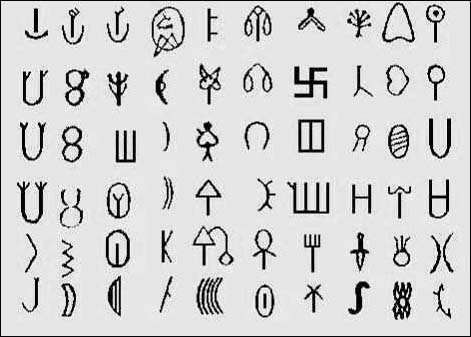
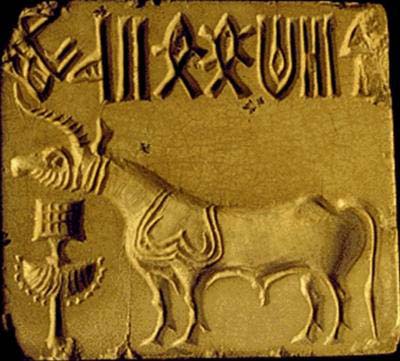
encouraged me to dig a bit deeper and educate myself about the 2009 work of Prof. Rao and his fellow researchers at the University of Washington, which was discussed in the above essay, and how it was received by the scientific community. Posting my notes from some googling and research.


pictures link.
1. The Witzel-Farmer tag team's response was predictably condescending: discredit, going so far as to blast the journal for publishing what they felt was a phoney paper. There was hint of panic in their response which was framed almost immediately after Rao et al.'s work was published. Basically, they had a monopoly on such matters, and Rao's work shook their conclusions in a different way.
2. Rao et al.'s work has since spawned a sequence of counter and counter-counter papers by pro-language and anti-language groups. Here are two recent rebuttals (2010, pro), and a more recent one by the anti group (2013). We have a bit of a stalemate, which is not a bad thing, given how skewed the original scenario was.
3. The pro-group's publications rely on Shannon's work in information theory to calculate conditional entropy (as well as examining higher order of 'block' entropy) and bring into play other related mathematical laws to show that the probability of Indus script being a language has increased. They also counter the criticism that the briefness of texts is not conclusive ("absence of evidence is not evidence of absence", in their words).
Basically, these statistical models can tells us if there is just the right balance between order (low CE) and chaos (high CE) in the data. For example in English, if u fix 'Q', then probability of any other letter other than 'U' occurring after that is 0 (inflexible). However, if u fix 'Z', then there are multiple possibilities, but not all other 25 letters in the alphabet can occur next. Thus with language, there is some flexibility, but also some constraints on the sequences (pairs of letters at the simplest level) that can be constructed. CE is one of the metrics that captures this.
Data sets that exhibit too much order or too much chaos can most likely be rejected as non-languages. The Indus script passed the 'null hypothesis' test pretty well, while also exhibiting more helpful statistical properties that increase the chances of it being a language (by comparing the CE with other language and non-language data). This is why Rao's work got attention and was deemed worthy of publication. I read the whole thing and saw no hanky-panky.
(By the way, isn't this balance in language another beautiful illustration of Rajiv Malhotra's order-chaos concept?)
4. The anti-group's claims (and there are a few groups now, who appear to be more science-driven compared to Witzel-Farmer) was that such entropic methods can't conclusively discriminate between linguistic and non-linguistic data, and came up with their own data sets and conclusions. Then the pro-group came up with improved metrics, more data, to show stronger results in favor of the Indus script. However, what may be revealing is that the anti-group after lots of pages of scientific rebuttal (Jan 2013) invariably return to the 'curb appeal' argument: "Forget all the complex math. This is simple. Just look at it. The messages are too brief, so it can't be a language."
The evidence listed in Vikas' CRI essay, combined with the Witzel-Farmer duo's bad habit of mixing prejudice with science/math hurts the anti-group cause. Witzel doesn't do much of Sanskrit at Harvard now-a-days and was last seen hosting dead-beat Marxist seminars with sepoy Angana Chatterji, after she was fired from her previous academic job.
5. My own opinion is that the Hinduphobia of Witzel & co. caused them to reach a premature and gleeful conclusion a decade ago that our old desi ancestors were mass-illiterates. Rao et al.'s systematic work and improvements to their methods since 2009, *when taken together* with lots of other independent supporting material mentioned in the CRI essay has tilted the balance, and certainly given the Indus script theory another boost. Their opposition is working hard to come up with responses that out-think or at least, out-number the pro-group's output. What is clear is that a multi-disciplinary approach can be very useful in solving such problems.
This is not over yet in the minds of many in the west, but at least the playing field if a bit more level, though still loaded against India (thanks to Indian Gov's continued and bizarre acceptance of the now-discredited AIT). What is sad is that much of the publicized work is happening in western universities and not as much in India (though some is happening in TIFR, Chennai, etc.), whose heritage is the subject of the debate. Hopefully the next Indian government will not neglect the importance of such research, and increase funding for such worthwhile projects and staff them based on merit.
The fascinating CRI article by Vikas Saraswat
"Indus Script: The no script theory is a non-starter"
encouraged me to dig a bit deeper and educate myself about the 2009 work of Prof. Rao and his fellow researchers at the University of Washington, which was discussed in the above essay, and how it was received by the scientific community. Posting my notes from some googling and research.
pictures link.
1. The Witzel-Farmer tag team's response was predictably condescending: discredit, going so far as to blast the journal for publishing what they felt was a phoney paper. There was hint of panic in their response which was framed almost immediately after Rao et al.'s work was published. Basically, they had a monopoly on such matters, and Rao's work shook their conclusions in a different way.
2. Rao et al.'s work has since spawned a sequence of counter and counter-counter papers by pro-language and anti-language groups. Here are two recent rebuttals (2010, pro), and a more recent one by the anti group (2013). We have a bit of a stalemate, which is not a bad thing, given how skewed the original scenario was.
3. The pro-group's publications rely on Shannon's work in information theory to calculate conditional entropy (as well as examining higher order of 'block' entropy) and bring into play other related mathematical laws to show that the probability of Indus script being a language has increased. They also counter the criticism that the briefness of texts is not conclusive ("absence of evidence is not evidence of absence", in their words).
Basically, these statistical models can tells us if there is just the right balance between order (low CE) and chaos (high CE) in the data. For example in English, if u fix 'Q', then probability of any other letter other than 'U' occurring after that is 0 (inflexible). However, if u fix 'Z', then there are multiple possibilities, but not all other 25 letters in the alphabet can occur next. Thus with language, there is some flexibility, but also some constraints on the sequences (pairs of letters at the simplest level) that can be constructed. CE is one of the metrics that captures this.
Data sets that exhibit too much order or too much chaos can most likely be rejected as non-languages. The Indus script passed the 'null hypothesis' test pretty well, while also exhibiting more helpful statistical properties that increase the chances of it being a language (by comparing the CE with other language and non-language data). This is why Rao's work got attention and was deemed worthy of publication. I read the whole thing and saw no hanky-panky.
(By the way, isn't this balance in language another beautiful illustration of Rajiv Malhotra's order-chaos concept?)
4. The anti-group's claims (and there are a few groups now, who appear to be more science-driven compared to Witzel-Farmer) was that such entropic methods can't conclusively discriminate between linguistic and non-linguistic data, and came up with their own data sets and conclusions. Then the pro-group came up with improved metrics, more data, to show stronger results in favor of the Indus script. However, what may be revealing is that the anti-group after lots of pages of scientific rebuttal (Jan 2013) invariably return to the 'curb appeal' argument: "Forget all the complex math. This is simple. Just look at it. The messages are too brief, so it can't be a language."
The evidence listed in Vikas' CRI essay, combined with the Witzel-Farmer duo's bad habit of mixing prejudice with science/math hurts the anti-group cause. Witzel doesn't do much of Sanskrit at Harvard now-a-days and was last seen hosting dead-beat Marxist seminars with sepoy Angana Chatterji, after she was fired from her previous academic job.
5. My own opinion is that the Hinduphobia of Witzel & co. caused them to reach a premature and gleeful conclusion a decade ago that our old desi ancestors were mass-illiterates. Rao et al.'s systematic work and improvements to their methods since 2009, *when taken together* with lots of other independent supporting material mentioned in the CRI essay has tilted the balance, and certainly given the Indus script theory another boost. Their opposition is working hard to come up with responses that out-think or at least, out-number the pro-group's output. What is clear is that a multi-disciplinary approach can be very useful in solving such problems.
This is not over yet in the minds of many in the west, but at least the playing field if a bit more level, though still loaded against India (thanks to Indian Gov's continued and bizarre acceptance of the now-discredited AIT). What is sad is that much of the publicized work is happening in western universities and not as much in India (though some is happening in TIFR, Chennai, etc.), whose heritage is the subject of the debate. Hopefully the next Indian government will not neglect the importance of such research, and increase funding for such worthwhile projects and staff them based on merit.
Monday, December 23, 2013
Digestion of Hinduism: Inside the American Veda
The first part of my notes-to-self covered my interpretation of digestion, a term coined by Rajiv Malhotra. This lead to an active twitter debate that led to many questions, mostly centered around Phil Goldberg's 'American Veda', which was previously critiqued elsewhere as facilitating digestion, and a stand which I support. I fact, I have found that AV does a lot more than that. It also directly digests and misrepresents Hinduism, and celebrates the digestion of Hinduism, perhaps unintentionally. This second set of notes will add more substance and take some of those follow-up questions as a starting point.
Throughout these posts, the emphasis in bold/underline/quotes are mine. Often direct quotes are italicized. Let me state upfront that I admire Goldberg's candid admissions. I believe he is Jewish, and therefore does not proselytize. This is my critique of his work, as well as the other interviews and articles he has written. There are places in the book AV where he even agrees that Indian methods and dharmic ideas have been misappropriated. But his disappointing response is to kick the can down the road to the Hindu advocacy groups to deal with the Hindu image issue, and washes his hands off, i.e. 'it is not my problem'. Fair enough. He is not Hindu, and this book is not about Hinduism. AV is a book written by the west, of the west, and for the west. Hindus and Hinduism are but props in the AV stage.
[update Dec 23: typos fixed]
Cover Page
American Veda: How Indian Spirituality Changed the West

American Veda and Indian spirituality implies that Hindu religious concepts are tied to a geography. There is no call-out in the book of the universal truth claims of Karma and Punar Janma of Hinduism and the universality of dharma - the latter is the single-most important thing, in my opinion, a Hindu reader should look for in such books: Ask what is the status of dharma in the book? It is totally ignored in the title. The title suggests that the book starts with some fuzzy "spirituality" from India toward building a new American Veda suitable for western consumption without the stench of Hinduism's caste, cows, and curry.
Strong words? read on and make up your own mind.
Foreword by Huston Smith
Who is this Huston Smith and why did Goldberg pick him to write the foreword?
He's described a 90+ year old "rock star of religions". My ignorance. I never heard of this chap, so I looked him up. Here are some interesting snippets.
"Smith was born in 1919 in China, where his parents were Christian missionaries...."
Smith: "... "I happen to be a Christian. I was brought up and drenched in that," he said. "I am very orthodox in thinking that Jesus acted in his life the way God would have acted if God had assumed human form... I think that God imploded, like a spiritual big bang, to launch the eight civilizations that make up recorded history and the religions in those civilizations.""
Zero connection with dharma so far, but we see Mr. Smith clearly state where his roots are: History-centric Christianity.
Here's the Wikipedia entry on his religious practice that examines other religions (including, and in particular, Hindu Vedanta) for many years, he returning to his Christian roots to write this book:
"The Soul of Christianity: Restoring the Great Tradition"
Here's an Amazon.com blurb on what this restored Christianity looks like:
"... "I have tried to describe a Christianity which is fully compatible with everything we now know, and to indicate why Christians feel privileged to give their lives to it."
—Huston Smith
.... In his most personal and passionate book on the spiritual life, renowned author, scholar, and teacher of world religions Huston Smith turns to his own life-long religion, Christianity....Smith cuts through these to describe Christianity's "Great Tradition," the common faith of the first millennium of believers, which is the trunk of the tree from which Christianity's many branches, twigs, and leaves have grown. This is not the exclusivist Christianity of strict fundamentalists, nor the liberal, watered-down Christianity practiced by many contemporary churchgoers..."
Right in the introductory pages available for free at Amazon.com, you can clearly see Smith states that he visited India may times and learnt of "dharma" before proceeding to digest Dharma into the Christian notion. His exact words on how he redefines dharma: "It is the duty that God has imposed on me". Being a Christian, he is of course referring to a monotheist God who is a task-master. The meaning of dharma has been totally inverted. This is the abysmal level of scholarship and mis-translation of Sanskrit, which we see in other chapters of the AV book too.
In the first chapter of Smith's book, after the introduction, Smith talks of his new Christian world view, where the very first set of paragraphs attempts to mangle the dharmic idea of "Purna" made famous by the famous Shloka. Next, tackles at causation (related to Karma...), at which point I cried halt. The foreword to AV cites a single verse from the Christian bible where false equivalences for Bhakti, Jnana, and Karma is given! Rock star.
Foreword writers are deliberately and carefully chosen, and usually for deep reasons. AV's foreword writer is a famous and devout Christian, the son of two devoted missionaries who studied Vedanta for long, and visited India several times, and ultimately used this information, not to become Hindu or dharmic, but to repair and re-invent an improved Christianity for the west using digested versions of Hindu concepts.
This is how American Veda begins and ends. This is the template.
Theme of American Veda
Goldberg is sincere westerner who is looking to improving the condition of his country and repairing their society and religion. To achieve this task, he, like Huston Smith, uses Hinduism as a tool-box containing an useful assortment of nuts and bolts, from which the west can freely select compatible parts to plug the gaping holes in their systems. Chapter after chapter in this book is not about how Hinduism and India benefits from the interaction with the west, but the total opposite. Which begs the question:
If AV is about utilizing bits and pieces of Hindu ideas deleted from their Indian context, and suitably modified to enhance Christianity, Judaism, and western health care, etc., why the heck are the useful Hindu idiots cheering, showcasing, and funding such works? What has India and dharmic systems got in return from the US for this? ZILCH.
Much of American Veda is a biographical celebration of who's who of U-turners and digesters:
Maslow, Bensen, Ken Wilber, Carl Jung, Father Keating, ....
and a bunch of opportunists like Deepak Chopra who have made a lot of money selling faux-Vedantic snake oil to a gullible western audience. This blogpost links to a video lecture of Rajiv Malhotra that walks through an entire list of U-turners and digesters. We won't go into these biographies, even though they make for fascinating and bewildering reading. In this remainder of this part of the self-study, I cover the introduction and the first chapter of AV, focusing on Goldberg's own words and annotations. I highlight just a few of the many gaping holes in this book that makes a mockery of dharmic concepts and try to point out how these mangled ideas facilitate digestion.
For more background and context on American Veda and Phil Goldberg, readers can read this blog: digestingveda.blogspot.in. We owe the writer a thanks.
Chapter - Introduction
1. Here, PG starts off providing a list of excuses about why he has not used Hinduism in the title. Clearly, he is aware this would become an issue. Some reasons include:
a. "people will misconstrue the nature of this book". (Exactly how?)
b. [Opportunistic] gurus who came to the west said they were not preaching Hinduism (so?)
c. Yoga and Vedanta do not have to be viewed religiously at all ...
2. As far as Buddhism, he equates the Buddha to Jesus as a reformer. I would seriously contest this as another false equivalence, but some other day. This book does not credit Buddhism in the cover either. Of Jainism or Sikhism, I could find no mention.
3. He calls Yoga and Vedanta, India's major export. Despite that, India has not seen one dollar in returns yet!
4. He finds India's epic 'tales' of Ramayana and Mahabharata to be rich in 'magic and mystery', and makes the Iliad and Odyssey look like short stories.
5. Page 10:
Goldberg offers us this gem: infinite divine can be called Allah, Lord, or Brahman, which is justified citing 'Ekam sat Vipraha bahudha vadanti'.
Shockingly poor scholarship fills the American Veda. Goldberg is honest enough to concede that he is not confident about the completeness of the translation of the Vedantic principles he cites by adding caveats such as "does not pretend to do justice to Vedanta...". What can we be sure of in AV then?
The above reasoning is a distortion of Hinduism, designed to propagate the myth of sameness. Doing so allows him to move on to his next, and by far, most serious error, which opens the door to wholesale digestion.
6. On Page 11, Goldberg claims:
"Vedantic principles are accompanied by Vedic concepts of Karma.... and reincarnation. Most applications of Vedanta-Yoga do not require these supplementary ideas, and ordinary practitioners in the west do not necessarily believe in them"
Supplementary ideas?!
Karma (cause and effect) and Punar Janma (Reincarnation) are central and fundamental truth-claims of dharmic thought system. Hinduism (and its pluralism of manifestations), Sikhs, Jains, and Buddhists subscribe to this. These dharmic fundamentals are precisely the ones that the Judeo-Christian system is incompatible with, and this is also exactly why Goldberg has deliberately brushed them aside as unimportant waste material that can be rejected! Once we get rid of these crucial dharmic elements, the mutilated remainder of the Hindu concepts can be digested into JC systems, without hurting their history-centric dogma. This is exactly what was stated in part-1. In Philip Goldberg's own words, we have clear evidence of digestion being facilitated.
7. On the same page, PG favorably compares Vedanta to perennialism. Rajiv Malhotra has previously stated that "The whole Perennial Philosophy is merely stage-2 of the uturn." AV systematically glorifies (as Rajiv Malhotra put it) these so-called western pioneers, who in reality, just reassembled and repackaged many of the original ideas from dharmic systems.
8. In Page 12, he says "whether it's a falafel or philosophy, Americans embrace foreign products when the circumstances are right, and conditions in the United States were right for Vedanta-Yoga from the start"
Falafel. Vedanta-Yoga. foreign product (!)
Wow, such reverence and seriousness.
This is the author that Ms. Nirmala Seetharaman's foundation found worthy enough to invite for a talk, and for RSS to promote? that certain Sanathana Dharma institutions showered money on?
These are just the first few pages. Toward the end of the book, there are sections where it appears like Goldberg is practically showing Padres/Rabbis how such digested Vedanta-Yoga' can improve the situation in their church and synagogue without impacting their central dogma. He also does this in a Huffington Post article. Indeed as early as page 23-24, Goldberg very honestly states his intentions. Indeed, AV is a very honest book. I'm sure PG believes in his mind that he's doing a lot of good.
9. In his own words, we can find the real reason for deleting Hinduism/Buddhism/Sikhism/Jainism from this book:
"This [book] is not a threat to Western religions; Americans are not about to abandon their churches, synagogues, and mosques, for Hindu temples. Figures of Shiva and Krishna will not replace crosses in American homes."
It is very, very clear. Hinduism has NO role in this book, and he sees no role for Hinduism in American homes. He is seeking not to replace dogmatic Judeo-christian ideology with dharmic ideas as many gullible Hindus believe. Instead, he is seeking to complement and solidify the existing dogma with a digested Hindu layer. This is precisely what was mentioned in part 1. In his own words, we have the evidence of the outcome of digestion. Once this happens, this enhanced Christianity can be re-exported to India. Conversion in India will be a piece of cake. This is what India gains from digestion.
Still not convinced? then read further ...
"Exposure to eastern spirituality is more likely to strengthen a person's relationship to his or her native religion than to destroy it".
Goldberg has gone out of his way to calm his western audience and his publishers. This book is not about bringing dharma to replace dogma. This is about making Judeo-Christianity stronger to stem the flow of disenchanted members out of their system.
I could go on. There are nearly 400 pages in this book, and I have covered less than 25 in this post since I do not have a digital copy to expedite this work. There are more fallacies and errors to point out, but that will take up a lot of space and is left as an exercise to the reader. I will however add one final point on the comments that Goldberg makes in page 292, to illustrate the kind of lame arguments used to justify digestion.
"One physician told me "But replacing the the orange robe with a white lab coat opens it up to a lot more people". So does calling meditation a stress-reduction technique, not a sadhana for achieving moksha. We will never know how many heart attacks were prevented, or how many millions of pills were not taken, because of that decision.
There is another place in the book where a false argument of "Indian philosophy versus Western science" argument is given. Digestion of Yoga into all these medical buzzwords is justified since it gives these methods the requisite "scientific legitimacy". Mr. Goldberg: Indians, Tibetans, Sri Lankans, Indonesians, and many millions in Asia (not just India) for centuries benefited scientifically from Yoga, without having to mutilate Yoga and delete moksha, and did not require white lab coats to "make it look" scientific. It always was scientific, and dharmic religions have never been in conflict with science. This silly justification insults intelligence.
Conclusion and Summary
Based on my study, I personally find American Veda to be a mediocre and error-ridden piece of work that directly enables, and also (perhaps inadvertently) celebrates digestion while moving toward a goal of ensuring that western society derives maximum benefits from the Hindu toolbox, taking what it deems to be compatible and useful (dharma-nirpeksha stuff), and discarding the rest.
Digestion is not an end-goal. It is not easy to spot unless you examine the end-state of the Hindu concept being appropriated. It is merely a means to an end. Usually, that end-goal is to preserve and enhance Western religion. The primary goal is neither to harm or help the cause of dharma. Rather they are indifferent to it. Impact on Hinduism and dharma is collateral damage, which authors may express regret about, but is not really their concern.
It's time we stop celebrating every new and shiny piece of work that comes of the west just because it is superficially favorable to Hinduism. That's a symptom of mental colonization. Let's first fund and support those among our own who are busting their backs coming up with high-quality work. Being brown should not be a disqualification.
Throughout these posts, the emphasis in bold/underline/quotes are mine. Often direct quotes are italicized. Let me state upfront that I admire Goldberg's candid admissions. I believe he is Jewish, and therefore does not proselytize. This is my critique of his work, as well as the other interviews and articles he has written. There are places in the book AV where he even agrees that Indian methods and dharmic ideas have been misappropriated. But his disappointing response is to kick the can down the road to the Hindu advocacy groups to deal with the Hindu image issue, and washes his hands off, i.e. 'it is not my problem'. Fair enough. He is not Hindu, and this book is not about Hinduism. AV is a book written by the west, of the west, and for the west. Hindus and Hinduism are but props in the AV stage.
[update Dec 23: typos fixed]
Cover Page
American Veda: How Indian Spirituality Changed the West

American Veda and Indian spirituality implies that Hindu religious concepts are tied to a geography. There is no call-out in the book of the universal truth claims of Karma and Punar Janma of Hinduism and the universality of dharma - the latter is the single-most important thing, in my opinion, a Hindu reader should look for in such books: Ask what is the status of dharma in the book? It is totally ignored in the title. The title suggests that the book starts with some fuzzy "spirituality" from India toward building a new American Veda suitable for western consumption without the stench of Hinduism's caste, cows, and curry.
Strong words? read on and make up your own mind.
Foreword by Huston Smith
Who is this Huston Smith and why did Goldberg pick him to write the foreword?
He's described a 90+ year old "rock star of religions". My ignorance. I never heard of this chap, so I looked him up. Here are some interesting snippets.
"Smith was born in 1919 in China, where his parents were Christian missionaries...."
Smith: "... "I happen to be a Christian. I was brought up and drenched in that," he said. "I am very orthodox in thinking that Jesus acted in his life the way God would have acted if God had assumed human form... I think that God imploded, like a spiritual big bang, to launch the eight civilizations that make up recorded history and the religions in those civilizations.""
Zero connection with dharma so far, but we see Mr. Smith clearly state where his roots are: History-centric Christianity.
Here's the Wikipedia entry on his religious practice that examines other religions (including, and in particular, Hindu Vedanta) for many years, he returning to his Christian roots to write this book:
"The Soul of Christianity: Restoring the Great Tradition"
Here's an Amazon.com blurb on what this restored Christianity looks like:
"... "I have tried to describe a Christianity which is fully compatible with everything we now know, and to indicate why Christians feel privileged to give their lives to it."
—Huston Smith
.... In his most personal and passionate book on the spiritual life, renowned author, scholar, and teacher of world religions Huston Smith turns to his own life-long religion, Christianity....Smith cuts through these to describe Christianity's "Great Tradition," the common faith of the first millennium of believers, which is the trunk of the tree from which Christianity's many branches, twigs, and leaves have grown. This is not the exclusivist Christianity of strict fundamentalists, nor the liberal, watered-down Christianity practiced by many contemporary churchgoers..."
Right in the introductory pages available for free at Amazon.com, you can clearly see Smith states that he visited India may times and learnt of "dharma" before proceeding to digest Dharma into the Christian notion. His exact words on how he redefines dharma: "It is the duty that God has imposed on me". Being a Christian, he is of course referring to a monotheist God who is a task-master. The meaning of dharma has been totally inverted. This is the abysmal level of scholarship and mis-translation of Sanskrit, which we see in other chapters of the AV book too.
In the first chapter of Smith's book, after the introduction, Smith talks of his new Christian world view, where the very first set of paragraphs attempts to mangle the dharmic idea of "Purna" made famous by the famous Shloka. Next, tackles at causation (related to Karma...), at which point I cried halt. The foreword to AV cites a single verse from the Christian bible where false equivalences for Bhakti, Jnana, and Karma is given! Rock star.
Foreword writers are deliberately and carefully chosen, and usually for deep reasons. AV's foreword writer is a famous and devout Christian, the son of two devoted missionaries who studied Vedanta for long, and visited India several times, and ultimately used this information, not to become Hindu or dharmic, but to repair and re-invent an improved Christianity for the west using digested versions of Hindu concepts.
This is how American Veda begins and ends. This is the template.
Theme of American Veda
Goldberg is sincere westerner who is looking to improving the condition of his country and repairing their society and religion. To achieve this task, he, like Huston Smith, uses Hinduism as a tool-box containing an useful assortment of nuts and bolts, from which the west can freely select compatible parts to plug the gaping holes in their systems. Chapter after chapter in this book is not about how Hinduism and India benefits from the interaction with the west, but the total opposite. Which begs the question:
If AV is about utilizing bits and pieces of Hindu ideas deleted from their Indian context, and suitably modified to enhance Christianity, Judaism, and western health care, etc., why the heck are the useful Hindu idiots cheering, showcasing, and funding such works? What has India and dharmic systems got in return from the US for this? ZILCH.
Much of American Veda is a biographical celebration of who's who of U-turners and digesters:
Maslow, Bensen, Ken Wilber, Carl Jung, Father Keating, ....
and a bunch of opportunists like Deepak Chopra who have made a lot of money selling faux-Vedantic snake oil to a gullible western audience. This blogpost links to a video lecture of Rajiv Malhotra that walks through an entire list of U-turners and digesters. We won't go into these biographies, even though they make for fascinating and bewildering reading. In this remainder of this part of the self-study, I cover the introduction and the first chapter of AV, focusing on Goldberg's own words and annotations. I highlight just a few of the many gaping holes in this book that makes a mockery of dharmic concepts and try to point out how these mangled ideas facilitate digestion.
For more background and context on American Veda and Phil Goldberg, readers can read this blog: digestingveda.blogspot.in. We owe the writer a thanks.
Chapter - Introduction
1. Here, PG starts off providing a list of excuses about why he has not used Hinduism in the title. Clearly, he is aware this would become an issue. Some reasons include:
a. "people will misconstrue the nature of this book". (Exactly how?)
b. [Opportunistic] gurus who came to the west said they were not preaching Hinduism (so?)
c. Yoga and Vedanta do not have to be viewed religiously at all ...
2. As far as Buddhism, he equates the Buddha to Jesus as a reformer. I would seriously contest this as another false equivalence, but some other day. This book does not credit Buddhism in the cover either. Of Jainism or Sikhism, I could find no mention.
3. He calls Yoga and Vedanta, India's major export. Despite that, India has not seen one dollar in returns yet!
4. He finds India's epic 'tales' of Ramayana and Mahabharata to be rich in 'magic and mystery', and makes the Iliad and Odyssey look like short stories.
5. Page 10:
Goldberg offers us this gem: infinite divine can be called Allah, Lord, or Brahman, which is justified citing 'Ekam sat Vipraha bahudha vadanti'.
Shockingly poor scholarship fills the American Veda. Goldberg is honest enough to concede that he is not confident about the completeness of the translation of the Vedantic principles he cites by adding caveats such as "does not pretend to do justice to Vedanta...". What can we be sure of in AV then?
The above reasoning is a distortion of Hinduism, designed to propagate the myth of sameness. Doing so allows him to move on to his next, and by far, most serious error, which opens the door to wholesale digestion.
6. On Page 11, Goldberg claims:
"Vedantic principles are accompanied by Vedic concepts of Karma.... and reincarnation. Most applications of Vedanta-Yoga do not require these supplementary ideas, and ordinary practitioners in the west do not necessarily believe in them"
Supplementary ideas?!
Karma (cause and effect) and Punar Janma (Reincarnation) are central and fundamental truth-claims of dharmic thought system. Hinduism (and its pluralism of manifestations), Sikhs, Jains, and Buddhists subscribe to this. These dharmic fundamentals are precisely the ones that the Judeo-Christian system is incompatible with, and this is also exactly why Goldberg has deliberately brushed them aside as unimportant waste material that can be rejected! Once we get rid of these crucial dharmic elements, the mutilated remainder of the Hindu concepts can be digested into JC systems, without hurting their history-centric dogma. This is exactly what was stated in part-1. In Philip Goldberg's own words, we have clear evidence of digestion being facilitated.
7. On the same page, PG favorably compares Vedanta to perennialism. Rajiv Malhotra has previously stated that "The whole Perennial Philosophy is merely stage-2 of the uturn." AV systematically glorifies (as Rajiv Malhotra put it) these so-called western pioneers, who in reality, just reassembled and repackaged many of the original ideas from dharmic systems.
8. In Page 12, he says "whether it's a falafel or philosophy, Americans embrace foreign products when the circumstances are right, and conditions in the United States were right for Vedanta-Yoga from the start"
Falafel. Vedanta-Yoga. foreign product (!)
Wow, such reverence and seriousness.
This is the author that Ms. Nirmala Seetharaman's foundation found worthy enough to invite for a talk, and for RSS to promote? that certain Sanathana Dharma institutions showered money on?
These are just the first few pages. Toward the end of the book, there are sections where it appears like Goldberg is practically showing Padres/Rabbis how such digested Vedanta-Yoga' can improve the situation in their church and synagogue without impacting their central dogma. He also does this in a Huffington Post article. Indeed as early as page 23-24, Goldberg very honestly states his intentions. Indeed, AV is a very honest book. I'm sure PG believes in his mind that he's doing a lot of good.
9. In his own words, we can find the real reason for deleting Hinduism/Buddhism/Sikhism/Jainism from this book:
"This [book] is not a threat to Western religions; Americans are not about to abandon their churches, synagogues, and mosques, for Hindu temples. Figures of Shiva and Krishna will not replace crosses in American homes."
It is very, very clear. Hinduism has NO role in this book, and he sees no role for Hinduism in American homes. He is seeking not to replace dogmatic Judeo-christian ideology with dharmic ideas as many gullible Hindus believe. Instead, he is seeking to complement and solidify the existing dogma with a digested Hindu layer. This is precisely what was mentioned in part 1. In his own words, we have the evidence of the outcome of digestion. Once this happens, this enhanced Christianity can be re-exported to India. Conversion in India will be a piece of cake. This is what India gains from digestion.
Still not convinced? then read further ...
"Exposure to eastern spirituality is more likely to strengthen a person's relationship to his or her native religion than to destroy it".
Goldberg has gone out of his way to calm his western audience and his publishers. This book is not about bringing dharma to replace dogma. This is about making Judeo-Christianity stronger to stem the flow of disenchanted members out of their system.
I could go on. There are nearly 400 pages in this book, and I have covered less than 25 in this post since I do not have a digital copy to expedite this work. There are more fallacies and errors to point out, but that will take up a lot of space and is left as an exercise to the reader. I will however add one final point on the comments that Goldberg makes in page 292, to illustrate the kind of lame arguments used to justify digestion.
"One physician told me "But replacing the the orange robe with a white lab coat opens it up to a lot more people". So does calling meditation a stress-reduction technique, not a sadhana for achieving moksha. We will never know how many heart attacks were prevented, or how many millions of pills were not taken, because of that decision.
There is another place in the book where a false argument of "Indian philosophy versus Western science" argument is given. Digestion of Yoga into all these medical buzzwords is justified since it gives these methods the requisite "scientific legitimacy". Mr. Goldberg: Indians, Tibetans, Sri Lankans, Indonesians, and many millions in Asia (not just India) for centuries benefited scientifically from Yoga, without having to mutilate Yoga and delete moksha, and did not require white lab coats to "make it look" scientific. It always was scientific, and dharmic religions have never been in conflict with science. This silly justification insults intelligence.
Conclusion and Summary
Based on my study, I personally find American Veda to be a mediocre and error-ridden piece of work that directly enables, and also (perhaps inadvertently) celebrates digestion while moving toward a goal of ensuring that western society derives maximum benefits from the Hindu toolbox, taking what it deems to be compatible and useful (dharma-nirpeksha stuff), and discarding the rest.
Digestion is not an end-goal. It is not easy to spot unless you examine the end-state of the Hindu concept being appropriated. It is merely a means to an end. Usually, that end-goal is to preserve and enhance Western religion. The primary goal is neither to harm or help the cause of dharma. Rather they are indifferent to it. Impact on Hinduism and dharma is collateral damage, which authors may express regret about, but is not really their concern.
It's time we stop celebrating every new and shiny piece of work that comes of the west just because it is superficially favorable to Hinduism. That's a symptom of mental colonization. Let's first fund and support those among our own who are busting their backs coming up with high-quality work. Being brown should not be a disqualification.
Subscribe to:
Posts (Atom)