Some rambling thoughts that arose from informal discussions with some engineering and B-school professors from universities around the globe...
The crusades aren't really over. The skirmishes are quite clear. A Syria here, an Iraq there, a Pakistan somewhere else. In response, a 9-11 here, a Kenya mall quiz there... World domination is a ludicrous movie theme that never goes out of fashion.The contemporary crusade is couched in modern language and subterfuge, but at the end of the day, it is still a Pax Romana versus Dhimmicracy, where dharmic peoples are expendable. A Darwinian battle between two history-centric systems. China may seem to be making it a tri-cornered fight, but really, it is being digested by the former, what with their huge underground church movement.
Which really leaves us with the pluralistic, dharmic Indian systems as the only viable, scientific and sustainable alternatives. As it has invariably been since forever. As the battle between these two Tamassic park dinosaurs begins to overflow into India, enter: India's secularist sepoys. A bunch of English-speaking Desi Don Quixotes and Def Sufi poets. Conquering heroes in the battle of futility fought and won entirely against vast strawmen armies, sailing their battleships through storms in many a teacup. Oblivious to data-driven methods, unhindered by fact, these dharma-illiterates remain supremely confident in their theoretical ability to alter the center of mass from within a closed physical system, despite failing in every single experiment. The more opportunistic sepoys get rewarded and graduate into prize idiots, while their subalterns remain content as intellectual coolies for either side. Satyam eva Jayate in the long run, but in the short term, secular Mithya rules the roost in India.
Updated October 28
The blasts in Bihar during the Hunkaar political rally that killed many innocent civilians, is a gentle reminder from sepoys for their fellow Indians to renew their membership of (Pax Romana + Dhimmicracy) and not strive for dharma based governance.
Monday, October 14, 2013

Wednesday, October 2, 2013
Transcription of Narendra Modi's IAA talk
I found Modi's IAA speech (marketing India to the world) yesterday quite remarkable in terms of the original Indian ideas it contained - thoughts that went beyond rhetoric and deeply substantial, in sync with some Rajiv Malhotra's novel ideas in his book 'Being Different' that Rajiv has also explained via his videos. I've tried to transcribe some of his observations into English to the best of my ability with some limited annotation (words in italics)
Why he attended this event
Modi: I could not escape attending this event because of Swami Dayanand Saraswati and Swami's father (aged around 90?). His father used to work and scrutinize each issue and I observed how there are different angles of examining the same issue.
Colonized Mindset
There are many topics where we have our own personal problem entangled, and because of this, 'Brand-India' is not displayed to the world with any strength of conviction. The first requirement for being able to so is self-belief and self-confidence. If you are taking an product or topic to the world, but you don't believe in it yourself, then you just cannot do it. After 1200 years of slavery, we Indians have developed just a colonized mindset, that when we find a white man, a six-footer, who rattles off English vocabulary, we retreat into our shell. Consequently, even after 60 years of independence, haven't been able to overcome this problem.
Gandhi
There are some things that have symbolic value. Everything has symbolic value that opens door, and the belief you have in this symbolic value is crucial. You may find great orators and speakers who deliver nice lines, but communicators are few. In the last century, the greatest communicator was Mahatma Gandhi. In this world where people resort to shortcuts (cutting corners), the focus is on impressive marketing. We have a choice. whether to go with inspiring marketing or impressive marketing. If you look at Gandhi's personality, there was nothing "impressive" about him, but was truly inspiring in totality. Simply dressed, humble-living. He talked about Ahimsa, but carried a stick. Today's world hasn't paid much attention to this communication of contrast. He did not wear a cap, but many wear the Gandhi cap! What strength!
In those days, there was little media coverage. extremely tough to transmit information. Gandhi's words, spirit, without any dilution, diversion, or loss in translation, reached every last person. Friends, such communicating skills are rare, but on this point, nobody in marketing has written a book on this topic. Please form a committee, and next year, please research and launch a book "Gandhi, the great communicator". it must become a case study for world top universities. This also means that branding of India has also been accomplished! This is how its done. Even today, our mental colonization, we talk of Tulsidas as India's Shakespeare, and Sardar Patel as India's Bismarck. Why? It's because of our lack of confidence. We should be saying the reverse (Shakespeare is England's Tulsidas, Germany's Sardar Patel). This is how we must express comparisons, but we have lost our identity.
If we want to talk of a brand India, we have to understand our core competencies, only then can we effectively market our brand. The world knows MLK, but we don't know if the world views Gandhi in a similar manner. When the Gandhi movie was made in the1980s, a publisher friend remarked that all his Gandhi books were sold out after the movie and reprints were required. Friends, Attenborough did a job. If in the last 50 years, for the benefit of humanity, if we presented the values of Gandhi to the world, and force them to think about it, we would not even had to strive for a brand-India, the world's universities would be coming to India searching for Gandhi here.
Global Warming and Environment
The world is abuzz with talk about global warming. When people are in search of something, when they find what is necessary, it is immediately accepted and in marketing u go to the top. The world worries about global warming and searching for solutions. Who worries the most? Those societies who most exploited nature the most. Those who most toyed with nature and today, are the champions in the fight against global warming. Winning Nobel prizes (as a society)! We are the people, whose nature, whose Sanskriti and cultural heritage if protected and popularized, can convince the world that we have the best answer to global warming. We don't have that confidence. Ganga did not get polluted as long as it was considered Mother Ganga. Once it was viewed as some H20, the degradation began. Our ancestors called it 'mother', plants were called 'Paramatma' (highest souls) so trees were not cut, living in harmony with nature. People mocked us for worshiping trees, cows, and rivers, and labeled us 'backward' We believed this criticism and began to destroy our natural heritage. Today the world talks about protecting the environment, while we received this as a cultural treasure. Gandhiji would pour back half a glass of Sabarmati water because that was what he wanted. Nothing more. No exploitation or milking of nature. Such lofty ideals and vision our ancestors had, and the world desperately seeks a solution to global warming. With such ideas for brand India, via these ideas, with a scientific approach, and keeping with modern terminology and presentation, move forward.
Heritage Sites and Tourism
In the world of architecture or heritage building, France is well known. Suppose India was as small was France, and all of its monuments and heritages were present in the same space, then we would encounter a heritage building every three steps. Why can't we globally market this heritage? For those in tourism, this can be such a big deal. But for us, this is just some vague building built by some old king. We have the world's oldest port, 5000 year old Lothal, oldest citiy Dholavira. Have we every wondered - how great our ancestors were. If you go to Dholavira, you will surprised to know, 5000 years back, road signs are there! Which means people from other parts of the world must have come there. Did we market this with pride? No. Dholavira had a 5000-sitting capacity stadium for sports. Sports, entertainment, social gathering must have been there 5000 years ago in India! If the world hears about this, they would be most interested in visiting. We must have faith in our cultural heritage and values.
Music and Soft Power
(India's real soft power (not the superficial Bollywood type) is one of the key ideas that Rajiv Malhotra has promoted)
If you just take only music and market it to the world, then we can give a lot, which doesn't even know that the 5am music is different from the music during sunset. The afternoon music is different from that at night. Let them know about this heritage. Did i market this? No. Dance, Drama .... My ancestors gave me this heritage that I haven't presented to the world. Even when our kings were fighting, the world was not running on military power or economic power, even though that is important, it is soft power that built relationships. History is witness to this. Two potentially warring kings ceased hostility when a sister of one king tied a Rakhi to the other king. This is an example of soft power. We are more rich in soft power than any other country in the world. The power of music is immense. Why are people united by music? You must have attended concerts too. Music is not just meant for the ear. It is tied to the mind and heart. If you listen to an hour of loud western music, take a break, and then listen to an hour of any original Indian music with rhythms. Western music enthralls the body, but Indian music deeply influences the heart and mind. Impact on bodily senses is shortlived joy. The joy that reaches the mind can even be Chiranjeev (eternal). The difference between western and Indian music is just as wide as listening to mighty ocean waves, versus listening to a small stream. Have we branded this? No.
Yoga
(Rajiv mentions this is already multi-billion dollar industry and India has missed the boat big-time)
The world is crazy behind Yoga. If you know how to breathe in and breathe out, regardless of how low the rupee falls, dollars will fill your pockets :) There is no bigger market for India's knowledge industry than Yoga. If you ask our govt, why we aren't exporting Yoga, the world is ready to accept it ... We did not brand it. who first taught the world how to breathe in and out are not marketing Yoga. Today is about holistic health and healing. Desperate for it, sick of medical drug based treatment. Such a big market. Have we a brand-India that markets our traditional medicine and treatment approach? Herbal medicine is our ancestral treasure. We performed the world's first surgery! In Mahabharata, Karna was born via genetic science :)) We are pioneers in medicine. What the world desperately seeks, we have. But we need to have belief in ourselves, but we don't have that belief today. During Pandit Nehru's time, there was Haathi commission about marketing Ayurveda. Due to the craze of socialism in those days, there wasn't any emphasis on marketing. The report came out that Ayurveda is fine as far as its substance, but it can only be popularized by improved packaging. Friends, China is #1 in the world in Herbal medicine export, when it OUR ancestral treasure. If we properly package, perform value addition, and brand it, we can market it to the world as traditional food if not medicine, and make it part of a holistic heath care offering and preventive care solutions. The market is ready for this.
Youth and youngsters are committing suicide today all over the world. In such a situation, are there ways to prevent them from taking this extreme step? Our ancient texts and treatises on Yoga, Pranayama, etc. focus on the inner sciences (adhyatma vidya, in Rajiv Malhotra's terminology). We can't sell Taj Mahal to everybody. We can only sell what a person needs. We still haven't progressed beyond Taj!!
Vegetarianism
Vegetarianism is another popular movement today. When Clinton was first elected, I visited the US. Our team visited a hotel in Houston. ... If we are late, we say "this is Indian time, isn't it"? If every Indian says this, insulting India, then how can we do branding of India?? This has to change. So I reached early. The Gujarati person (secretary) there embraced me. I asked why. He said he was vegetarian, and there were many Gujarati veg restaurants. He was proud of it. The world is receptive to it. Have we ever done an Indian food festival? In Japan, our curry is popular. Did you know that Subhash Chandra Bose's brother introduced Indian curry to Japan. This is again our cultural treasure. Not just food travels when we market this properly, the entire Indian identity goes along!
Science and Literature
When we talk about Nobel winners, we talk about Einstein, but not our people. When we talk about literary greats, why do we take the name of some random western guy but not the name of Rabindranath Tagore? To effectively do brand India, we have fill our minds with India. Like the cricket ad that does "i eat, sleep cricket etc', If we do "India, India ...." every moment, then we can do effective branding of India :))
Organic Lifestyle Market
My background is in RSS. There are stories about what we can and cannot do. We cannot do fashion shows it seems. I organized a fashion show. I was sure those who "love" me would call me out. I held it in Porbunder. I know how to create a stir :) Our NIFT/NID students in their campus totally live in their western world, no sign of India whatsoever there. We selected those kids and make them come on the ramp. They liked doing such stuff anyway :) We played Vaishnav Jan song, used Khadi costumes, in Porbunder, on Gandhiji's birthday, with Vinobha Bhave's disciple in the audience - we tried to market Khadi in a fully modern manner. VB's disciple was very impressed. The point is, the world is looking for chemical-free cotton, natural grown cotton. Our Khadi has that strength. The poor get their livelihood from Khadi, but we have limited it to politician's houses. If we make it a global market, it would light the cooking stoves of many poor people in India. Holistic lifestyle seekers would be proud to wear a Khadi that is chemical free and natural, and willing to pay a premium for it. Maybe 10% of our farmers still haven't used pesticides but continued to do natural, traditional organic farming all their life - our people don't know that in the global world, organic food market is massive. (Cow's milk example is given). Our farmers have traditionally done organic farming for centuries. We don't have certification facilities, authorization procedures etc., so we cant create an organic food market. If the farmer can sell his products with organic branding, he can command a premium price in the world market. The point is, from a farmer's livelihood perspective, we can fulfill our vision of Brand-India in a harmonious manner.
(Extempore again) Seeing Kiran ji, i recall that our nation is celebrating 100 years of our film industry. The world's biggest industry that feeds lakhs and crores. But we lost the opportunity to do global marketing. If I could, I would have done a branding of India just via Indian films. But fear not, I'm not entering this world :) But I've talked to (some names) for hours on such topics. We should stop trying to impress the world, but inspire the world. India must be branded properly, and this should be our dream. Thanks.
Why he attended this event
Modi: I could not escape attending this event because of Swami Dayanand Saraswati and Swami's father (aged around 90?). His father used to work and scrutinize each issue and I observed how there are different angles of examining the same issue.
Colonized Mindset
There are many topics where we have our own personal problem entangled, and because of this, 'Brand-India' is not displayed to the world with any strength of conviction. The first requirement for being able to so is self-belief and self-confidence. If you are taking an product or topic to the world, but you don't believe in it yourself, then you just cannot do it. After 1200 years of slavery, we Indians have developed just a colonized mindset, that when we find a white man, a six-footer, who rattles off English vocabulary, we retreat into our shell. Consequently, even after 60 years of independence, haven't been able to overcome this problem.
Gandhi
There are some things that have symbolic value. Everything has symbolic value that opens door, and the belief you have in this symbolic value is crucial. You may find great orators and speakers who deliver nice lines, but communicators are few. In the last century, the greatest communicator was Mahatma Gandhi. In this world where people resort to shortcuts (cutting corners), the focus is on impressive marketing. We have a choice. whether to go with inspiring marketing or impressive marketing. If you look at Gandhi's personality, there was nothing "impressive" about him, but was truly inspiring in totality. Simply dressed, humble-living. He talked about Ahimsa, but carried a stick. Today's world hasn't paid much attention to this communication of contrast. He did not wear a cap, but many wear the Gandhi cap! What strength!
In those days, there was little media coverage. extremely tough to transmit information. Gandhi's words, spirit, without any dilution, diversion, or loss in translation, reached every last person. Friends, such communicating skills are rare, but on this point, nobody in marketing has written a book on this topic. Please form a committee, and next year, please research and launch a book "Gandhi, the great communicator". it must become a case study for world top universities. This also means that branding of India has also been accomplished! This is how its done. Even today, our mental colonization, we talk of Tulsidas as India's Shakespeare, and Sardar Patel as India's Bismarck. Why? It's because of our lack of confidence. We should be saying the reverse (Shakespeare is England's Tulsidas, Germany's Sardar Patel). This is how we must express comparisons, but we have lost our identity.
If we want to talk of a brand India, we have to understand our core competencies, only then can we effectively market our brand. The world knows MLK, but we don't know if the world views Gandhi in a similar manner. When the Gandhi movie was made in the1980s, a publisher friend remarked that all his Gandhi books were sold out after the movie and reprints were required. Friends, Attenborough did a job. If in the last 50 years, for the benefit of humanity, if we presented the values of Gandhi to the world, and force them to think about it, we would not even had to strive for a brand-India, the world's universities would be coming to India searching for Gandhi here.
Global Warming and Environment
The world is abuzz with talk about global warming. When people are in search of something, when they find what is necessary, it is immediately accepted and in marketing u go to the top. The world worries about global warming and searching for solutions. Who worries the most? Those societies who most exploited nature the most. Those who most toyed with nature and today, are the champions in the fight against global warming. Winning Nobel prizes (as a society)! We are the people, whose nature, whose Sanskriti and cultural heritage if protected and popularized, can convince the world that we have the best answer to global warming. We don't have that confidence. Ganga did not get polluted as long as it was considered Mother Ganga. Once it was viewed as some H20, the degradation began. Our ancestors called it 'mother', plants were called 'Paramatma' (highest souls) so trees were not cut, living in harmony with nature. People mocked us for worshiping trees, cows, and rivers, and labeled us 'backward' We believed this criticism and began to destroy our natural heritage. Today the world talks about protecting the environment, while we received this as a cultural treasure. Gandhiji would pour back half a glass of Sabarmati water because that was what he wanted. Nothing more. No exploitation or milking of nature. Such lofty ideals and vision our ancestors had, and the world desperately seeks a solution to global warming. With such ideas for brand India, via these ideas, with a scientific approach, and keeping with modern terminology and presentation, move forward.
Heritage Sites and Tourism
In the world of architecture or heritage building, France is well known. Suppose India was as small was France, and all of its monuments and heritages were present in the same space, then we would encounter a heritage building every three steps. Why can't we globally market this heritage? For those in tourism, this can be such a big deal. But for us, this is just some vague building built by some old king. We have the world's oldest port, 5000 year old Lothal, oldest citiy Dholavira. Have we every wondered - how great our ancestors were. If you go to Dholavira, you will surprised to know, 5000 years back, road signs are there! Which means people from other parts of the world must have come there. Did we market this with pride? No. Dholavira had a 5000-sitting capacity stadium for sports. Sports, entertainment, social gathering must have been there 5000 years ago in India! If the world hears about this, they would be most interested in visiting. We must have faith in our cultural heritage and values.
Music and Soft Power
(India's real soft power (not the superficial Bollywood type) is one of the key ideas that Rajiv Malhotra has promoted)
If you just take only music and market it to the world, then we can give a lot, which doesn't even know that the 5am music is different from the music during sunset. The afternoon music is different from that at night. Let them know about this heritage. Did i market this? No. Dance, Drama .... My ancestors gave me this heritage that I haven't presented to the world. Even when our kings were fighting, the world was not running on military power or economic power, even though that is important, it is soft power that built relationships. History is witness to this. Two potentially warring kings ceased hostility when a sister of one king tied a Rakhi to the other king. This is an example of soft power. We are more rich in soft power than any other country in the world. The power of music is immense. Why are people united by music? You must have attended concerts too. Music is not just meant for the ear. It is tied to the mind and heart. If you listen to an hour of loud western music, take a break, and then listen to an hour of any original Indian music with rhythms. Western music enthralls the body, but Indian music deeply influences the heart and mind. Impact on bodily senses is shortlived joy. The joy that reaches the mind can even be Chiranjeev (eternal). The difference between western and Indian music is just as wide as listening to mighty ocean waves, versus listening to a small stream. Have we branded this? No.
Yoga
(Rajiv mentions this is already multi-billion dollar industry and India has missed the boat big-time)
The world is crazy behind Yoga. If you know how to breathe in and breathe out, regardless of how low the rupee falls, dollars will fill your pockets :) There is no bigger market for India's knowledge industry than Yoga. If you ask our govt, why we aren't exporting Yoga, the world is ready to accept it ... We did not brand it. who first taught the world how to breathe in and out are not marketing Yoga. Today is about holistic health and healing. Desperate for it, sick of medical drug based treatment. Such a big market. Have we a brand-India that markets our traditional medicine and treatment approach? Herbal medicine is our ancestral treasure. We performed the world's first surgery! In Mahabharata, Karna was born via genetic science :)) We are pioneers in medicine. What the world desperately seeks, we have. But we need to have belief in ourselves, but we don't have that belief today. During Pandit Nehru's time, there was Haathi commission about marketing Ayurveda. Due to the craze of socialism in those days, there wasn't any emphasis on marketing. The report came out that Ayurveda is fine as far as its substance, but it can only be popularized by improved packaging. Friends, China is #1 in the world in Herbal medicine export, when it OUR ancestral treasure. If we properly package, perform value addition, and brand it, we can market it to the world as traditional food if not medicine, and make it part of a holistic heath care offering and preventive care solutions. The market is ready for this.
Youth and youngsters are committing suicide today all over the world. In such a situation, are there ways to prevent them from taking this extreme step? Our ancient texts and treatises on Yoga, Pranayama, etc. focus on the inner sciences (adhyatma vidya, in Rajiv Malhotra's terminology). We can't sell Taj Mahal to everybody. We can only sell what a person needs. We still haven't progressed beyond Taj!!
Vegetarianism
Vegetarianism is another popular movement today. When Clinton was first elected, I visited the US. Our team visited a hotel in Houston. ... If we are late, we say "this is Indian time, isn't it"? If every Indian says this, insulting India, then how can we do branding of India?? This has to change. So I reached early. The Gujarati person (secretary) there embraced me. I asked why. He said he was vegetarian, and there were many Gujarati veg restaurants. He was proud of it. The world is receptive to it. Have we ever done an Indian food festival? In Japan, our curry is popular. Did you know that Subhash Chandra Bose's brother introduced Indian curry to Japan. This is again our cultural treasure. Not just food travels when we market this properly, the entire Indian identity goes along!
Science and Literature
When we talk about Nobel winners, we talk about Einstein, but not our people. When we talk about literary greats, why do we take the name of some random western guy but not the name of Rabindranath Tagore? To effectively do brand India, we have fill our minds with India. Like the cricket ad that does "i eat, sleep cricket etc', If we do "India, India ...." every moment, then we can do effective branding of India :))
Organic Lifestyle Market
My background is in RSS. There are stories about what we can and cannot do. We cannot do fashion shows it seems. I organized a fashion show. I was sure those who "love" me would call me out. I held it in Porbunder. I know how to create a stir :) Our NIFT/NID students in their campus totally live in their western world, no sign of India whatsoever there. We selected those kids and make them come on the ramp. They liked doing such stuff anyway :) We played Vaishnav Jan song, used Khadi costumes, in Porbunder, on Gandhiji's birthday, with Vinobha Bhave's disciple in the audience - we tried to market Khadi in a fully modern manner. VB's disciple was very impressed. The point is, the world is looking for chemical-free cotton, natural grown cotton. Our Khadi has that strength. The poor get their livelihood from Khadi, but we have limited it to politician's houses. If we make it a global market, it would light the cooking stoves of many poor people in India. Holistic lifestyle seekers would be proud to wear a Khadi that is chemical free and natural, and willing to pay a premium for it. Maybe 10% of our farmers still haven't used pesticides but continued to do natural, traditional organic farming all their life - our people don't know that in the global world, organic food market is massive. (Cow's milk example is given). Our farmers have traditionally done organic farming for centuries. We don't have certification facilities, authorization procedures etc., so we cant create an organic food market. If the farmer can sell his products with organic branding, he can command a premium price in the world market. The point is, from a farmer's livelihood perspective, we can fulfill our vision of Brand-India in a harmonious manner.
(Extempore again) Seeing Kiran ji, i recall that our nation is celebrating 100 years of our film industry. The world's biggest industry that feeds lakhs and crores. But we lost the opportunity to do global marketing. If I could, I would have done a branding of India just via Indian films. But fear not, I'm not entering this world :) But I've talked to (some names) for hours on such topics. We should stop trying to impress the world, but inspire the world. India must be branded properly, and this should be our dream. Thanks.
Wednesday, June 5, 2013
The Land of Zero
Purab aur Paschim is a 1970 Hindi movie that can be seen as a dramatized commentary on the tragic deracination of Indians post their political independence (1947). It's an eerie prophecy come true - colonized Indian minds dumping the dharmic thought system and the scientific (yogic) approach to life postulated by its Rishis and Gurus for myopic western models; swapping out India's integral unity for the superficial synthetic unity of the west. This has resulted in perhaps the largest human mercenary population that is ignorant of its own heritage, anywhere and any time in the history of the world. The sum of the violence during the often savage foreign occupation over the last 800 years has caused the psychological equivalent of a nuclear holocaust within the Indian psyche, but that can't be an excuse anymore in this 21st century era of 'big data'. It's time to be informed and factual. It's time to get rid of the 'moron Smriti'. This classic song of the movie is a popular marker used by many Indians to recall this movie that pleads with India to recall its contributions to mankind since ancient times (lyrics).
Records indicate that Rahul Gandhi was born in 1970. Eerie.
p.s. Would a game of checkers played between Rahul Gandhi and Kapil Sibal be a "zero sum game" ?
Records indicate that Rahul Gandhi was born in 1970. Eerie.
p.s. Would a game of checkers played between Rahul Gandhi and Kapil Sibal be a "zero sum game" ?
Sunday, March 31, 2013
The Moksha Probability Cycle
[work in progress]
Plan A: Moksha this time
The chance of that happening is finite but very slim, so we have to retry.
Plan B: Rebirth in dharmic faith and re-try plan A
Given the current population ratios, and assuming that we are born into a family that actually practices dharma rather that just provide lip-service, this is no more than 20%. In other words, if we don't try to attain Moksha this time, there's at best a 20% of even getting another chance to try in the next birth. It may be possible that if we really, really tried to follow dharma to the extent possible, this may work in our favor and increase the odds of dharmic rebirth in our favor. Conversely, if we devote life to adharma, the chance of being born human itself may decrease. There's a 80% that we move to iteration #3, and see if we get lucky. After N rebirths, assuming that dharmic faiths are miraculously still around in this Kaliyuga and form 20% of humanity, the chance that we are born in a dharmic faith = probability of at least one success in N births = 1 - probability of no success in N births = 0.8^N. For example, the probability of being reborn dharmic in our next seven lives is no more than 79%. However, we can increase this probability by adopting the dharmic way of life in every birth, regardless of where we are born. This leads to plan C.
Plan C: Reject exclusivity and follow dharma regardless of birth
This requires that pluralism, righteousness, and dharma be respected and prevail for ages to come, so that the dharmic way of life is a popular option. This is the only way we can reduce our dependency on luck. Better start working towards that right now, and improve our chances in the Moksha probability cycle!
Plan A: Moksha this time
The chance of that happening is finite but very slim, so we have to retry.
Plan B: Rebirth in dharmic faith and re-try plan A
Given the current population ratios, and assuming that we are born into a family that actually practices dharma rather that just provide lip-service, this is no more than 20%. In other words, if we don't try to attain Moksha this time, there's at best a 20% of even getting another chance to try in the next birth. It may be possible that if we really, really tried to follow dharma to the extent possible, this may work in our favor and increase the odds of dharmic rebirth in our favor. Conversely, if we devote life to adharma, the chance of being born human itself may decrease. There's a 80% that we move to iteration #3, and see if we get lucky. After N rebirths, assuming that dharmic faiths are miraculously still around in this Kaliyuga and form 20% of humanity, the chance that we are born in a dharmic faith = probability of at least one success in N births = 1 - probability of no success in N births = 0.8^N. For example, the probability of being reborn dharmic in our next seven lives is no more than 79%. However, we can increase this probability by adopting the dharmic way of life in every birth, regardless of where we are born. This leads to plan C.
Plan C: Reject exclusivity and follow dharma regardless of birth
This requires that pluralism, righteousness, and dharma be respected and prevail for ages to come, so that the dharmic way of life is a popular option. This is the only way we can reduce our dependency on luck. Better start working towards that right now, and improve our chances in the Moksha probability cycle!
Monday, March 18, 2013
The Merchant of Surat
I briefly met a merchant from Surat who was visiting New Jersey this weekend. It was quite a chance meeting. I did not find anything remarkable about his appearance - aside from his thoroughly Indian-Hindu visage and that Gujarati courteousness that disarms you immediately. He personally cooked food for a bunch of Indian start-up techies who were there to meet him the previous day. I later learned this:
He was born in poverty, and studied in a Swaminarayan-trust run school, by availing of a 50% discount in fees that you could get by writing "Jai Swaminarayan" a million times over. With his limited education, he used to walk from school to school selling ball-point pens. He later branched off into trading a bunch of other things. At some point, during a visit to Antwerp, he figured out an ingenious way to cut small diamonds in Surat and essentially take over this European area of expertise to dominate their market. The rest is history. Today he's given employment to half-a-million Indians who swear by him. He wakes up early every morning and meditates, the Hindu way. He is aghast at the sight of smart and well-educated Indians - who are far more learned than he ever was, flock sheep-like, to dead-end white-collar jobs, accepting salaries and wages from corporations to turn the proverbial nut and bolt from 9-5, instead of being entrepreneurs who create more jobs, the Indian way. As he moves into semi-retirement, he plans to open up a thousand schools in India that will run on original Indian moral values.
This is how India flourishes. India remains, as always, the land of opportunity, if we manage to throw away those colonial western shackles that enslave our minds, and rediscover Dharmic India.
He was born in poverty, and studied in a Swaminarayan-trust run school, by availing of a 50% discount in fees that you could get by writing "Jai Swaminarayan" a million times over. With his limited education, he used to walk from school to school selling ball-point pens. He later branched off into trading a bunch of other things. At some point, during a visit to Antwerp, he figured out an ingenious way to cut small diamonds in Surat and essentially take over this European area of expertise to dominate their market. The rest is history. Today he's given employment to half-a-million Indians who swear by him. He wakes up early every morning and meditates, the Hindu way. He is aghast at the sight of smart and well-educated Indians - who are far more learned than he ever was, flock sheep-like, to dead-end white-collar jobs, accepting salaries and wages from corporations to turn the proverbial nut and bolt from 9-5, instead of being entrepreneurs who create more jobs, the Indian way. As he moves into semi-retirement, he plans to open up a thousand schools in India that will run on original Indian moral values.
This is how India flourishes. India remains, as always, the land of opportunity, if we manage to throw away those colonial western shackles that enslave our minds, and rediscover Dharmic India.
Saturday, March 9, 2013
Does disagreeing with Narendra Modi make you a communist?
(scroll down for new update on November 21, 2013)
NO- as Malini Parthasarathy, formerly (update: now editor) of the renowned communist newspaper, The Hindu, tweeted today, but wait ...

On the other hand, given that there are very few Indian communists in this universe who agree with Narendra Modi (NaMo), the following implication holds true.
Theorem
Prob (disagree with Modi | person is commie ) > Prob (any person disagrees with Modi)
⇒ Prob (person is a commie | disagree with Modi ) > Prob (person is commie ).
In simple language, the theorem states:
Since a person is more likely to hate Modi if it known that he/she is a commie, this in turn implies that the probability that any random Indian is a commie increases if it is additionally known that he/she disagrees with Modi.
In fact, if given additional information that the person also worked for a reputed communist newspaper, this probability goes up even more. On the other hand, if you try to flip this around to say "You are more likely to be a Hindutva-vaadi if you agree with Modi", this theorem won't support you much. There are a huge number of Hindutva-vaadis who do not agree, and who agree with NaMo, since support for NaMo is issue-based and cuts across sectarian barriers.
Update November 21, 2013:
After the Tehelka and AAP fiascos in the last 24 hours, we now have a
Corollary to main result
Prob (pSecular | person is big fraud) > Prob (person is pSecular)
⇒ Prob (person is big fraud | pSecular ) > Prob (person is a big fraud)
in other words, the corollary states:
Given that we are observing with increasing frequency that the biggest frauds of Indian origin being exposed are pSecular cheerleaders, this in turn implies that the probability that a random person of Indian-origin you meet is a big fraud increases if it is additionally known that he/she is a pSecular.
Hence the phrase "pseudo-secular fraud" is kinda becoming redundant, since being one increases the probability of being the other.
This is not opinion, but a mathematically provable, data-driven result that serves as a warning for gullible Indians.
Here's a short proof from the Endeavor blog:

NO- as Malini Parthasarathy, formerly (update: now editor) of the renowned communist newspaper, The Hindu, tweeted today, but wait ...
On the other hand, given that there are very few Indian communists in this universe who agree with Narendra Modi (NaMo), the following implication holds true.
Theorem
Prob (disagree with Modi | person is commie ) > Prob (any person disagrees with Modi)
⇒ Prob (person is a commie | disagree with Modi ) > Prob (person is commie ).
In simple language, the theorem states:
Since a person is more likely to hate Modi if it known that he/she is a commie, this in turn implies that the probability that any random Indian is a commie increases if it is additionally known that he/she disagrees with Modi.
In fact, if given additional information that the person also worked for a reputed communist newspaper, this probability goes up even more. On the other hand, if you try to flip this around to say "You are more likely to be a Hindutva-vaadi if you agree with Modi", this theorem won't support you much. There are a huge number of Hindutva-vaadis who do not agree, and who agree with NaMo, since support for NaMo is issue-based and cuts across sectarian barriers.
Update November 21, 2013:
After the Tehelka and AAP fiascos in the last 24 hours, we now have a
Corollary to main result
Prob (pSecular | person is big fraud) > Prob (person is pSecular)
⇒ Prob (person is big fraud | pSecular ) > Prob (person is a big fraud)
in other words, the corollary states:
Given that we are observing with increasing frequency that the biggest frauds of Indian origin being exposed are pSecular cheerleaders, this in turn implies that the probability that a random person of Indian-origin you meet is a big fraud increases if it is additionally known that he/she is a pSecular.
Hence the phrase "pseudo-secular fraud" is kinda becoming redundant, since being one increases the probability of being the other.
This is not opinion, but a mathematically provable, data-driven result that serves as a warning for gullible Indians.
Here's a short proof from the Endeavor blog:
Friday, January 11, 2013
Why Did Shiva Drink The Poison?
[This is an example of an attempt at digesting Shiva into Christianity (Jesus). An abbreviated version of this blog was first posted in the Rajiv Malhotra Forum]

(link source: http://beingdifferentbook.com)
The Samudra Manthana story in Hinduism (pictured in book cover, above) appears to be a key metaphor to describe order & chaos in the book 'Being Different: An Indian Challenge to Western Universalism" (BD), where the Amrit (nectar) that comes out of the churning the ocean represents 'order', and the accompanying poison, the 'chaos and disorder'. In multiple online forums, Shiva's drinking of the poison is equated to Christ's crucifixion to proactively save humanity from original sin. Some Hindus have equated Shiva's act as one of collective salvation from sin, feeding the myth of sameness. (see here, here, and here). A key truth-claim of Hinduism is the cause-and-then-effect concept of Karma, so Shiva cannot bear anybody else's "sins". We all have to follow our own Sva-Dharma and shape our own destiny across multiple births. Hindus do not have to (and can't) depend on a "single-life + third-party salvation model" like Christianity. (Read BD & the earlier blog posts on history-centric model of Abrahamic Faiths). Reading Chapter 4 of BD again (I quote from the Amazon-Kindle copy), indicates that this interpretation is incorrect.
1. Firstly, BD notes:
"....The story of the Samudra-manthana is not intended to be taken literally.
Indeed, the ultimate uncertainty of knowing how the universe came about is given
eloquent expression in the famous 'Hymn of Creation' ..."
whereas History-Centric Christianity requires Crucifixion, resurrection & its
implications of collective salvation to be literally and absolutely true, with
no room for alternative explanations.
2. BD also rules out equivalence to a story in the 'book of revelation' where
'satanic disorder' has to be absolutely vanquished:
"...In one such story, Lord Shiva himself consumes the fierce, dark and bitter
poison first churned up from the ocean. He does so in order to overcome it,
leaving the nectar to others. But significantly, Shiva makes this choice both
out of knowledge (of the poison's deadly effect) and love (for those who might
suffer harm) – not out of any dark, destructive passion. Furthermore, he is able
to transmute the poison not by ejecting it but by incorporating it in himself.
An equivalent story in the Book of Revelation, conceivably, might be for Christ,
in his second coming, to assimilate the Devil rather than defeat him in an
external struggle. Thus Christ would be setting a constructive example as
opposed to demanding that all humans join him in a war against all those who
side with the Devil. But, needless to say, this is but a hypothetical scenario;
the good versus evil dualism of Judaism and Christianity is absolute."
3. The section below appears to give the interpretation of 'why Shiva drank the
poison':
"... Disorder serves as a source of creativity by preventing order from becoming
fossilized. The Lord is not only the creator of the universe (as Brahma) and the
maintainer of its order (as Vishnu) but also the one who ultimately dissolves it
(as Shiva). The dissolution makes room for the next cycle of creation. At the
spiritual level, Shiva, the Lord of Yoga, aptly assumes the appearance of chaos
to facilitate the dissolution of bondage to the falsehoods in our minds – making
way for new creation..."
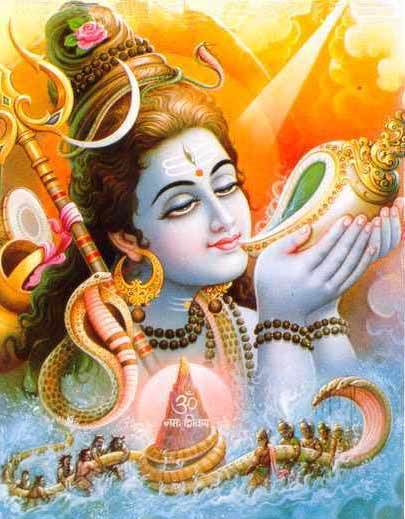 (picture link source: http://bhavanajagat.com/tag/bhagavata-purana-prahlada-charitra/)
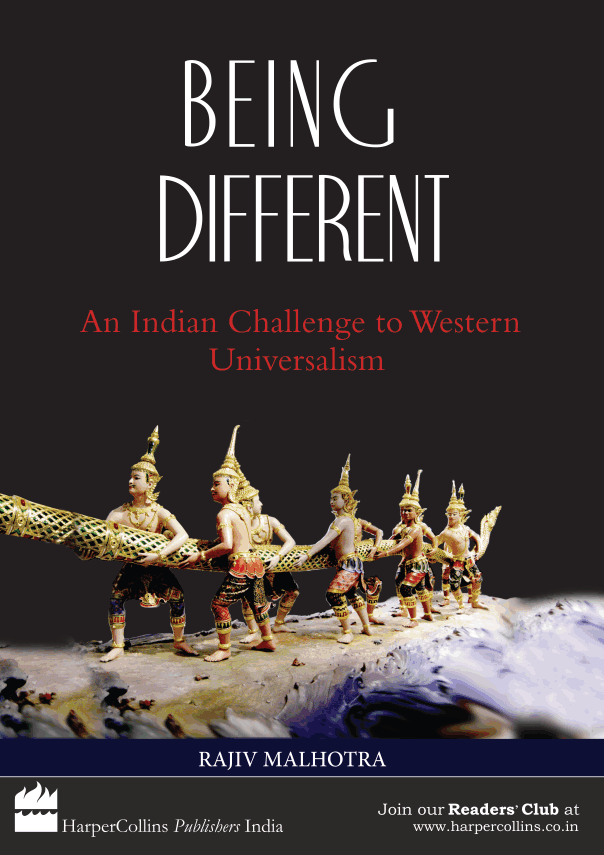
(link source: http://beingdifferentbook.com)
The Samudra Manthana story in Hinduism (pictured in book cover, above) appears to be a key metaphor to describe order & chaos in the book 'Being Different: An Indian Challenge to Western Universalism" (BD), where the Amrit (nectar) that comes out of the churning the ocean represents 'order', and the accompanying poison, the 'chaos and disorder'. In multiple online forums, Shiva's drinking of the poison is equated to Christ's crucifixion to proactively save humanity from original sin. Some Hindus have equated Shiva's act as one of collective salvation from sin, feeding the myth of sameness. (see here, here, and here). A key truth-claim of Hinduism is the cause-and-then-effect concept of Karma, so Shiva cannot bear anybody else's "sins". We all have to follow our own Sva-Dharma and shape our own destiny across multiple births. Hindus do not have to (and can't) depend on a "single-life + third-party salvation model" like Christianity. (Read BD & the earlier blog posts on history-centric model of Abrahamic Faiths). Reading Chapter 4 of BD again (I quote from the Amazon-Kindle copy), indicates that this interpretation is incorrect.
1. Firstly, BD notes:
"....The story of the Samudra-manthana is not intended to be taken literally.
Indeed, the ultimate uncertainty of knowing how the universe came about is given
eloquent expression in the famous 'Hymn of Creation' ..."
whereas History-Centric Christianity requires Crucifixion, resurrection & its
implications of collective salvation to be literally and absolutely true, with
no room for alternative explanations.
2. BD also rules out equivalence to a story in the 'book of revelation' where
'satanic disorder' has to be absolutely vanquished:
"...In one such story, Lord Shiva himself consumes the fierce, dark and bitter
poison first churned up from the ocean. He does so in order to overcome it,
leaving the nectar to others. But significantly, Shiva makes this choice both
out of knowledge (of the poison's deadly effect) and love (for those who might
suffer harm) – not out of any dark, destructive passion. Furthermore, he is able
to transmute the poison not by ejecting it but by incorporating it in himself.
An equivalent story in the Book of Revelation, conceivably, might be for Christ,
in his second coming, to assimilate the Devil rather than defeat him in an
external struggle. Thus Christ would be setting a constructive example as
opposed to demanding that all humans join him in a war against all those who
side with the Devil. But, needless to say, this is but a hypothetical scenario;
the good versus evil dualism of Judaism and Christianity is absolute."
3. The section below appears to give the interpretation of 'why Shiva drank the
poison':
"... Disorder serves as a source of creativity by preventing order from becoming
fossilized. The Lord is not only the creator of the universe (as Brahma) and the
maintainer of its order (as Vishnu) but also the one who ultimately dissolves it
(as Shiva). The dissolution makes room for the next cycle of creation. At the
spiritual level, Shiva, the Lord of Yoga, aptly assumes the appearance of chaos
to facilitate the dissolution of bondage to the falsehoods in our minds – making
way for new creation..."
Subscribe to:
Posts (Atom)