Purab aur Paschim is a 1970 Hindi movie that can be seen as a dramatized commentary on the tragic deracination of Indians post their political independence (1947). It's an eerie prophecy come true - colonized Indian minds dumping the dharmic thought system and the scientific (yogic) approach to life postulated by its Rishis and Gurus for myopic western models; swapping out India's integral unity for the superficial synthetic unity of the west. This has resulted in perhaps the largest human mercenary population that is ignorant of its own heritage, anywhere and any time in the history of the world. The sum of the violence during the often savage foreign occupation over the last 800 years has caused the psychological equivalent of a nuclear holocaust within the Indian psyche, but that can't be an excuse anymore in this 21st century era of 'big data'. It's time to be informed and factual. It's time to get rid of the 'moron Smriti'. This classic song of the movie is a popular marker used by many Indians to recall this movie that pleads with India to recall its contributions to mankind since ancient times (lyrics).
Records indicate that Rahul Gandhi was born in 1970. Eerie.
p.s. Would a game of checkers played between Rahul Gandhi and Kapil Sibal be a "zero sum game" ?
Wednesday, June 5, 2013

Sunday, March 31, 2013
The Moksha Probability Cycle
[work in progress]
Plan A: Moksha this time
The chance of that happening is finite but very slim, so we have to retry.
Plan B: Rebirth in dharmic faith and re-try plan A
Given the current population ratios, and assuming that we are born into a family that actually practices dharma rather that just provide lip-service, this is no more than 20%. In other words, if we don't try to attain Moksha this time, there's at best a 20% of even getting another chance to try in the next birth. It may be possible that if we really, really tried to follow dharma to the extent possible, this may work in our favor and increase the odds of dharmic rebirth in our favor. Conversely, if we devote life to adharma, the chance of being born human itself may decrease. There's a 80% that we move to iteration #3, and see if we get lucky. After N rebirths, assuming that dharmic faiths are miraculously still around in this Kaliyuga and form 20% of humanity, the chance that we are born in a dharmic faith = probability of at least one success in N births = 1 - probability of no success in N births = 0.8^N. For example, the probability of being reborn dharmic in our next seven lives is no more than 79%. However, we can increase this probability by adopting the dharmic way of life in every birth, regardless of where we are born. This leads to plan C.
Plan C: Reject exclusivity and follow dharma regardless of birth
This requires that pluralism, righteousness, and dharma be respected and prevail for ages to come, so that the dharmic way of life is a popular option. This is the only way we can reduce our dependency on luck. Better start working towards that right now, and improve our chances in the Moksha probability cycle!
Plan A: Moksha this time
The chance of that happening is finite but very slim, so we have to retry.
Plan B: Rebirth in dharmic faith and re-try plan A
Given the current population ratios, and assuming that we are born into a family that actually practices dharma rather that just provide lip-service, this is no more than 20%. In other words, if we don't try to attain Moksha this time, there's at best a 20% of even getting another chance to try in the next birth. It may be possible that if we really, really tried to follow dharma to the extent possible, this may work in our favor and increase the odds of dharmic rebirth in our favor. Conversely, if we devote life to adharma, the chance of being born human itself may decrease. There's a 80% that we move to iteration #3, and see if we get lucky. After N rebirths, assuming that dharmic faiths are miraculously still around in this Kaliyuga and form 20% of humanity, the chance that we are born in a dharmic faith = probability of at least one success in N births = 1 - probability of no success in N births = 0.8^N. For example, the probability of being reborn dharmic in our next seven lives is no more than 79%. However, we can increase this probability by adopting the dharmic way of life in every birth, regardless of where we are born. This leads to plan C.
Plan C: Reject exclusivity and follow dharma regardless of birth
This requires that pluralism, righteousness, and dharma be respected and prevail for ages to come, so that the dharmic way of life is a popular option. This is the only way we can reduce our dependency on luck. Better start working towards that right now, and improve our chances in the Moksha probability cycle!
Monday, March 18, 2013
The Merchant of Surat
I briefly met a merchant from Surat who was visiting New Jersey this weekend. It was quite a chance meeting. I did not find anything remarkable about his appearance - aside from his thoroughly Indian-Hindu visage and that Gujarati courteousness that disarms you immediately. He personally cooked food for a bunch of Indian start-up techies who were there to meet him the previous day. I later learned this:
He was born in poverty, and studied in a Swaminarayan-trust run school, by availing of a 50% discount in fees that you could get by writing "Jai Swaminarayan" a million times over. With his limited education, he used to walk from school to school selling ball-point pens. He later branched off into trading a bunch of other things. At some point, during a visit to Antwerp, he figured out an ingenious way to cut small diamonds in Surat and essentially take over this European area of expertise to dominate their market. The rest is history. Today he's given employment to half-a-million Indians who swear by him. He wakes up early every morning and meditates, the Hindu way. He is aghast at the sight of smart and well-educated Indians - who are far more learned than he ever was, flock sheep-like, to dead-end white-collar jobs, accepting salaries and wages from corporations to turn the proverbial nut and bolt from 9-5, instead of being entrepreneurs who create more jobs, the Indian way. As he moves into semi-retirement, he plans to open up a thousand schools in India that will run on original Indian moral values.
This is how India flourishes. India remains, as always, the land of opportunity, if we manage to throw away those colonial western shackles that enslave our minds, and rediscover Dharmic India.
He was born in poverty, and studied in a Swaminarayan-trust run school, by availing of a 50% discount in fees that you could get by writing "Jai Swaminarayan" a million times over. With his limited education, he used to walk from school to school selling ball-point pens. He later branched off into trading a bunch of other things. At some point, during a visit to Antwerp, he figured out an ingenious way to cut small diamonds in Surat and essentially take over this European area of expertise to dominate their market. The rest is history. Today he's given employment to half-a-million Indians who swear by him. He wakes up early every morning and meditates, the Hindu way. He is aghast at the sight of smart and well-educated Indians - who are far more learned than he ever was, flock sheep-like, to dead-end white-collar jobs, accepting salaries and wages from corporations to turn the proverbial nut and bolt from 9-5, instead of being entrepreneurs who create more jobs, the Indian way. As he moves into semi-retirement, he plans to open up a thousand schools in India that will run on original Indian moral values.
This is how India flourishes. India remains, as always, the land of opportunity, if we manage to throw away those colonial western shackles that enslave our minds, and rediscover Dharmic India.
Saturday, March 9, 2013
Does disagreeing with Narendra Modi make you a communist?
(scroll down for new update on November 21, 2013)
NO- as Malini Parthasarathy, formerly (update: now editor) of the renowned communist newspaper, The Hindu, tweeted today, but wait ...

On the other hand, given that there are very few Indian communists in this universe who agree with Narendra Modi (NaMo), the following implication holds true.
Theorem
Prob (disagree with Modi | person is commie ) > Prob (any person disagrees with Modi)
⇒ Prob (person is a commie | disagree with Modi ) > Prob (person is commie ).
In simple language, the theorem states:
Since a person is more likely to hate Modi if it known that he/she is a commie, this in turn implies that the probability that any random Indian is a commie increases if it is additionally known that he/she disagrees with Modi.
In fact, if given additional information that the person also worked for a reputed communist newspaper, this probability goes up even more. On the other hand, if you try to flip this around to say "You are more likely to be a Hindutva-vaadi if you agree with Modi", this theorem won't support you much. There are a huge number of Hindutva-vaadis who do not agree, and who agree with NaMo, since support for NaMo is issue-based and cuts across sectarian barriers.
Update November 21, 2013:
After the Tehelka and AAP fiascos in the last 24 hours, we now have a
Corollary to main result
Prob (pSecular | person is big fraud) > Prob (person is pSecular)
⇒ Prob (person is big fraud | pSecular ) > Prob (person is a big fraud)
in other words, the corollary states:
Given that we are observing with increasing frequency that the biggest frauds of Indian origin being exposed are pSecular cheerleaders, this in turn implies that the probability that a random person of Indian-origin you meet is a big fraud increases if it is additionally known that he/she is a pSecular.
Hence the phrase "pseudo-secular fraud" is kinda becoming redundant, since being one increases the probability of being the other.
This is not opinion, but a mathematically provable, data-driven result that serves as a warning for gullible Indians.
Here's a short proof from the Endeavor blog:

NO- as Malini Parthasarathy, formerly (update: now editor) of the renowned communist newspaper, The Hindu, tweeted today, but wait ...
On the other hand, given that there are very few Indian communists in this universe who agree with Narendra Modi (NaMo), the following implication holds true.
Theorem
Prob (disagree with Modi | person is commie ) > Prob (any person disagrees with Modi)
⇒ Prob (person is a commie | disagree with Modi ) > Prob (person is commie ).
In simple language, the theorem states:
Since a person is more likely to hate Modi if it known that he/she is a commie, this in turn implies that the probability that any random Indian is a commie increases if it is additionally known that he/she disagrees with Modi.
In fact, if given additional information that the person also worked for a reputed communist newspaper, this probability goes up even more. On the other hand, if you try to flip this around to say "You are more likely to be a Hindutva-vaadi if you agree with Modi", this theorem won't support you much. There are a huge number of Hindutva-vaadis who do not agree, and who agree with NaMo, since support for NaMo is issue-based and cuts across sectarian barriers.
Update November 21, 2013:
After the Tehelka and AAP fiascos in the last 24 hours, we now have a
Corollary to main result
Prob (pSecular | person is big fraud) > Prob (person is pSecular)
⇒ Prob (person is big fraud | pSecular ) > Prob (person is a big fraud)
in other words, the corollary states:
Given that we are observing with increasing frequency that the biggest frauds of Indian origin being exposed are pSecular cheerleaders, this in turn implies that the probability that a random person of Indian-origin you meet is a big fraud increases if it is additionally known that he/she is a pSecular.
Hence the phrase "pseudo-secular fraud" is kinda becoming redundant, since being one increases the probability of being the other.
This is not opinion, but a mathematically provable, data-driven result that serves as a warning for gullible Indians.
Here's a short proof from the Endeavor blog:
Friday, January 11, 2013
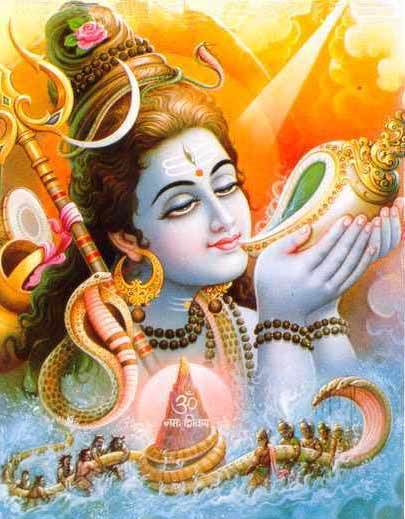
Why Did Shiva Drink The Poison?
[This is an example of an attempt at digesting Shiva into Christianity (Jesus). An abbreviated version of this blog was first posted in the Rajiv Malhotra Forum]

(link source: http://beingdifferentbook.com)
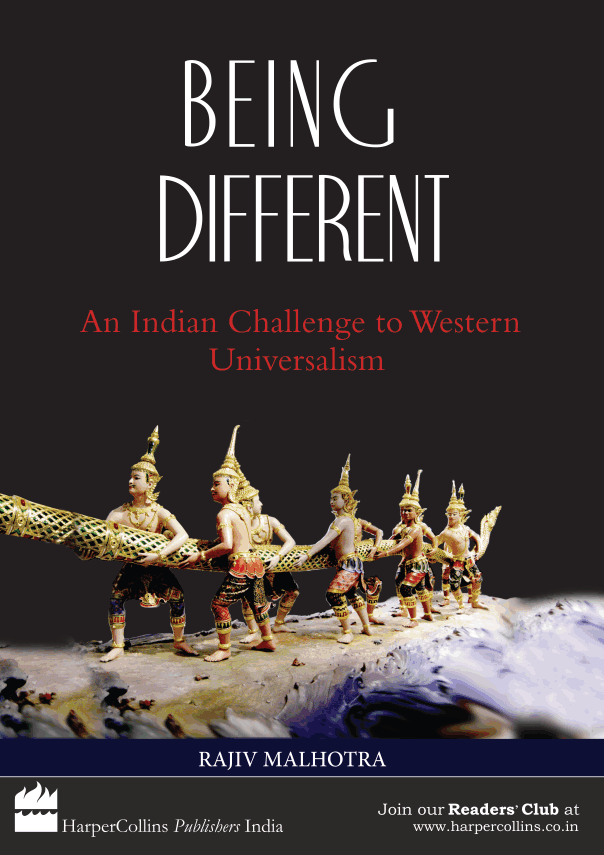
The Samudra Manthana story in Hinduism (pictured in book cover, above) appears to be a key metaphor to describe order & chaos in the book 'Being Different: An Indian Challenge to Western Universalism" (BD), where the Amrit (nectar) that comes out of the churning the ocean represents 'order', and the accompanying poison, the 'chaos and disorder'. In multiple online forums, Shiva's drinking of the poison is equated to Christ's crucifixion to proactively save humanity from original sin. Some Hindus have equated Shiva's act as one of collective salvation from sin, feeding the myth of sameness. (see here, here, and here). A key truth-claim of Hinduism is the cause-and-then-effect concept of Karma, so Shiva cannot bear anybody else's "sins". We all have to follow our own Sva-Dharma and shape our own destiny across multiple births. Hindus do not have to (and can't) depend on a "single-life + third-party salvation model" like Christianity. (Read BD & the earlier blog posts on history-centric model of Abrahamic Faiths). Reading Chapter 4 of BD again (I quote from the Amazon-Kindle copy), indicates that this interpretation is incorrect.
1. Firstly, BD notes:
"....The story of the Samudra-manthana is not intended to be taken literally.
Indeed, the ultimate uncertainty of knowing how the universe came about is given
eloquent expression in the famous 'Hymn of Creation' ..."
whereas History-Centric Christianity requires Crucifixion, resurrection & its
implications of collective salvation to be literally and absolutely true, with
no room for alternative explanations.
2. BD also rules out equivalence to a story in the 'book of revelation' where
'satanic disorder' has to be absolutely vanquished:
"...In one such story, Lord Shiva himself consumes the fierce, dark and bitter
poison first churned up from the ocean. He does so in order to overcome it,
leaving the nectar to others. But significantly, Shiva makes this choice both
out of knowledge (of the poison's deadly effect) and love (for those who might
suffer harm) – not out of any dark, destructive passion. Furthermore, he is able
to transmute the poison not by ejecting it but by incorporating it in himself.
An equivalent story in the Book of Revelation, conceivably, might be for Christ,
in his second coming, to assimilate the Devil rather than defeat him in an
external struggle. Thus Christ would be setting a constructive example as
opposed to demanding that all humans join him in a war against all those who
side with the Devil. But, needless to say, this is but a hypothetical scenario;
the good versus evil dualism of Judaism and Christianity is absolute."
3. The section below appears to give the interpretation of 'why Shiva drank the
poison':
"... Disorder serves as a source of creativity by preventing order from becoming
fossilized. The Lord is not only the creator of the universe (as Brahma) and the
maintainer of its order (as Vishnu) but also the one who ultimately dissolves it
(as Shiva). The dissolution makes room for the next cycle of creation. At the
spiritual level, Shiva, the Lord of Yoga, aptly assumes the appearance of chaos
to facilitate the dissolution of bondage to the falsehoods in our minds – making
way for new creation..."
 (picture link source: http://bhavanajagat.com/tag/bhagavata-purana-prahlada-charitra/)
(link source: http://beingdifferentbook.com)
The Samudra Manthana story in Hinduism (pictured in book cover, above) appears to be a key metaphor to describe order & chaos in the book 'Being Different: An Indian Challenge to Western Universalism" (BD), where the Amrit (nectar) that comes out of the churning the ocean represents 'order', and the accompanying poison, the 'chaos and disorder'. In multiple online forums, Shiva's drinking of the poison is equated to Christ's crucifixion to proactively save humanity from original sin. Some Hindus have equated Shiva's act as one of collective salvation from sin, feeding the myth of sameness. (see here, here, and here). A key truth-claim of Hinduism is the cause-and-then-effect concept of Karma, so Shiva cannot bear anybody else's "sins". We all have to follow our own Sva-Dharma and shape our own destiny across multiple births. Hindus do not have to (and can't) depend on a "single-life + third-party salvation model" like Christianity. (Read BD & the earlier blog posts on history-centric model of Abrahamic Faiths). Reading Chapter 4 of BD again (I quote from the Amazon-Kindle copy), indicates that this interpretation is incorrect.
1. Firstly, BD notes:
"....The story of the Samudra-manthana is not intended to be taken literally.
Indeed, the ultimate uncertainty of knowing how the universe came about is given
eloquent expression in the famous 'Hymn of Creation' ..."
whereas History-Centric Christianity requires Crucifixion, resurrection & its
implications of collective salvation to be literally and absolutely true, with
no room for alternative explanations.
2. BD also rules out equivalence to a story in the 'book of revelation' where
'satanic disorder' has to be absolutely vanquished:
"...In one such story, Lord Shiva himself consumes the fierce, dark and bitter
poison first churned up from the ocean. He does so in order to overcome it,
leaving the nectar to others. But significantly, Shiva makes this choice both
out of knowledge (of the poison's deadly effect) and love (for those who might
suffer harm) – not out of any dark, destructive passion. Furthermore, he is able
to transmute the poison not by ejecting it but by incorporating it in himself.
An equivalent story in the Book of Revelation, conceivably, might be for Christ,
in his second coming, to assimilate the Devil rather than defeat him in an
external struggle. Thus Christ would be setting a constructive example as
opposed to demanding that all humans join him in a war against all those who
side with the Devil. But, needless to say, this is but a hypothetical scenario;
the good versus evil dualism of Judaism and Christianity is absolute."
3. The section below appears to give the interpretation of 'why Shiva drank the
poison':
"... Disorder serves as a source of creativity by preventing order from becoming
fossilized. The Lord is not only the creator of the universe (as Brahma) and the
maintainer of its order (as Vishnu) but also the one who ultimately dissolves it
(as Shiva). The dissolution makes room for the next cycle of creation. At the
spiritual level, Shiva, the Lord of Yoga, aptly assumes the appearance of chaos
to facilitate the dissolution of bondage to the falsehoods in our minds – making
way for new creation..."
Thursday, December 13, 2012
Asimov's 'Strikebreaker' and the Caste System Fractal
Thanks, Sri Aravindan Neelakandan.
This post attempts to use Asimov's 'Strikebreaker' that appeared in 'Anthropology and Science Fiction', 1971 to better understand the caste systems of the world. A Purva Paksha of religious cults based on Asimov's classic 1941 'Nightfall' can be read here.
Elsevere
Elsevere is a totally self-contained planet out in space. Its surface area is very small, but real-estate in that planet is measured in terms of habitable volume. Resources are at a premium, and imports are kept to a minimum, so the planet requires a very high degree of efficiency in recycling waste. Rather than adopting an autocratic or theocratic way of managing such a fragile ecosystem, the society of Elsevere is segmented along hereditary, occupation-based endogamous castes (caste comes from the Portuguese word 'Casta') to efficiently divide up the planet's tasks. The increasing level of specialization achieved by successive generations refining the skill sets associated with the performance of their assigned tasks helps keep Elsevere prosperous. The family of Ragusnik are in charge of waste disposal (including human waste) and are considered 'untouchable' and are ranked at the bottom of their social heirarchy. The rest of the planet do not interact with them or speak face-to-face. To keep the Ragusnik family tree going, the society supplies them orphaned girl babies.
The Strike
Ragusnik does not directly come into contact with the waste disposal and recycling, which is completed mechanized. He just has to push a button and monitor some meters. Ragusnik is housed in the best and most spacious house in the planet with maximum access to resources, but he is a social outcast. He resents this treatment one day, asserts his individualism within the caste system and goes on a strike. Waste continues to pile up, and it is a only a matter of time before the system breaks down, killing all inhabitants of Elsevere. All it takes is a few minutes of training to do the job, but no one in Elsever would even dream of doing Ragusnik's job. It is incredibly repulsive to the rest of the planet. Talks break down, and the planet faces annihilation.
The Observer
Dr. Lamorak is a social scientist from earth, and an outsider, who visits Elsevere on a data gathering mission, notices the dispute and what is at stake, and wants to mediate. He sees the illogical exclusion of Ragusnik from the society, but cannot convince the Elsevarians of their bizarre attitude.
Asimov notes:
"Elsevere is a world caught in a bind. It is limited by its lack of resources, lack of space, and its need to generate its own gravity and power. It is delicately balanced, tightly knit, and everything must fit properly into place. People must fit properly too, for any rocking of this boat is a constant danger. Any changes to the system will most likely be for the worst. This is the reason behind the rigid castes and the justification for the isolation of Ragusnik".
Enter: The Strikebreaker
As it often happens on earth, Lamorak drops his neutrality and takes sides. He has a difficult choice to make. The welfare of 30,000 Elsevarians versus the injustice to one man and his family. As time starts running out, he decides in favor of the greatest good and volunteers to read the manuals and operate the disposal unit himself to save the planet. He operates the waste disposal system and saves the planet.
Lamorak explains to Ragusnik that the rest of the universe does not worry about pushing buttons and outsiders can be hired to this job going forward. Over time, the galaxy will come to know about the injustice done to him, and his future generations can live like normal human beings. Ragusnik is aghast at this intervention since he feels his brinkmanship would have definitely resulted in his winning back his dignity and justice now. He decides to end his strike, much to Lamorak's relief, and gets back to work. He is upset with Lamorak and refuses to shake his hand. In the end, Lamorak is considered an outcast in Elsevere for pushing those buttons. He is thanked for his intervention, but is forced to leave the planet immediately and is not welcome to return.
Whose Responsibility?
Asimov notes:
"Lamorak's choice makes a cogent point in this story, a point about responsibility. The people of Elsevere have been brought up to view Ragusnikhood as repulsive and unspeakable, an attitude learned from earliest childhood. At what point do they become so responsible for his misery that they should have to pay such a terrible price for having supported it? Every individual is born into a cultural system that presents him with attitudes and beliefs read-made - many of them are of current usefulness and others are simply historical baggage, but all of them are part of that system. Who, then, is to blame for the misery of Ragusnik and his lonely attempt to win the status of a full and equal human being?"
Purva Paksha
Much has been said about India's caste system and much of it is misinformed. Few realize that India did not really have a caste system for a long, long time. They had a Jati-and-Varna system (Jati = the group you were born into, Varna = your occupational group, and Varna initially allowed social mobility before it ossified). The colonials merged this two-dimensional social structure into a single-dimensional 'caste', distorting the meaning significantly. Untouchability is illegal in India, and former untouchables have made amazing progress. They have produced powerful political leaders who have an impact on national politics, as well as business leaders, although more needs to be done. However, like every other place in the world, people who choose to discriminate will do so, and India is no exception. Some of the best discussions on caste systems are summarized below.
Anatomy of a Caste System
We will start off with Asimov notes some interesting instances of untouchability in ancient times on earth:
"Lamorak thought of Untoucbhables in ancient India, the ones who handled corpses. He thought of the position of swineherds in ancient Judea".
This tells us that caste systems are or were not present in India alone and so not unique to India. The findings of Sri. Neelakandan's Purva Paksha of caste systems in the West, and Rajiv Malhotra's P.P of the one in the United States, are simply stunning. We start with Rajiv's work first. In this brilliant essay, he clearly identifies the American caste system (yes). Along the way, he also explains why doing Purva Pakshas are important:
"Understanding this American caste system has important implications for Asian Americans. Indians have traditionally been too introverted and due to that, have not studied the rest of the world. But the dynamics of the West are important to understand, even to deepen one's understanding of oneself. The field of academic scholarship and teaching of Hinduism is dominated by Jews and Christians. Indians have been content to be portrayed by others, and yet complain later when the portrayal begins to play out in society -- be it in the form of peer pressure facing their own kids growing up in the West, or as public opinion shaped by Marxists of Indian origin, or in the form of aggressive proselytizing back in India."
Thus, we have seen an example of a more recent caste system in place. Nor is the caste system in India solely due to a single religion. The Muslims there have a very well codified caste system in place as well. Christianity in India also has a well-defined caste system. To dig deeper, we will refer to a March 2011 discussion in the Rajiv Malhotra forum that is summarized in the other blog I maintain. There, Rajiv's co-author of 'Breaking India', Sri. Aravindan Neelakandan credits Asimov's 'Strikebreaker' as providing one of the best insights into how and why a caste system comes into being and how it operates. You can join the Rajiv Malhotra Forum to read the discussion in its entirety. Here is what Sri. Neelakandan has to say on this topic:
"Now the birth-based multi-layered institutions of pre-modern Europe were supported by Christian theologians and law-makers. This does not make Christianity, in the eyes of modern scholars, a supporter of this system. However with Hinduism different yard sticks are used. An essentialist argument is put forth to say that Hinduism is intertwined with Jaathi. This is simply not the complete picture and is a distorted picture of history. In this connection, with regard to the evolution of untouchability, one of the best insights on the
subject is in an unexpected realm. I suggest the science fiction short story "Strikebreaker," by Isaac Asimov, in "Anthropology Through Science Fiction",
(Ed. Carol Mason, Martin Harry Green- berg, and Patricia Warrick, New York: St. Martin's Press, 1974) Unfortunately I lost my copy of this wonderful collection.:( In the related discussion, Asimov states that caste system evolves
in a society with limited resources and limited mobility.
Veracity of this speculation by the good doctor of science fiction, can be further validated by the fact that pre-Modern Europe also had defiled trades and ritual notions of purity and untouchability. It is not just an accident that not many works or literature can be found on this subject in the Western curriculum. The one rare book I came across in this regard is "Defiled Trades and Social Outcasts: Honor and Ritual Pollution in Early Modern Germany" (my comment: I found a free pdf link) by Kathy Stuart (Cambridge University Press 2006). It was not a phenomenon limited to Germany though. Please see the passage below and change some words and one can pass it for the account of an European traveler about pre-Modern India.
"Throughout the Holy Roman empire dishonorable tradesmen suffered various forms of social, economic, leagal and political discrimination on a graduated scale of dishonor at the hands of "honorable" guild artisans and in "honorable" society at large....Executioners and skinners might be pelted with stones by onlookers, they might be refused access to taverns, excluded from public baths or denied an honorable burial. Dishonor was transmitted through heredity often over several generayions. The polluting quality of dishonor is one of its defining characteristics." (pp.2-3)
So we need not justify or label Jaathi as an uniquely Indic phenomenon. But what one finds unique as an Indian is this: There is not a single instance of mass movement in Christendom that spoke for these voiceless people of dishonorable trades. Luther took pride in saying that he was instrumental in the massacre of peasants. As against that all Bhakthi movements were peasant based. One cannot
imagine a medieval Pope or Cardinal or noble-born Christian saint performing the last rites of a defiled person as one's own father. But in India we have the greatest Vaishanava Acharya not only receiving wisdom from but performing the last rites of a man of Pulaya Jaathi.
So caste system can evolve anywhere given the appropriate social conditions . In India it became rigid with colonial resource drain. In Europe it withered away with enormous inflow of capital and resources -particularly India- as well as acquisition of vast lands by Europeans in Australia, Africa and Americas. So in a way, it was through the suffering of colonized countries like India that the birth based discriminations in European society was mostly erased.
I also think those who want to somehow preserve the Jaathi and project it in a positive light often fail to see the dark alchemy that this system is undergoing in India. "
Western Strikebreakers
Dr. Lamorak intervenes and ends up messing with the planet's social system and ensures that Ragusnik is forced to continue his sub-humanly existence. India is a tragic example of misinformed and often diabolical interference from the west as recorded in 'Breaking India' (although the west does not brook outside interference into its own society). Toward this, let's return to the discussion and see what Sri. Neelakandan has to say:
"... Here let me again quote 'Breaking India' which deals more objectively the situation and the pros and cons of Jaathi. This is from Chapter 5 of the book and is under the sub-heading "Building on Max Muller's work":
Prior to colonialism, the jati-varna system in India had little, if anything, to do with race, ethnicity, or genetics. It was better understood as a set of distinctions based on traditional or inherited social status derived from work roles. Jati is a highly localized and intricately organized social structure. One of the important aspects of jati, which was conspicuously overlooked by western Indologists, was its dynamic nature – allowing social mobility as well as occupational diversification. These rural social structures were more horizontally organized than vertically stratified. It was this inherent feature of the jati-varna system that led Gandhi to postulate the model of `oceanic circle' for the ideal Indian village society rather than the Western pyramidal model. Nevertheless, the colonial imposition of the hierarchical view, coupled with distortions of jati in order to fit it into a racial framework, grossly distorted the characteristics of jati and greatly amplified its negative features. Max Müller, who was largely responsible for entrenching the racial framework for studying jati, had his own evangelical motive. In his view, caste: which has hitherto proved an impediment to conversion of the Hindus, may in future became one of the most powerful engines for the conversion not merely of the individuals, but of whole classes of Indian society. (Breaking India p.52)
Today Jaathi has become an important and effective tool for community evangelism. So those who bat for it should take this worrying aspect into consideration. "
The Caste System Fractal
 (pic source: /www.fractal.org)
In fact, a quick look at the how the world is organized itself will tell me that there is little difference between Elsevere and today's earth in some respects - we most likely have a world caste system in place. A Caste system is a fractal, and like fractals, tends to show up everywhere. Within earth we have a country-based caste system (more about that below). Each country or social cluster has its own caste system. Within each such caste, you see sub-castes, etc.. so on until you see formal or informally segregated neighborhoods (like in the US), and so forth.
An alien visitor to earth would surely notice that there is a clear hierarchy of countries, the UN security council, the G5, G20, etc. - those who call the shots, control the world's oil, stockpile nuclear weapons, control human rights groups, act as the global policemen, establish travel and trade barriers, sell Western universalism, and enjoy high standards of living based on a lavish consumptive lifestyle, .. and then there are those who don't do these things, and store the nuclear waste, manufacture low-level goods, and many of whose citizens endure sub-human conditions... I leave it a social scientist who passes by this site to connect the dots to validate/invalidate this hypothesis if someone hasn't already done so.
Conclusions
To summarize, a Purva Paksha clearly establishes that there are caste systems all around us, and at every time in recorded history. Give the right set of conditions, some kind of a caste system is inevitable, and this is not unique to a country, region, religion, or time. However, when a caste system starts to create more problems that it solves, it's continued use must be re-examined. Asimov notes:
"A caste system woks only so long as everyone recognizes the rightness of its structure and realizes a fair share of the benefits thereof. When members of the lower castes begin to complain about their treatment and members of the higher castes begin to wonder about their justness, the system is in trouble".
These are some of the lessons we can learn from 'Strikebreaker', a 13-page sci-fi story written long ago.
This post attempts to use Asimov's 'Strikebreaker' that appeared in 'Anthropology and Science Fiction', 1971 to better understand the caste systems of the world. A Purva Paksha of religious cults based on Asimov's classic 1941 'Nightfall' can be read here.
Elsevere
Elsevere is a totally self-contained planet out in space. Its surface area is very small, but real-estate in that planet is measured in terms of habitable volume. Resources are at a premium, and imports are kept to a minimum, so the planet requires a very high degree of efficiency in recycling waste. Rather than adopting an autocratic or theocratic way of managing such a fragile ecosystem, the society of Elsevere is segmented along hereditary, occupation-based endogamous castes (caste comes from the Portuguese word 'Casta') to efficiently divide up the planet's tasks. The increasing level of specialization achieved by successive generations refining the skill sets associated with the performance of their assigned tasks helps keep Elsevere prosperous. The family of Ragusnik are in charge of waste disposal (including human waste) and are considered 'untouchable' and are ranked at the bottom of their social heirarchy. The rest of the planet do not interact with them or speak face-to-face. To keep the Ragusnik family tree going, the society supplies them orphaned girl babies.
The Strike
Ragusnik does not directly come into contact with the waste disposal and recycling, which is completed mechanized. He just has to push a button and monitor some meters. Ragusnik is housed in the best and most spacious house in the planet with maximum access to resources, but he is a social outcast. He resents this treatment one day, asserts his individualism within the caste system and goes on a strike. Waste continues to pile up, and it is a only a matter of time before the system breaks down, killing all inhabitants of Elsevere. All it takes is a few minutes of training to do the job, but no one in Elsever would even dream of doing Ragusnik's job. It is incredibly repulsive to the rest of the planet. Talks break down, and the planet faces annihilation.
The Observer
Dr. Lamorak is a social scientist from earth, and an outsider, who visits Elsevere on a data gathering mission, notices the dispute and what is at stake, and wants to mediate. He sees the illogical exclusion of Ragusnik from the society, but cannot convince the Elsevarians of their bizarre attitude.
Asimov notes:
"Elsevere is a world caught in a bind. It is limited by its lack of resources, lack of space, and its need to generate its own gravity and power. It is delicately balanced, tightly knit, and everything must fit properly into place. People must fit properly too, for any rocking of this boat is a constant danger. Any changes to the system will most likely be for the worst. This is the reason behind the rigid castes and the justification for the isolation of Ragusnik".
Enter: The Strikebreaker
As it often happens on earth, Lamorak drops his neutrality and takes sides. He has a difficult choice to make. The welfare of 30,000 Elsevarians versus the injustice to one man and his family. As time starts running out, he decides in favor of the greatest good and volunteers to read the manuals and operate the disposal unit himself to save the planet. He operates the waste disposal system and saves the planet.
Lamorak explains to Ragusnik that the rest of the universe does not worry about pushing buttons and outsiders can be hired to this job going forward. Over time, the galaxy will come to know about the injustice done to him, and his future generations can live like normal human beings. Ragusnik is aghast at this intervention since he feels his brinkmanship would have definitely resulted in his winning back his dignity and justice now. He decides to end his strike, much to Lamorak's relief, and gets back to work. He is upset with Lamorak and refuses to shake his hand. In the end, Lamorak is considered an outcast in Elsevere for pushing those buttons. He is thanked for his intervention, but is forced to leave the planet immediately and is not welcome to return.
Whose Responsibility?
Asimov notes:
"Lamorak's choice makes a cogent point in this story, a point about responsibility. The people of Elsevere have been brought up to view Ragusnikhood as repulsive and unspeakable, an attitude learned from earliest childhood. At what point do they become so responsible for his misery that they should have to pay such a terrible price for having supported it? Every individual is born into a cultural system that presents him with attitudes and beliefs read-made - many of them are of current usefulness and others are simply historical baggage, but all of them are part of that system. Who, then, is to blame for the misery of Ragusnik and his lonely attempt to win the status of a full and equal human being?"
Purva Paksha
Much has been said about India's caste system and much of it is misinformed. Few realize that India did not really have a caste system for a long, long time. They had a Jati-and-Varna system (Jati = the group you were born into, Varna = your occupational group, and Varna initially allowed social mobility before it ossified). The colonials merged this two-dimensional social structure into a single-dimensional 'caste', distorting the meaning significantly. Untouchability is illegal in India, and former untouchables have made amazing progress. They have produced powerful political leaders who have an impact on national politics, as well as business leaders, although more needs to be done. However, like every other place in the world, people who choose to discriminate will do so, and India is no exception. Some of the best discussions on caste systems are summarized below.
Anatomy of a Caste System
We will start off with Asimov notes some interesting instances of untouchability in ancient times on earth:
"Lamorak thought of Untoucbhables in ancient India, the ones who handled corpses. He thought of the position of swineherds in ancient Judea".
This tells us that caste systems are or were not present in India alone and so not unique to India. The findings of Sri. Neelakandan's Purva Paksha of caste systems in the West, and Rajiv Malhotra's P.P of the one in the United States, are simply stunning. We start with Rajiv's work first. In this brilliant essay, he clearly identifies the American caste system (yes). Along the way, he also explains why doing Purva Pakshas are important:
"Understanding this American caste system has important implications for Asian Americans. Indians have traditionally been too introverted and due to that, have not studied the rest of the world. But the dynamics of the West are important to understand, even to deepen one's understanding of oneself. The field of academic scholarship and teaching of Hinduism is dominated by Jews and Christians. Indians have been content to be portrayed by others, and yet complain later when the portrayal begins to play out in society -- be it in the form of peer pressure facing their own kids growing up in the West, or as public opinion shaped by Marxists of Indian origin, or in the form of aggressive proselytizing back in India."
Thus, we have seen an example of a more recent caste system in place. Nor is the caste system in India solely due to a single religion. The Muslims there have a very well codified caste system in place as well. Christianity in India also has a well-defined caste system. To dig deeper, we will refer to a March 2011 discussion in the Rajiv Malhotra forum that is summarized in the other blog I maintain. There, Rajiv's co-author of 'Breaking India', Sri. Aravindan Neelakandan credits Asimov's 'Strikebreaker' as providing one of the best insights into how and why a caste system comes into being and how it operates. You can join the Rajiv Malhotra Forum to read the discussion in its entirety. Here is what Sri. Neelakandan has to say on this topic:
"Now the birth-based multi-layered institutions of pre-modern Europe were supported by Christian theologians and law-makers. This does not make Christianity, in the eyes of modern scholars, a supporter of this system. However with Hinduism different yard sticks are used. An essentialist argument is put forth to say that Hinduism is intertwined with Jaathi. This is simply not the complete picture and is a distorted picture of history. In this connection, with regard to the evolution of untouchability, one of the best insights on the
subject is in an unexpected realm. I suggest the science fiction short story "Strikebreaker," by Isaac Asimov, in "Anthropology Through Science Fiction",
(Ed. Carol Mason, Martin Harry Green- berg, and Patricia Warrick, New York: St. Martin's Press, 1974) Unfortunately I lost my copy of this wonderful collection.:( In the related discussion, Asimov states that caste system evolves
in a society with limited resources and limited mobility.
Veracity of this speculation by the good doctor of science fiction, can be further validated by the fact that pre-Modern Europe also had defiled trades and ritual notions of purity and untouchability. It is not just an accident that not many works or literature can be found on this subject in the Western curriculum. The one rare book I came across in this regard is "Defiled Trades and Social Outcasts: Honor and Ritual Pollution in Early Modern Germany" (my comment: I found a free pdf link) by Kathy Stuart (Cambridge University Press 2006). It was not a phenomenon limited to Germany though. Please see the passage below and change some words and one can pass it for the account of an European traveler about pre-Modern India.
"Throughout the Holy Roman empire dishonorable tradesmen suffered various forms of social, economic, leagal and political discrimination on a graduated scale of dishonor at the hands of "honorable" guild artisans and in "honorable" society at large....Executioners and skinners might be pelted with stones by onlookers, they might be refused access to taverns, excluded from public baths or denied an honorable burial. Dishonor was transmitted through heredity often over several generayions. The polluting quality of dishonor is one of its defining characteristics." (pp.2-3)
So we need not justify or label Jaathi as an uniquely Indic phenomenon. But what one finds unique as an Indian is this: There is not a single instance of mass movement in Christendom that spoke for these voiceless people of dishonorable trades. Luther took pride in saying that he was instrumental in the massacre of peasants. As against that all Bhakthi movements were peasant based. One cannot
imagine a medieval Pope or Cardinal or noble-born Christian saint performing the last rites of a defiled person as one's own father. But in India we have the greatest Vaishanava Acharya not only receiving wisdom from but performing the last rites of a man of Pulaya Jaathi.
So caste system can evolve anywhere given the appropriate social conditions . In India it became rigid with colonial resource drain. In Europe it withered away with enormous inflow of capital and resources -particularly India- as well as acquisition of vast lands by Europeans in Australia, Africa and Americas. So in a way, it was through the suffering of colonized countries like India that the birth based discriminations in European society was mostly erased.
I also think those who want to somehow preserve the Jaathi and project it in a positive light often fail to see the dark alchemy that this system is undergoing in India. "
Western Strikebreakers
Dr. Lamorak intervenes and ends up messing with the planet's social system and ensures that Ragusnik is forced to continue his sub-humanly existence. India is a tragic example of misinformed and often diabolical interference from the west as recorded in 'Breaking India' (although the west does not brook outside interference into its own society). Toward this, let's return to the discussion and see what Sri. Neelakandan has to say:
"... Here let me again quote 'Breaking India' which deals more objectively the situation and the pros and cons of Jaathi. This is from Chapter 5 of the book and is under the sub-heading "Building on Max Muller's work":
Prior to colonialism, the jati-varna system in India had little, if anything, to do with race, ethnicity, or genetics. It was better understood as a set of distinctions based on traditional or inherited social status derived from work roles. Jati is a highly localized and intricately organized social structure. One of the important aspects of jati, which was conspicuously overlooked by western Indologists, was its dynamic nature – allowing social mobility as well as occupational diversification. These rural social structures were more horizontally organized than vertically stratified. It was this inherent feature of the jati-varna system that led Gandhi to postulate the model of `oceanic circle' for the ideal Indian village society rather than the Western pyramidal model. Nevertheless, the colonial imposition of the hierarchical view, coupled with distortions of jati in order to fit it into a racial framework, grossly distorted the characteristics of jati and greatly amplified its negative features. Max Müller, who was largely responsible for entrenching the racial framework for studying jati, had his own evangelical motive. In his view, caste: which has hitherto proved an impediment to conversion of the Hindus, may in future became one of the most powerful engines for the conversion not merely of the individuals, but of whole classes of Indian society. (Breaking India p.52)
Today Jaathi has become an important and effective tool for community evangelism. So those who bat for it should take this worrying aspect into consideration. "
The Caste System Fractal

In fact, a quick look at the how the world is organized itself will tell me that there is little difference between Elsevere and today's earth in some respects - we most likely have a world caste system in place. A Caste system is a fractal, and like fractals, tends to show up everywhere. Within earth we have a country-based caste system (more about that below). Each country or social cluster has its own caste system. Within each such caste, you see sub-castes, etc.. so on until you see formal or informally segregated neighborhoods (like in the US), and so forth.
An alien visitor to earth would surely notice that there is a clear hierarchy of countries, the UN security council, the G5, G20, etc. - those who call the shots, control the world's oil, stockpile nuclear weapons, control human rights groups, act as the global policemen, establish travel and trade barriers, sell Western universalism, and enjoy high standards of living based on a lavish consumptive lifestyle, .. and then there are those who don't do these things, and store the nuclear waste, manufacture low-level goods, and many of whose citizens endure sub-human conditions... I leave it a social scientist who passes by this site to connect the dots to validate/invalidate this hypothesis if someone hasn't already done so.
Conclusions
To summarize, a Purva Paksha clearly establishes that there are caste systems all around us, and at every time in recorded history. Give the right set of conditions, some kind of a caste system is inevitable, and this is not unique to a country, region, religion, or time. However, when a caste system starts to create more problems that it solves, it's continued use must be re-examined. Asimov notes:
"A caste system woks only so long as everyone recognizes the rightness of its structure and realizes a fair share of the benefits thereof. When members of the lower castes begin to complain about their treatment and members of the higher castes begin to wonder about their justness, the system is in trouble".
These are some of the lessons we can learn from 'Strikebreaker', a 13-page sci-fi story written long ago.
Monday, December 10, 2012
Review of Asimov's 'Nightfall' from a Dharmic Perspective
Introduction
Nightfall (NF) was written by Isaac Asimov in 1941, when the war that was burning down Europe would escalate into a global war. It remains one of the best science fiction stories ever written and won many awards. Reams have been written about this book in the western literature. The attempt here is to subject 'Nightfall' to a Purva Paksha, i.e., examine the ideas in the book from a native Indian (Dharmic) viewpoint, utilizing some key ideas in Rajiv Malhotra's book 'Being Different'. We will rely on the original version (about 20-odd pages) of NF that was published in 'Anthropology through Science Fiction', 1971. (The next post in the TQ blog will cover another Asimov story in this book). You can read 'Nightfall' online here.

(picture source link: ghostradio.files.wordpress.com)
Synopsis
NF visits the human-inhabited planet of Lagash at a most critical point in its civilization, when five of its six suns have fizzled out, and the sixth ("Beta") appears to be in danger of meeting the same fate, leaving its inhabitants to endure 'night' for the first time ever. Archaeologists determine that Lagash has gone through repeated cycles of birth and destruction. Physicists , after applying the laws of gravity and orbital motions, and centuries of analysis, calculate that each boom-bust cycle lasts 2049 years that ends with a solar eclipse of a sole remaining sun. Psychologists explain that the resulting onset of nightfall and its terrifying darkness brings about an extraordinary claustrophobia among the population. Driven insane by fear and chaos, the people will proceed to light up and eventually burn down Lagash to cinder. This fear drives a bunch of scientists to build and move into an artificially lit doomsday hide-out.
On the other hand, Lagash has a group of cultists who follow 'the book of revelations' that pretty much talks about all these effects, but attributing causality to some external divine force. Furthermore, the book talks about an appearance of many stars in the sky in the end, which cult followers have to view to achieve salvation. While the cult cares less about the cause ("they believe it because the book says so"), they share valuable data with the scientists, and in this bargain, the scientists will validate that the cultists were indeed prophetic.
The scientists proceed to provide rational explanations for the phenomena that coincide with that the cult says, but as a result of this scientific explanation, increasing number of Lagashians desert the cult since they do not need the book anymore for supernatural explanations, greatly annoying the cult that accuses the seculars of Blasphemy. The scientists reciprocate this dislike for the cultists and in the end, the cultists attempt to destroy their observatory that is trying to photograph and analyze the final scene, fearing that the scientists were interfering with their moment of salvation. As nightfall descends, the Lagashians go crazy and burn down their civilization, as predicted.
Asimov's introduction to Nightfall
Per Wikipedia, Asimov says that he wrote NF after being introduced to Emerson's quote by John Campbell:
"... If the stars should appear one night in a thousand years, how would men believe and adore,
and preserve for many generations,
the remembrance of the city of God which had been shown!
Campbell's opinion to the contrary was: "I think men would go mad." "
Asimov writes a two-page introduction to NF in this book and makes the following observations:
a. A cult that at it's core does not address the problems that cause the society's ills will hasten its disintegration.
b. Religion or science? (classical binary choice approach that characterizes the Western frame of reference). Science was successful in explaining why Lagash would burn down, and in that process were able to rescue many cultists from their dogmatic existence. But in the end, neither science, nor the cult were able to save the people from self-destructing, thereby indicating the inadequacy of the cult and science in providing timely and practical solutions for a critical problem.
Emerson's Quote
Emerson, whose quote inspired the book, was greatly influenced by Hinduism. Rajiv Malhotra writes in his book 'Being Different: An Indian Challenge to Western Universalism': "... Europe's encounter with Sanskrit revolutionized the European study of linguistics, and its encounter with Hinduism and Buddhism deeply informed Western philosophy and challenged the Judeo-Christian traditions. Some westerners, such as the American transcendentalists: Thoreau, Emerson and Whitman, broke away from Christian orthodoxy as a result. This process continues today ever more deeply in the mainstream of the West through yoga, meditation, healing sciences, the arts, eco-feminism, philosophy, and pop culture...".
Indeed, Emerson's aforementioned quote is taken from his work 'Nature'. Sanderson Beck notes:
".. In his essay on "Nature" Emerson reveals the essence of his philosophy: "Philosophically considered, the universe is composed of Nature and the Soul." This has been stated before in the Sankhya philosophy of India ... Spirit, or the oversoul which includes all individual souls, is the eternal essence of an infinite absolute reality which creates all the transitory phenomena of Nature The Sanskrit terms are Purusha which means Person and Prakriti meaning Nature.."
Interestingly, Beck says "....the truth may be spoken in any language, and we must not hasten to conclude that he merely adopted the Hindu religion, but rather that he found there corresponding ideas to the illumination he received from his own soul and experience in life. In his essay "Compensation" which describes the spiritual law of karma, or cause and effect in human action, he indicates he discovered this principle himself although it has been known for millennia in India and is similar to Greek notions of justice and retribution .."
This paragraph can be recognized as yet another attempt to digest Hinduism into Western universalism, and amputate critical Hindu ideas from its original body of work. In fact, Emerson's text reads but like an English re-interpretation of the original Sanskrit texts of Hinduism.
Nightfall appears to depict Emerson as the cultists in NF who see the divine in the once-in-a-thousand-year stars but at the same time, also exposes the limitations of science in solving society's most difficult problems. In the end, the scientists of Lagash are shocked to see thousands of stars that they never expected would fit into such a small sky, and as they begin their descent into terror, lose their coherence, and remain unable to find a rational explanation for this final phenomenon. On the other hands, the cultists did have an explanation, however inadequate.
Dharmic point of view
Hinduism, like other Dharmic religions, does NOT see a contradiction between itself and science. Indeed, concepts of Hinduism have not come into conflict with science so far, be it Heliocentrism, Evolution, Quantum Mechanics, or the
Theory of Relativity. The Hindu belief of cyclical time is exemplified in NF by the creative-destructive cycles of Lagash. In contrast, NF's cultists accept their book-ordained fiery end without question and implicitly reject Karma - a mindset that could have potentially changed the end result for the population. They believe that the stars that show up on doomsday are a historically divine intervention from elsewhere (duality). These stars provide, at the risk of madness, a collective salvation for only the populace of Lagash that views them but not others, who will be damned, and is thus not linked to individual Karma or Sva-Dharma. It is clear that NF's cult is not based on a Dharmic thought system but is history-centric, and nearly exactly models any Abrahamic religion.
In the end, neither the cultists (who are not dharmic but dogmatic), nor the atheistic seculars (limited by their senses to incomplete understanding) are able to develop adhyatma vidya (inner sciences, self-realization techniques) required to transcend the limitation of the human sense and the primordial fear of darkness. Doing so would have also enabled them to get past the few hours of darkness due to a solar eclipse.
Nightfall on Earth
Clearly, all religions are NOT the same, not in 1941 when the global war began, not now on earth, or in some futuristic Lagash. Every year, there are many predictions of the end of the world. Every year, the primordial fear of nightfall drives many so-called rational and smart people to believe this may well be possible and call for a collective holding of hands to fight the terror of darkness. This is how cults operate. Science merely laughs. Dharmic faiths like Hinduism, on the other hand that have no conflict with science by design, talk of timeless, cyclical time and empower you to overcome your fear of eternal darkness.
Nightfall (NF) was written by Isaac Asimov in 1941, when the war that was burning down Europe would escalate into a global war. It remains one of the best science fiction stories ever written and won many awards. Reams have been written about this book in the western literature. The attempt here is to subject 'Nightfall' to a Purva Paksha, i.e., examine the ideas in the book from a native Indian (Dharmic) viewpoint, utilizing some key ideas in Rajiv Malhotra's book 'Being Different'. We will rely on the original version (about 20-odd pages) of NF that was published in 'Anthropology through Science Fiction', 1971. (The next post in the TQ blog will cover another Asimov story in this book). You can read 'Nightfall' online here.
(picture source link: ghostradio.files.wordpress.com)
Synopsis
NF visits the human-inhabited planet of Lagash at a most critical point in its civilization, when five of its six suns have fizzled out, and the sixth ("Beta") appears to be in danger of meeting the same fate, leaving its inhabitants to endure 'night' for the first time ever. Archaeologists determine that Lagash has gone through repeated cycles of birth and destruction. Physicists , after applying the laws of gravity and orbital motions, and centuries of analysis, calculate that each boom-bust cycle lasts 2049 years that ends with a solar eclipse of a sole remaining sun. Psychologists explain that the resulting onset of nightfall and its terrifying darkness brings about an extraordinary claustrophobia among the population. Driven insane by fear and chaos, the people will proceed to light up and eventually burn down Lagash to cinder. This fear drives a bunch of scientists to build and move into an artificially lit doomsday hide-out.
On the other hand, Lagash has a group of cultists who follow 'the book of revelations' that pretty much talks about all these effects, but attributing causality to some external divine force. Furthermore, the book talks about an appearance of many stars in the sky in the end, which cult followers have to view to achieve salvation. While the cult cares less about the cause ("they believe it because the book says so"), they share valuable data with the scientists, and in this bargain, the scientists will validate that the cultists were indeed prophetic.
The scientists proceed to provide rational explanations for the phenomena that coincide with that the cult says, but as a result of this scientific explanation, increasing number of Lagashians desert the cult since they do not need the book anymore for supernatural explanations, greatly annoying the cult that accuses the seculars of Blasphemy. The scientists reciprocate this dislike for the cultists and in the end, the cultists attempt to destroy their observatory that is trying to photograph and analyze the final scene, fearing that the scientists were interfering with their moment of salvation. As nightfall descends, the Lagashians go crazy and burn down their civilization, as predicted.
Asimov's introduction to Nightfall
Per Wikipedia, Asimov says that he wrote NF after being introduced to Emerson's quote by John Campbell:
"... If the stars should appear one night in a thousand years, how would men believe and adore,
and preserve for many generations,
the remembrance of the city of God which had been shown!
Campbell's opinion to the contrary was: "I think men would go mad." "
Asimov writes a two-page introduction to NF in this book and makes the following observations:
a. A cult that at it's core does not address the problems that cause the society's ills will hasten its disintegration.
b. Religion or science? (classical binary choice approach that characterizes the Western frame of reference). Science was successful in explaining why Lagash would burn down, and in that process were able to rescue many cultists from their dogmatic existence. But in the end, neither science, nor the cult were able to save the people from self-destructing, thereby indicating the inadequacy of the cult and science in providing timely and practical solutions for a critical problem.
Emerson's Quote
Emerson, whose quote inspired the book, was greatly influenced by Hinduism. Rajiv Malhotra writes in his book 'Being Different: An Indian Challenge to Western Universalism': "... Europe's encounter with Sanskrit revolutionized the European study of linguistics, and its encounter with Hinduism and Buddhism deeply informed Western philosophy and challenged the Judeo-Christian traditions. Some westerners, such as the American transcendentalists: Thoreau, Emerson and Whitman, broke away from Christian orthodoxy as a result. This process continues today ever more deeply in the mainstream of the West through yoga, meditation, healing sciences, the arts, eco-feminism, philosophy, and pop culture...".
Indeed, Emerson's aforementioned quote is taken from his work 'Nature'. Sanderson Beck notes:
".. In his essay on "Nature" Emerson reveals the essence of his philosophy: "Philosophically considered, the universe is composed of Nature and the Soul." This has been stated before in the Sankhya philosophy of India ... Spirit, or the oversoul which includes all individual souls, is the eternal essence of an infinite absolute reality which creates all the transitory phenomena of Nature The Sanskrit terms are Purusha which means Person and Prakriti meaning Nature.."
Interestingly, Beck says "....the truth may be spoken in any language, and we must not hasten to conclude that he merely adopted the Hindu religion, but rather that he found there corresponding ideas to the illumination he received from his own soul and experience in life. In his essay "Compensation" which describes the spiritual law of karma, or cause and effect in human action, he indicates he discovered this principle himself although it has been known for millennia in India and is similar to Greek notions of justice and retribution .."
This paragraph can be recognized as yet another attempt to digest Hinduism into Western universalism, and amputate critical Hindu ideas from its original body of work. In fact, Emerson's text reads but like an English re-interpretation of the original Sanskrit texts of Hinduism.
Nightfall appears to depict Emerson as the cultists in NF who see the divine in the once-in-a-thousand-year stars but at the same time, also exposes the limitations of science in solving society's most difficult problems. In the end, the scientists of Lagash are shocked to see thousands of stars that they never expected would fit into such a small sky, and as they begin their descent into terror, lose their coherence, and remain unable to find a rational explanation for this final phenomenon. On the other hands, the cultists did have an explanation, however inadequate.
Dharmic point of view
Hinduism, like other Dharmic religions, does NOT see a contradiction between itself and science. Indeed, concepts of Hinduism have not come into conflict with science so far, be it Heliocentrism, Evolution, Quantum Mechanics, or the
Theory of Relativity. The Hindu belief of cyclical time is exemplified in NF by the creative-destructive cycles of Lagash. In contrast, NF's cultists accept their book-ordained fiery end without question and implicitly reject Karma - a mindset that could have potentially changed the end result for the population. They believe that the stars that show up on doomsday are a historically divine intervention from elsewhere (duality). These stars provide, at the risk of madness, a collective salvation for only the populace of Lagash that views them but not others, who will be damned, and is thus not linked to individual Karma or Sva-Dharma. It is clear that NF's cult is not based on a Dharmic thought system but is history-centric, and nearly exactly models any Abrahamic religion.
In the end, neither the cultists (who are not dharmic but dogmatic), nor the atheistic seculars (limited by their senses to incomplete understanding) are able to develop adhyatma vidya (inner sciences, self-realization techniques) required to transcend the limitation of the human sense and the primordial fear of darkness. Doing so would have also enabled them to get past the few hours of darkness due to a solar eclipse.
Nightfall on Earth
Clearly, all religions are NOT the same, not in 1941 when the global war began, not now on earth, or in some futuristic Lagash. Every year, there are many predictions of the end of the world. Every year, the primordial fear of nightfall drives many so-called rational and smart people to believe this may well be possible and call for a collective holding of hands to fight the terror of darkness. This is how cults operate. Science merely laughs. Dharmic faiths like Hinduism, on the other hand that have no conflict with science by design, talk of timeless, cyclical time and empower you to overcome your fear of eternal darkness.
Subscribe to:
Posts (Atom)